
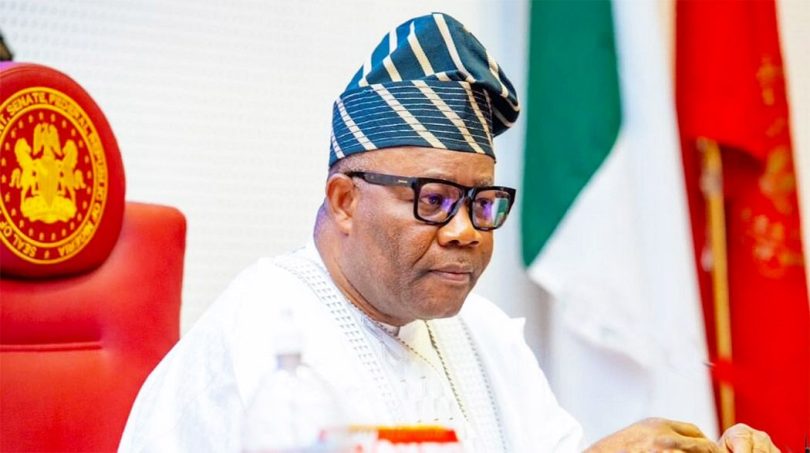
Senate President Godswill Akpabio has responded to criticisms by Senator Adams Oshiomhole over the recent amendment to the Senate Standing Rules, saying the changes were introduced to strengthen the upper chamber and improve legislative leadership.
Akpabio’s position was conveyed on Sunday in a statement issued in Abuja by his spokesman, Eseme Eyiboh.
The Senate President defended the revised rules, particularly the introduction of experience requirements for senators seeking principal and presiding offices, insisting that leadership within the National Assembly requires competence, institutional knowledge and legislative experience.
The amendment has continued to generate reactions, with some critics questioning both the process and implications of the changes, while others have called for Akpabio’s resignation.
Reacting to the controversy, Akpabio said public discussions surrounding the amendment had focused too much on individuals rather than the broader institutional issues involved.
“The controversy surrounding the recent amendment to the Senate Standing Rules has generated more heat than light. Unfortunately, much of the public conversation has been framed around personalities rather than principles, and emotions rather than institutional logic.
“Yet the real issue before the Senate is neither about Senator Godswill Akpabio nor Senator Adams Oshiomhole,” he said.
Akpabio maintained that the office of the Senate President is highly technical and demands a strong understanding of parliamentary practice and governance.
“Parliamentary leadership is not merely ceremonial. The office of Senate President is one of the most sensitive and technically demanding constitutional offices in Nigeria.
“It requires not only political popularity but also deep familiarity with parliamentary traditions, legislative procedures, negotiation dynamics, committee systems, constitutional interpretation, and intergovernmental relations. Experience matters,” he argued.
The former Akwa Ibom State governor also stated that legislative institutions around the world regularly review their rules in order to improve stability and preserve institutional memory.
According to him, such reforms should not be interpreted as efforts to shut out newer lawmakers or protect personal interests.
“It is therefore inaccurate to reduce the issue to the suggestion that the amendment was crafted merely to “shrink competition” or protect personal interests. Institutions do not become stronger by permanently freezing their rules in time.
“Even more problematic is the argument suggesting that because the new qualification threshold did not exist when Senator Godswill Akpabio emerged as Senate President, he should now resign if the new rule is adopted,” the statement added.
Akpabio further argued that laws and regulations are generally not retroactive unless clearly stated.
“A law or rule takes effect from the point of enactment forward unless expressly stated otherwise. The amendment cannot logically invalidate a mandate that was legitimately acquired under previously existing rules,” he stated.
The clarification followed recent remarks by Senator Adams Oshiomhole, who criticised the amendment and called for Akpabio to step down.
The senator representing Edo North had described the revised rules as evidence of a “moral crisis” within the Senate, arguing that the amendment raised concerns about fairness, ethics and leadership standards.
Oshiomhole also contended that based on the new standards being proposed, Akpabio no longer met the moral and procedural conditions required to continue presiding over the Senate.