
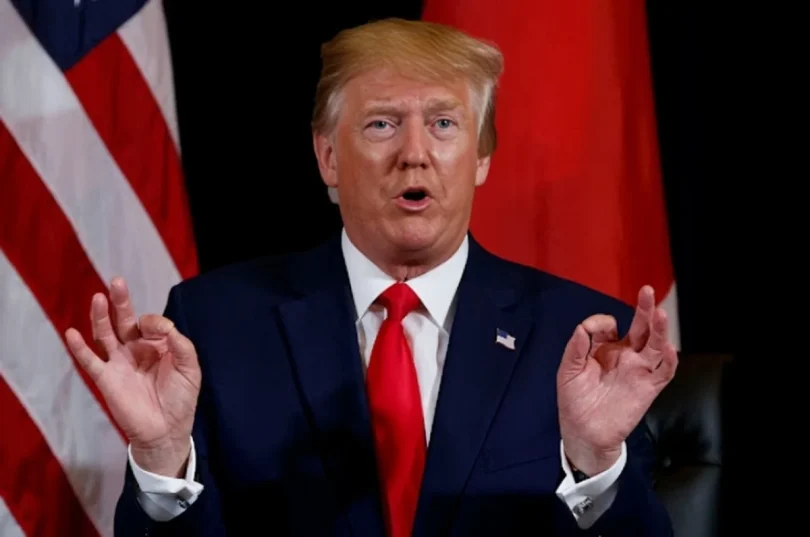
US President Donald Trump has rejected a proposal from Iran that would have reopened the Strait of Hormuz to shipping within seven days as part of a plan to end hostilities in the Middle East.
Trump confirmed the rejection on Saturday, telling reporters outside the White House: “I reject their proposal. They made a proposal but I’ve rejected it.”
“They want to make a deal where they open the Strait immediately because they’re losing so badly. They want to make a deal and I think that’s fine. I like making a deal too.”
The proposal, presented by Iran during the 81st United Nations General Assembly in New York, would require the United States to lift its naval blockade of Iranian ports, ease sanctions on Iranian oil and observe a ceasefire covering the wider Middle East, including Lebanon.
Iranian Foreign Minister Abbas Araghchi said the plan had been conveyed to Washington through Qatar and was based on conditions contained in an earlier memorandum of understanding between the two countries.
He said Iran would reopen the Strait of Hormuz on the seventh day after the United States accepted the proposal.
Iranian President Masoud Pezeshkian, who was returning to Tehran after attending the UN General Assembly, said the proposal had been developed “in coordination” with Supreme Leader Mojtaba Khamenei, according to an excerpt of a CBS News interview shared by Iranian media.
Pezeshkian said the process would begin immediately after the United States accepted the proposal.
At the United Nations, Saudi Arabia’s Foreign Minister Faisal bin Farhan criticised what he described as the failure of the international community to ensure the continued opening of the Strait of Hormuz and the Bab al-Mandab.
ALSO READ: Trump vows Iran will never get nuclear weapon as oil prices react to UN speech
“The kingdom rejects any party’s use of these vital passages as a tool for pressure, threat, or harm to the interests of states,” he said, stressing the waterways’ importance to global energy security.
Russia’s Foreign Minister, Sergei Lavrov, also told member states that “Russia, together with other responsible states, stands ready to constructively contribute to stabilizing this strategically important region.”
Pezeshkian also met with UN Secretary-General Antonio Guterres in New York, according to his office, and said: “Iran has not walked away from the negotiating table but, given past experiences, it no longer trusts the United States.”
Araghchi said Iran had given Washington a specific timeline for reopening the waterway.
“Iran has conveyed to the United States, through Qatar, a concrete seven-day plan. If the necessary conditions are met, the strait can be reopened, and normal maritime passage restored within seven days,” he said.
“The choice now rests with the United States. Iran does not accept coercion, threats or intimidation, and Iran will not surrender its sovereign rights under pressure,” he added.
The Wall Street Journal subsequently reported that Trump was sceptical about Tehran meeting his demands and expected the US bombing campaign to resume, according to unnamed US officials.
Trump also posted an image on his Truth Social platform showing the Strait of Hormuz circled and labelled “Trump Strait”.
Meanwhile, Hossein Mohebi, a spokesman for Iran’s Revolutionary Guards, was quoted by Tasnim news agency as saying: “We will not cease punishing the US until Iran’s seven conditions are met.”
The Strait of Hormuz remains a key international shipping route and a major artery for global energy supplies. The dispute over its reopening has become a central issue in diplomatic efforts to end the conflict between Washington and Tehran.