
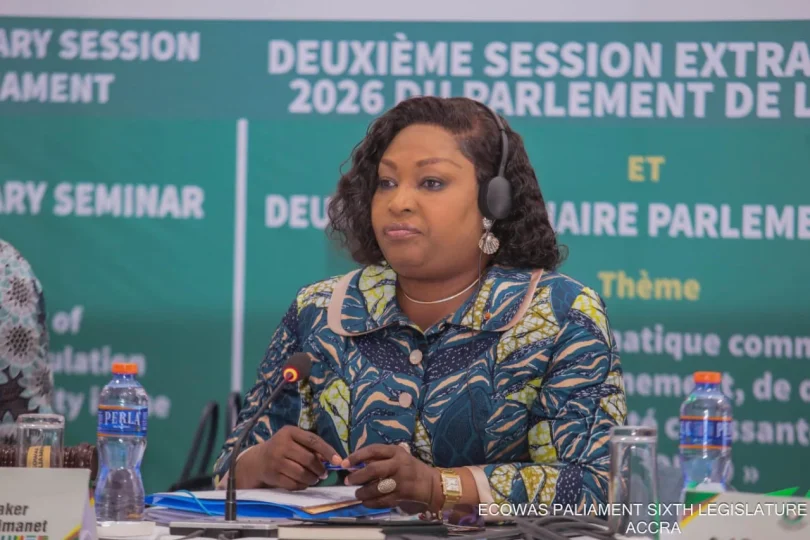
The ECOWAS Parliament has begun deliberations on a regional response to climate-driven displacement and insecurity in West Africa, as experts warned that rising temperatures, extreme weather events, drought, flooding and land degradation were increasingly threatening livelihoods, infrastructure and regional stability.
The discussions commenced in Accra, Ghana, on Monday at the Second Extraordinary Session of the ECOWAS Parliament and Second Seminar, with the theme “Climate Change as a Driver of Environmental Degradation, Population Displacement and Rising Insecurity in the ECOWAS Region.”
The experts called for stronger regional cooperation, increased investment in climate adaptation, improved early-warning systems and better access to climate finance to enable member states to respond effectively to growing climate risks.
Opening the proceedings, Speaker of the ECOWAS Parliament, Hadja Memounatou Ibrahima, welcomed parliamentarians and participants to Accra, noting the significance of the gathering and the opportunity it provided for delegates to deliberate on issues affecting the region.
The Speaker also recalled Ghana’s Founder’s Day, which coincides with the birth of the country’s first President, Dr Kwame Nkrumah, and his vision of a free and united Africa capable of determining its own destiny.
A minute of silence was observed in his honour.
In a presentation on climate change risks, vulnerabilities and implications for regional stability, the Senior Programme Officer, Climate Change and Ozone Directorate of Ghana’s Environmental Protection Authority, Dr Derek Sarfo-Yiadom, said climate hazards were already affecting communities across West Africa.
“Climate hazards are with us,” he said, identifying extreme heat, drought, heavy and unpredictable rainfall and rising sea levels among the major concerns.
Sarfo-Yiadom said climate hazards became disasters when exposed communities lacked the capacity to cope with them.
According to his presentation, seasonal temperatures had risen by between one and three degrees Celsius since 1970, contributing to hotter heatwaves and increasingly unpredictable weather patterns.
He said changing rainfall patterns were also increasing flood risks, while drought and heat were putting pressure on farming and livelihoods.
Sarfo-Yiadom identified farmers, low-income communities, coastal settlements and displaced populations among those particularly vulnerable to climate change.
He also highlighted risks to homes, irrigation systems, electricity, transport networks, ports, markets and public services.
The expert said climate change was no longer only an environmental concern, as its effects could have social and economic consequences, including displacement and conflict, particularly in communities dependent on agriculture and natural resources.
He called for increased investment in adaptation, flood-proof zoning and expanded climate-risk mapping, while urging governments to ensure that early-warning systems reached vulnerable communities.
Sarfo-Yiadom also called for greater accountability in climate-related spending.
In another presentation on the ECOWAS regulatory and institutional framework, the Principal Officer, Climate Change and Climate Services at the ECOWAS Commission, Mr Raoul Kouame, called for the harmonisation of regional climate policies and standards and stronger support for member states to implement their commitments under the Paris Agreement.
“The challenge is no longer just to define climate commitments,” he said.
Kouame identified institutional fragmentation, differences in national capacities and difficulties accessing climate finance as some of the challenges affecting climate action across the region.
He called for stronger coordination between regional and national institutions and greater sharing of experience among member states.
He also advocated mechanisms to help countries develop national frameworks connected to regional climate structures.
According to him, regional cooperation should cover climate services, early-warning systems, forest and ecosystem protection, carbon markets and access to climate finance.
Kouame said the region needed to strengthen its capacity to access available climate funds and develop innovative financing mechanisms to support implementation.
He stressed that ECOWAS had an important role to play in providing regional solidarity and helping member states implement their climate commitments more effectively.
Also speaking, a climate, water and meteorology expert with the Permanent Inter-State Committee for Drought Control in the Sahel (CILSS), Dr Abdou Ali, said regional cooperation was essential because climate and resource pressures crossed national borders.
His presentation focused on drought, land degradation and food insecurity, with emphasis on the need for member states to share climate information, data, technical expertise and climate services.
Ali identified agriculture, coastal areas, biodiversity, disaster risk and human displacement among areas requiring coordinated adaptation measures.
He also stressed the need to integrate climate action into policies covering agriculture, forestry, energy, transport, industrialisation and waste management.
The expert said regional climate strategies required adequate financing, stronger institutions and effective implementation mechanisms.
The presentations converged on the need for stronger climate adaptation measures across West Africa, with experts stressing that interventions should take account of the needs and livelihoods of affected communities to avoid creating new vulnerabilities.
Parliamentarians are currently deliberating on the expert presentations and the broader implications of climate change for the ECOWAS region.