
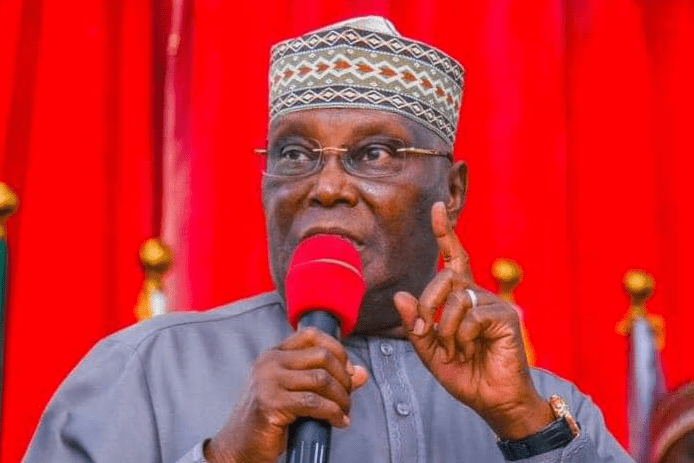
Former Vice President and Presidential candidate of the African Democratic Congress, Atiku Abubakar, has asked the Presidency to disclose who is constitutionally in charge of Nigeria, 21 days after President Bola Ahmed Tinubu left the country.
In a statement issued on Sunday, September 21, 2026, Atiku said President Tinubu left Nigeria on August 30 on what the Presidency described as a three-week annual vacation, and that the period has now elapsed without evidence of compliance with Section 145 of the Constitution.
“Section 145 of the Constitution is not ambiguous about presidential vacations. It provides that whenever the President proceeds on vacation, he shall transmit a written declaration to the President of the Senate and the Speaker of the House of Representatives, whereupon the Vice President performs the functions of President as Acting President,” Atiku said.
He noted that where the President fails to transmit that declaration within 21 days, the Constitution provides that the National Assembly shall, by a simple majority of each House, mandate the Vice President to act.
“President Tinubu left Nigeria on 30 August. The Presidency publicly announced a three-week vacation. Yet, to date, Nigerians have not been shown any constitutional letter transmitting presidential authority to Vice President Kashim Shettima,” he said.
“The 21 days have now elapsed. If such a letter exists, the Presidency should publish it immediately.”
Atiku added that if no such letter exists, the constitutional mechanism under Section 145(2) has been triggered and the National Assembly owes Nigerians an explanation on why it has not acted.
“This is not a matter of political convenience. It is a matter of constitutional order,” he stated.
The former Vice President also faulted the situation where both the President and Vice President are abroad at the same time, noting that Vice President Shettima is presently in New York representing Nigeria at the United Nations General Assembly – the third consecutive UNGA being delegated to him.
“So again: who is exercising presidential authority in Nigeria today, and under what constitutional instrument? Nigeria cannot be governed by assumptions. It cannot be governed by presidential social-media posts from Europe. It cannot be governed by photographs from private dinners at the Élysée Palace. It cannot be governed on autopilot,” Atiku said.
He cited recent developments while the President has been away, including the death of 37 persons in NSCDC custody in Minna, which he described as grave enough to trigger investigations and demands for independent scrutiny, and the high cost of petrol selling for as much as ₦1,500 per litre in parts of the country.
“These are not ordinary times. Yet the President is abroad. The Vice President is abroad. The Senate President is abroad. And Nigerians have not been told, in the clear constitutional language required of a serious democracy, who is exercising the powers of the President,” he said.
Atiku said President Tinubu’s private dinner with President Emmanuel Macron in Paris may serve diplomatic purposes but argued that Nigeria itself cannot be placed on vacation, stressing that the Constitution does not recognise a “working vacation” as an alternative system of presidential succession.
“The Presidency should therefore tell Nigerians immediately whether President Tinubu transmitted the declaration contemplated by Section 145(1) before leaving the country. The President of the Senate and the Speaker of the House should equally tell Nigerians whether such a communication was received,” he demanded.
“And if no declaration was transmitted within the constitutionally stipulated period, the National Assembly must explain why the procedure provided by Section 145(2) has not been activated.”
Atiku said: “Nigeria is bigger than any President. At a time of severe economic hardship, rising energy costs, security challenges and the shocking deaths of citizens in government custody, the country deserves visible, accountable and constitutionally grounded leadership. The question will not disappear: Who, constitutionally, is in charge of Nigeria?”