
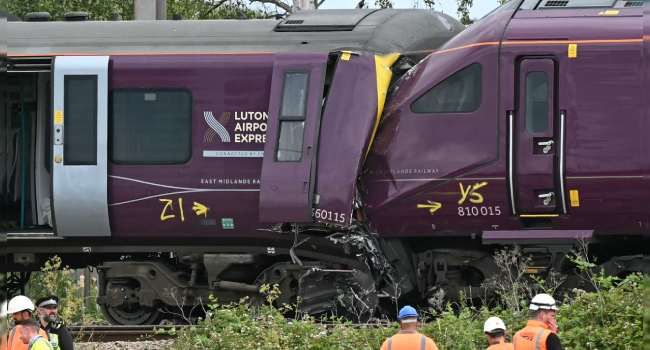
The collision occurred on Friday afternoon near Bedford, a town about 90 kilometres north of London. According to East Midlands Railway (EMR), the incident involved two of its London-bound trains travelling on the same track.
Speaking on Saturday, Transport Secretary Heidi Alexander said it was “too early to speculate” on the cause of the crash, assuring the public that there would be “a thorough investigation … to ensure that lessons are learnt”.
British Transport Police Chief Constable Lucy D’Orsi, who addressed journalists near the crash site, said more than 80 people had received treatment in hospitals following the accident, while 28 victims remained hospitalised.
“Nine are in a critical condition,” she added.
Police had earlier confirmed that the driver of one of the trains died at the scene.
D’Orsi said that “specialist investigators from British Transport Police are working with colleagues at the Rail Accident Investigation Branch (RAIB) to gather the facts and determine what has happened”.
Buckingham Palace said King Charles was “greatly saddened” by the tragedy and extended “his thoughts and sympathies” to the family of the deceased driver and those injured in the crash.
One passenger, Paul Cavin, recounted the terrifying moments leading up to the collision. Speaking to the BBC, he said: “We had stopped and suddenly we were hit from behind pretty bad.”
“There were people injured on my carriage,” he said, adding that he saw numerous passengers leaving the trains with injuries, including some with “smashed up noses”.
Emergency services mounted a large-scale response. The East of England Ambulance Service reported that 11 people suffered “very serious” injuries, while another 32 sustained serious injuries and 56 others suffered minor injuries.
More than 20 ambulances, specialist rescue teams and six air ambulances were deployed to the scene.
Fire authorities also mobilised over 20 fire and specialist vehicles, with more than 70 firefighters and officers involved in the rescue operation at its peak.
Another passenger, Brett Byatt, described the experience as “surreal” and expressed frustration over what may have led to the accident.
“I don’t know at whom,” he said. “But it’s more about (the fact) we’ve got one of the oldest railway networks and signal failures happen a lot… Why wasn’t that signalled to my train?”
Investigators have not yet indicated whether signalling failures contributed to the collision.
EMR Managing Director Will Rogers described the incident as “a profoundly sad day for the railway community”.
“We are deeply saddened that our driver has tragically died, and a number of other people have suffered injuries,” he said.
He added that the railway operator was “fully supporting” the ongoing investigation by the Rail Accident Investigation Branch.
Train collisions are uncommon in the United Kingdom. In September 2023, several people were injured when two trains collided at Aviemore station in the Scottish Highlands on the heritage Strathspey Railway.