
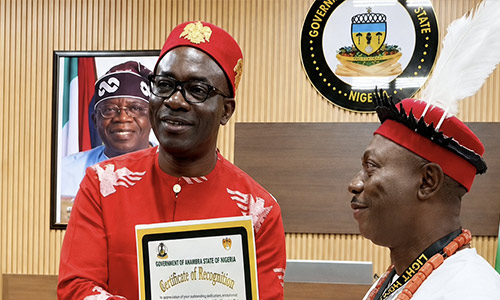
Anambra State Governor, Prof. Charles Soludo, has presented a certificate of recognition to Barrister John Nzekwesili Nweke as the traditional ruler of Nsugbe Community in Anambra East Local Government Area, amid an unresolved legal and community dispute over the process through which he emerged.
Nweke, who is the elder brother of the Anambra State Attorney-General and Commissioner for Justice, Tobechukwu Nweke, SAN, was recognised by the governor on Tuesday, two days after a controversial traditional stool election which had been the subject of a subsisting order of the Anambra State High Court.
“Respectfully, Barrister John Nzekwesili Nweke is now officially the Igwe of Nsugbe,” Soludo declared during a meeting with traditional rulers at the Government House before presenting him with the certificate of recognition.
The development has deepened controversy in the community, where disagreement over the method of selecting a new traditional ruler had already resulted in litigation, petitions to President Bola Tinubu, protests and the eventual relocation of the election from Nsugbe to the Anambra East Local Government headquarters in Otuocha.
The dispute centres principally on whether the traditional ruler should be selected through a delegate system or by universal adult suffrage within Ivite Quarter, which, under the community’s zoning arrangement, was due to produce the next traditional ruler.
Opponents of the delegate arrangement approached the High Court of Anambra State, Awka Judicial Division, on July 8, 2026.
On August 5, Justice Jude Obiora granted an interlocutory injunction directing the parties to maintain the status quo existing as of July 8 pending the amicable or judicial determination of the substantive suit.
The court stated, among other things, that no party, whether acting personally, through agents, servants, privies or other persons acting on their authority, should “organise, conduct, supervise, conclude or give effect to any election or selection” of the next Igwe of Nsugbe from Ivite Quarter pending determination of the action.
However, tensions rose again towards the end of August after a group known as Concerned Indigenes and Stakeholders in Nsugbe alleged that the state Commissioner for Local Government and Community Matters, Vincent Ezeaka, suspended the elected executive of the Nsugbe Development Union on August 28 and constituted a caretaker committee which was subsequently involved in arranging another selection exercise.
In a petition to President Tinubu, the group accused Ezeaka and the Attorney-General of engaging in what it described as unlawful and contemptuous actions connected with plans to proceed with the traditional ruler selection despite the court order.
At least 13 stakeholders signed the petition, including Senator Tony Nwoye, who represents Anambra North; former senator Alphonsus Igbeke; and Nsugbe Development Union Secretary-General, Uzoechina Benedict.
The group also asked the President to investigate what it described as a possible conflict of interest arising from the Attorney-General’s familial relationship with one of the contenders.
The allegations have, however, been denied by the Attorney-General.
“I have not been involved in this process from the beginning to the end. I have been minding my business, discharging my duties as the attorney-general of the state,” he said.
“I have not been involved in this process from the beginning to the end. I have been minding my business, discharging my duties as the attorney-general of the state,” he said.
“But Senator Tony wants to use blackmail to gain political points by always accusing me of interfering in the process.”
The Attorney-General acknowledged being an indigene of Nsugbe and receiving information about events in the community but maintained that he had no operational role in the selection process.
He explained that the earlier town union and electoral committee had planned an August 8 election using the delegate system, a method opposed by Nwoye and other stakeholders.
According to him, the government had initially approved the delegate arrangement forwarded by the community leadership, but following the controversy, Ezeaka suspended the town union executive and established a caretaker committee.
He said the caretaker committee subsequently engaged stakeholders and resolved the disagreement in favour of universal adult suffrage, which had been advocated by Nwoye’s group.