
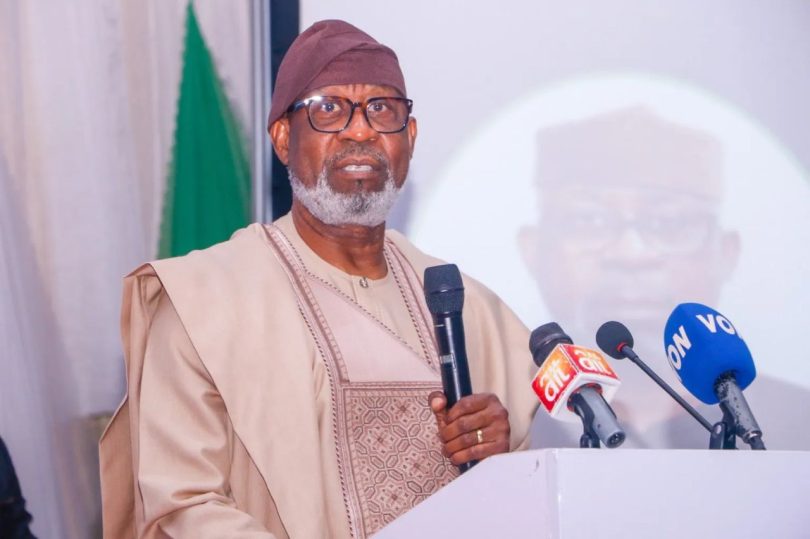
Minister of Solid Minerals Development, Dele Alake, made the disclosure on Wednesday during the opening of the African Natural Resources and Energy Investment Summit (AFNIS) 2026 in Abuja.
According to the minister, the discovery was confirmed by the Nigerian Geological Survey Agency (NGSA) and ranks among the most important breakthroughs recorded in Nigeria’s mining industry in recent years.
He explained that the mineral-rich province was identified through exploration activities carried out by a private company in collaboration with the geological agency.
“This is the first time I am announcing this publicly,” the minister said.
Alake noted that the newly discovered deposits contain critical minerals that are increasingly sought after worldwide for clean energy projects, battery manufacturing and advanced industrial production.
“The province is notable for significant deposits of gold, nickel, copper, lithium and rare earth elements of exceptionally high grades, positioning Nigeria among emerging destinations for strategic mineral resources and sustainable mining investment,” he added.
The minister said the discovery aligns with ongoing efforts by the Federal Government to transform the mining sector into a major driver of economic growth and industrial development.
He stated that the administration of President Bola Tinubu has placed the solid minerals sector at the centre of its economic diversification strategy through reforms aimed at attracting investors, improving regulatory oversight and encouraging local value addition.
As part of these reforms, Alake revealed that more than 3,000 inactive and underperforming mineral titles have been revoked to promote accountability and ensure that licences are held by operators capable of developing mining assets.
“We have focused on restoring discipline in licensing, strengthening compliance, improving transparency and ensuring that mineral assets are held by operators with the capacity and intention to develop them,” he noted.
He further explained that the government is discouraging the export of raw minerals by requiring mining lease applicants to present plans for local processing and beneficiation before obtaining approvals.
According to him, the policy has already encouraged increased investment in lithium processing plants and mineral refining projects across the country.
Among the investments highlighted were an $800 million lithium processing project, a $600 million lithium processing facility in Nasarawa State, a $200 million lithium plant near Abuja awaiting commissioning, and a $1 billion iron ore-to-steel project in Kogi State.
The minister also reported significant growth in revenue generated from the mining sector since the reforms were introduced.
“Our revenue performance has improved significantly,” he said.
He disclosed that annual mining revenue rose from about N6 billion before the current administration assumed office to more than N38 billion in 2024, surpassing N70 billion by the end of 2025.
The announcement came as Steron Mining and Company Limited unveiled an estimated 3.3 million metric tonnes of lithium reserves during a tour of its mining site for participants attending the summit.
Managing Director of the company, Abu Omar, said the visit was organised to demonstrate the contribution of indigenous companies to the development of Nigeria’s critical minerals sector.
He explained that the company operates both open-pit and underground mining activities and expanded beyond its original granite quarry business after discovering lithium deposits.