
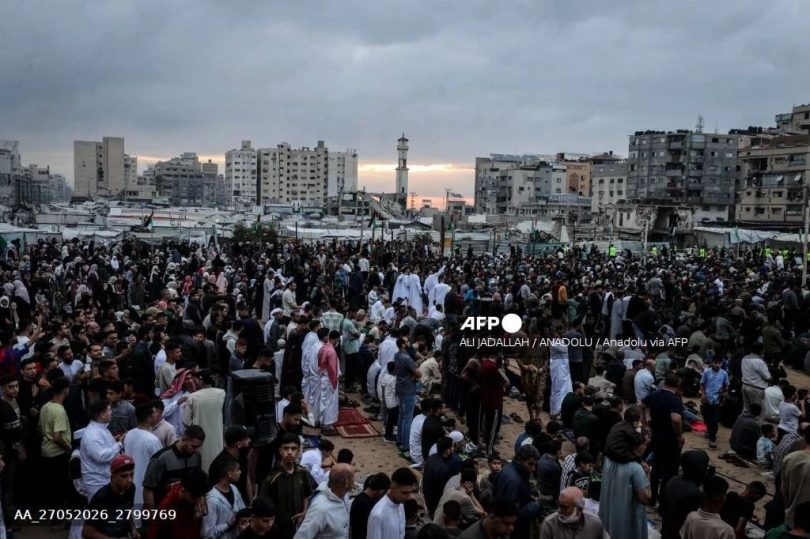
The usual excitement that comes with Eid al-Adha has faded across Gaza, where many families say the ongoing humanitarian crisis has made basic celebrations impossible.
For children, new clothes and festive treats have become luxuries beyond reach, while the cost of sacrificial animals has soared to levels many residents describe as unimaginable.
“I go to the market only to look around because I cannot afford to buy anything. Whenever I ask about prices, I return heartbroken,” Nadia Abu Shamala, a Palestinian resident of Gaza, told AFP.
Shamala, a 40-year-old mother originally from northern Gaza, said years of displacement and hardship have erased the joy traditionally associated with Eid celebrations. She and her family have been living in Deir al-Balah in central Gaza for more than two years after fleeing the conflict.
“This year, Eid comes with none of the joy we once knew in Gaza because of the effects of the war, the soaring prices, and our inability to provide even the simplest needs for our children,” she said.
Although a ceasefire brokered by the United States took effect in October 2025, residents say life in Gaza remains extremely difficult. Air strikes still occur frequently, while widespread destruction has left much of the territory in ruins. According to the United Nations, most residents now depend heavily on humanitarian aid for survival.
Aid organisations also say restrictions on goods entering Gaza have contributed to severe shortages and soaring prices, despite limited aid deliveries being allowed into the territory.
Still, some families are trying to preserve the spirit of Eid despite the economic hardship.
“The truce is a big lie, but in any case, we are trying to create joy for the children,” said Abu Abdullah al-Mosadar, 59, who told AFP he pooled around 13,000 shekels ($4,570) with his brother to buy a sheep for sacrifice.
It is a cost far beyond what many Gazans can afford.
“I know it is very expensive, but I decided to perform the sacrifice this year,” Mosadar said, expressing hope that he would eventually return to his former construction and real estate business.
Sacrificing sheep during Eid al-Adha commemorates the Islamic belief that Prophet Ibrahim was prepared to sacrifice his son in obedience to God before being provided with an animal instead.
However, livestock shortages in Gaza have made the tradition increasingly difficult to observe. The UN Food and Agriculture Organisation estimates that only about 15,000 sheep remain in the territory, a fraction of the population that existed before the war.
Raafat Asaliya, spokesperson for Gaza’s agriculture ministry, said the shortage has pushed prices to record levels.
“Regarding prices this year, sacrificial animals are witnessing an unprecedented increase due to the limited supply and the rising costs of breeding, feed, and transportation, and the shutdown of many farms,” Asaliya said.
As a result, “a sheep or goat that was sold before the war for around 1,000 shekels is now priced between 11,000 and 15,000 shekels,” he added.
Many residents say they have never experienced such conditions before.
“We have never heard of such prices in our lives,” Ahmed Abu Salem, a resident of Gaza City, told AFP.
“Families like ours, who used to make sacrifices every year, are now unable even to buy one kilogramme of meat for our children,” the 50-year-old said.