
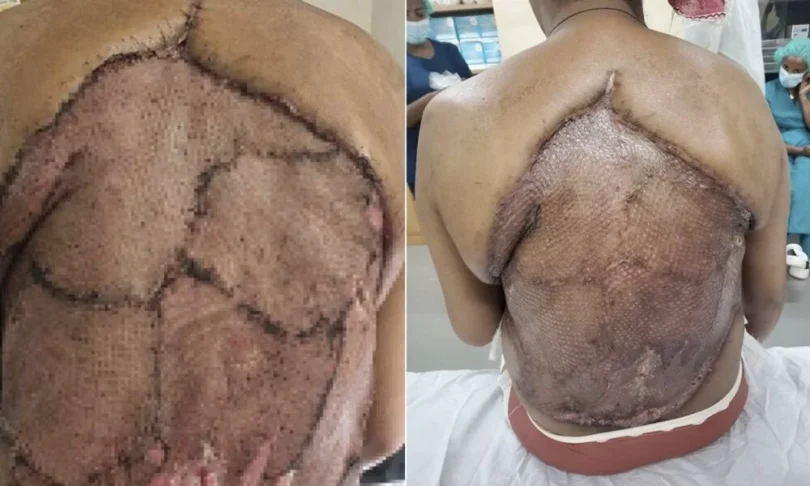
A woman living with diabetes has shared her frightening experience after a severe infection caused extensive damage to the tissue on her back.
Follow Our WhatsApp Channel here
According to the woman, she was diagnosed with sepsis and necrotising fasciitis, a rare but potentially life-threatening infection where bacteria rapidly destroy tissue beneath the skin.
She revealed that doctors had to remove a 40cm by 30cm area of infected skin, fat and muscle from her back, leaving parts of her ribs, shoulder blade and spine exposed.
Follow Our Telegram Channel here
The woman explained that she had been living with untreated type 2 diabetes for five years after declining medication when she was first diagnosed.
Over time, she developed a serious infection on her back, which resulted in extensive tissue death, sepsis and diabetic ketoacidosis.
By the time she was admitted to hospital, doctors discovered large areas of dead tissue across her thoracic and lumbar back.
Her skin had developed blisters and was producing pus, while gas had become trapped beneath the damaged tissue.
During the medical emergency, she was also experiencing a fever, rapid breathing and confusion, while her blood sugar levels were recorded at dangerously high levels.
Treatment began immediately with antibiotics, intravenous insulin and blood transfusions as doctors worked to stabilise the woman in intensive care at a hospital in Addis Ababa, Ethiopia.
Her condition required emergency surgery. Surgeons performed an extensive debridement procedure, removing dead and infected skin, fatty tissue and muscle until healthy tissue that could bleed properly was reached.
The procedure resulted in a massive wound measuring about 40cm by 30cm. Parts of her ribs, the tip of her shoulder blade and several bony areas along her spine were left exposed.
Her ordeal had started about two months earlier when she noticed swelling developing on her back. The swelling continued to worsen, and her condition became increasingly serious.
Before she was admitted to hospital, she developed abdominal pain, rapid breathing, fever and confusion.
Doctors later carried out another operation to remove tissue that was still unhealthy. However, they decided against immediately attempting major reconstructive surgery because her body was not yet strong enough to cope with such an extensive procedure.
Instead, the medical team focused on preparing the wound gradually for skin grafting.
To help new tissue develop, surgeons drilled small openings into the outer surface of the exposed ribs to stimulate bleeding and encourage the growth of healthy tissue. Sections of spinal bone that were protruding from the wound were also carefully reduced.
Muscle from the surrounding area was then repositioned over parts of the wound where viable bone remained, helping to provide coverage and a blood supply needed for healing.
The woman required daily wound treatment under sedation while doctors continued cleaning the area and removing tissue that was not recovering.