
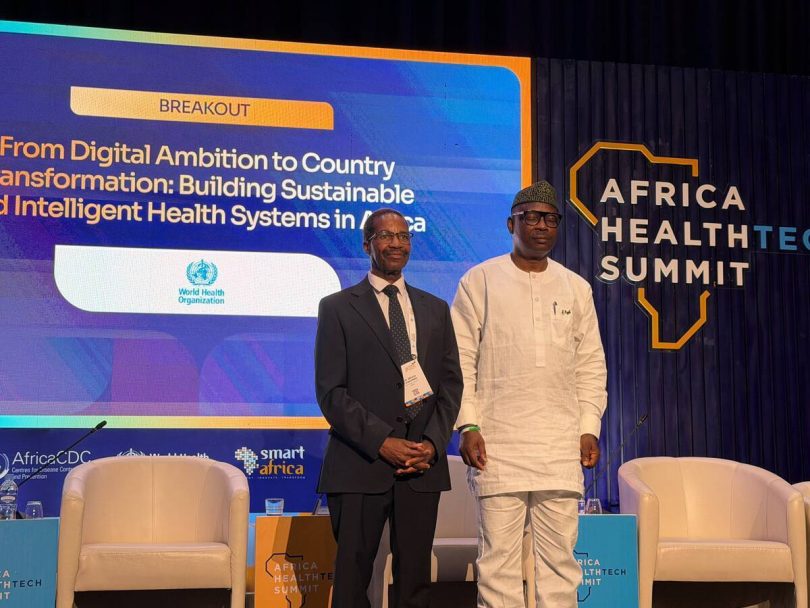
The federal government is working towards a unified digital health system aimed at improving healthcare delivery, ending fragmented medical records, and strengthening the use of artificial intelligence across the country.
The Minister of State for Health and Social Welfare, Dr Iziaq Adekunle Salako, disclosed this at the 5th Africa HealthTech Summit held at the Kigali Convention Centre, Rwanda.
Salako said Nigeria was moving from isolated digital health projects towards an integrated national system capable of improving service delivery, governance, healthcare financing, and health outcomes.
He spoke on the theme, “From Digital Ambition to Country Transformation: Building Sustainable and Intelligent Health Systems in Africa.”
According to him, digital transformation is a key component of the Nigeria Health Sector Renewal Investment Initiative, being implemented through a sector-wide approach under President Bola Tinubu.
The minister said Nigeria and other African countries had developed digital applications, electronic medical records, telemedicine platforms, disease surveillance systems, and artificial intelligence tools, but many of the solutions operated independently without common standards or the ability to exchange information.
He said the experience had shown that simply digitizing a fragmented health system did not automatically guarantee integration, efficiency, or value for money.
“Rather than beginning with another application, Nigeria decided to begin with the architecture,” the minister said.
Salako explained that through the Nigeria Digital in Health Initiative, the government had developed a National Digital Health Architecture, endorsed by the National Council on Health, to provide a unified framework for the country’s digital health ecosystem.
He said the architecture would replace fragmented projects with a secure and interoperable system supported by a Health Information Exchange, a Shared Health Record, and national registries for patients, healthcare facilities, and health workers.
The minister added that the initiative was already supporting digital health development at national and sub-national levels, including telemedicine services designed to bridge healthcare gaps and improve access to medical professionals in rural communities.
“The principle is simple: one patient, one health record. A system where a visit to a health facility does not make one effectively a new patient simply because one has crossed from one facility, program, or level of care to another,” he said.
According to Salako, the system would allow medical information to follow patients securely across healthcare facilities, enabling authorized health workers to make informed clinical decisions.
ALSO READ: FG seeks resilient health system through legal reform, financial accountability
He added that policymakers would also have access to better information for planning and resource allocation.
The minister, however, stressed that successful digital transformation would require strong governance, standardization, and accountability.
He said the government was working to address the fragmentation of electronic medical record systems and establish national interoperability standards.
Salako said the establishment of the National Health Technology and Data Analytics Office by President Tinubu was intended to strengthen coordination, standardization, and implementation of the country’s digital health agenda.
He said the office would coordinate digital health initiatives across public and private institutions, promote common standards, and oversee the full operationalization of the National Digital Health Architecture.
On artificial intelligence, Salako said the technology could support clinical decision-making, disease surveillance, supply chain management, health financing, and the early identification of health risks.
He, however, cautioned that African countries needed reliable digital infrastructure, trustworthy data systems, cybersecurity safeguards, and effective governance before deploying AI extensively in healthcare.
“AI cannot compensate for fragmented data, weak standards, or systems that cannot communicate. If Africa wants to benefit fully from AI, we must invest first in interoperable architecture, trustworthy data, cybersecurity, governance, and the people capable of managing these systems,” he said.
Salako urged African countries to move beyond being consumers of imported health technologies by taking part in setting standards, governing health data, developing local expertise, and creating an enabling environment for homegrown innovations.
He also called for stronger partnerships among governments, development partners, and the private sector, stressing that investments in digital health should strengthen existing national systems rather than create parallel structures.
The minister said development partners should ensure their investments leave behind stronger institutions, local technical capacity and sustainable infrastructure that governments could maintain after individual projects or grants ended.
According to him, the ultimate goal of digital transformation should be improved healthcare outcomes for ordinary citizens, particularly pregnant women, children, and vulnerable populations.
He said integrated digital health systems would help ensure that patients’ medical and vaccination records remained accessible when they moved between communities and healthcare facilities.
The systems, he added, would reduce administrative burdens on health workers and improve access to information for decision-making.
Salako also stressed the need to ensure that technological innovations remained equitable, accessible, secure, and sustainable, warning that digital transformation should close existing healthcare gaps rather than widen them.
“As African countries, therefore, our ambition should not simply be to digitize healthcare but to build health systems that can learn, connect, anticipate, and respond,” he said.
He reaffirmed Nigeria’s commitment to collaborating with other African countries, sharing experiences, and strengthening partnerships to advance digital health development across the continent.
Salako said Africa had an opportunity not only to participate in the future of digital health but also to help shape it through locally driven innovation, effective governance, and sustainable investment.