
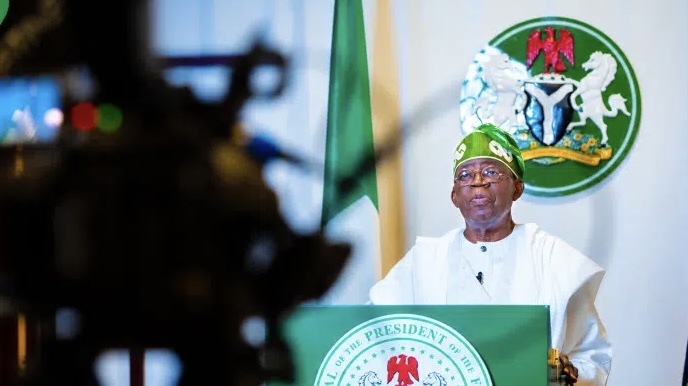
President Bola Tinubu has declared that reducing the cost of living will remain a major priority of his administration as Nigeria moves into what he described as a new phase of economic growth and shared prosperity.
Tinubu made the declaration in his Independence Day address to Nigerians on Thursday as the country marked its 66th anniversary.
The President said the government’s strategy would focus not only on economic growth but also on bringing down the cost of producing, moving and selling goods and services.
According to him, the objective is for lower costs across the production chain to eventually translate into cheaper prices for consumers.
Tinubu said the government would therefore continue investing in agriculture, transportation, infrastructure, electricity and other areas capable of reducing the burden on businesses and households.
Tinubu: Reform phase is over
Reflecting on Nigeria’s journey since independence, Tinubu acknowledged the economic crises, insecurity, political instability, military rule and other difficulties the country has experienced over the decades.
He said Nigeria had survived those challenges largely because of the resilience of its people.
The President argued that the country’s founding vision was not limited to political independence but included the creation of a nation where citizens could enjoy dignity, opportunity, freedom and a better standard of living.
Tinubu said his administration had spent roughly three years implementing economic reforms aimed at addressing what he described as longstanding distortions in the economy.
He maintained that the next phase should focus on turning those reforms into tangible improvements in the lives of Nigerians.
“The age of reform has done its work. Now begins the age of prosperity,” Tinubu said.
The President also defended the difficult measures introduced by his administration, arguing that the reforms were intended to tackle problems that had accumulated over several decades rather than create them.
He compared the economic restructuring to treating a serious illness, saying previous governments had often postponed difficult decisions.
President lists economic gains
Tinubu said the government had recorded several improvements since the reforms began.
He cited economic growth of more than four per cent in 2026, reduced oil theft, declining inflation from its peak, stronger foreign reserves and greater stability in the foreign exchange market.
He also said Nigeria’s non-oil exports generated more than $6 billion in 2025, which he described as the country’s highest recorded figure.
According to the President, the private sector has also responded positively to the reforms, while foreign direct investment has increased.
Tinubu said the next challenge was ensuring that improvements in macroeconomic indicators translated into better living conditions for ordinary Nigerians.
Lower production costs, cheaper goods
The President identified the high cost of production and transportation as major factors affecting prices across the country.
He said farmers must be able to produce food at lower costs, while manufacturers need access to affordable credit and reliable electricity.
Tinubu also promised continued investment in irrigation, dry-season farming, improved seeds and fertiliser, mechanisation, storage and transportation.
He said road, rail and port projects were being developed to strengthen connections between farms, factories and markets.
The President explained that reducing losses between farms and markets, cutting electricity costs for manufacturers and improving transport efficiency would help reduce the final price paid by consumers.
His administration has previously linked cheaper transportation to the expansion of compressed natural gas-powered vehicles and other alternatives to petrol-powered transport.
Jobs and industrialisation take centre stage
Tinubu also placed job creation at the centre of his vision for the next phase of the economy.
He said Nigeria’s large youth population made employment creation and enterprise development particularly important.
“We are therefore placing jobs, enterprise, and industrial growth at the heart of our government’s policies,” he said.
The President said Nigeria’s gas resources would be deployed to support new industries, while efforts would be made to assist businesses seeking to revive factories and expand production.
He also identified digital connectivity, skills development, infrastructure and access to finance as areas requiring greater attention.
Tinubu said his administration wanted to see more Nigerian farms supplying cities and factories, more locally produced goods reaching international markets and young Nigerians creating technology companies and employment opportunities.
Social support programmes to continue
Acknowledging that many Nigerians were still struggling with food costs, school fees, medical expenses and transportation, Tinubu said the government would continue strengthening its social intervention programmes.
He said the National Social Register was being improved to ensure assistance reached the poorest households.
The President also highlighted the Nigerian Education Loan Fund as a means of expanding access to higher education for students from low-income families.
He cited CREDICORP’s consumer credit programme, which he said was helping working Nigerians finance essential purchases such as vehicles, solar equipment and digital devices.
Tinubu further said the Federal Government would continue working with state and local governments on primary healthcare, basic education and other essential services.
Also Read: Nigeria @66: David Mark charges renewed commitment to national unity
He also said salaries and pensions had been paid promptly since 2023 and that pension reforms were being pursued to improve the welfare of retirees.
‘We will defeat poverty’
Tinubu acknowledged that changing Nigeria’s economic fortunes would not happen overnight, noting that many of the country’s problems had accumulated over generations.
He nevertheless insisted that the government could alter the direction of the economy.
“We cannot erase in four years what accumulated over generations. But we can change its course,” he said.
The President said government interventions should serve as a bridge towards prosperity rather than become permanent substitutes for economic opportunity.
“Our objective is not to manage poverty more efficiently. We will defeat it,” Tinubu said.
He urged Nigerians to remain hopeful and united, insisting that the country had entered a new phase after what he described as a difficult period of economic adjustment.
Tinubu said his vision was for a Nigeria where prosperity would be more widely shared and where children could aspire to better lives regardless of their circumstances.
“Our destination is in sight. Our foundations are strong. Our direction is clear. So let us go forward. No looking back,” he said.