
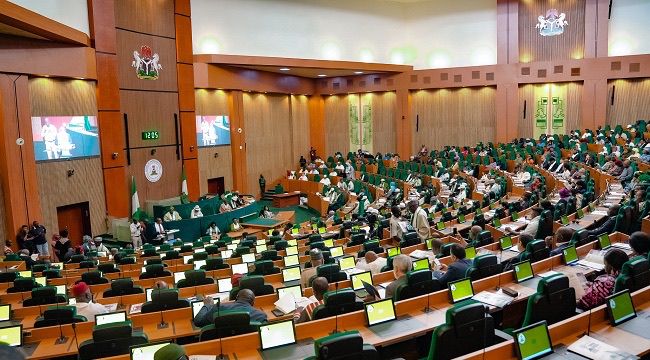
A wave of political defections has hit the House of Representatives, with no fewer than 17 lawmakers leaving the African Democratic Congress (ADC) to join the Nigerian Democratic Congress (NDC).
The Speaker read out the notices of defection during Tuesday’s plenary, formally confirming the lawmakers’ switch. In a separate move, Leke Abejide also exited the ADC, defecting instead to the All Progressives Congress (APC).
Among those who joined the NDC are Yusuf Datti, Uchenna Okonkwo, Adamu Wakili, Thaddeus Attah, George Ozodinobi, Lilian Orogbu, Oluwaseyi Sowunmi, Peter Aniekwe, Mukhtar Zakari, George Oluwande and Munachim Umezuruike. Others include Emeka Idu, Jesse Onuakalusi, Ifeanyi Uzokwe, Afam Ogene, Murphy Omoruyi and Abdulhakeem Ado.
The development underscores intensifying political realignments as parties reposition ahead of the 2027 general elections.
The lawmakers’ defection follows closely on the heels of a major political shift involving former Anambra State Governor Peter Obi and former Kano State Governor Musa Kwankwaso, who both moved from the ADC to the NDC just two days earlier.
Obi, the Labour Party’s 2023 presidential candidate, and Kwankwaso, who previously contested under the New Nigeria People’s Party (NNPP), were formally received into the NDC on Sunday. The duo were issued membership cards after a closed-door meeting with party leaders, in a moment that drew loud support from party faithful.
They were welcomed by former Bayelsa State Governor and NDC national leader, Senator Seriake Dickson.
Explaining his decision to leave the ADC, Obi pointed to a deteriorating political environment characterised by internal crises, external interference and increasing hostility within party structures. He described the nation’s political space as toxic, marked by intimidation, insecurity and constant scrutiny.
According to him, institutions expected to safeguard citizens are increasingly working against them, while those committed to genuine service face growing pressure both publicly and privately.
Despite his exit, Obi stressed that his decision was not driven by personal grievances against party leaders such as former Senate President David Mark or former Vice President Atiku Abubakar, both of whom he said he still holds in high regard.
“Let me state clearly: my decision to leave the ADC is not because our highly respected Chairman, Senator David Mark, treated me badly, nor because my leader and elder brother, Alhaji Atiku Abubakar, or any other respected leaders did anything personally wrong to me. I will continue to respect them.
“However, the same Nigerian state and its agents that created unnecessary crises and hostility within the Labour Party that forced me to leave now appear to be finding their way into the ADC, with endless court cases, internal battles, suspicion, and division, instead of focusing on deeper national problems and playing politics built more on control and exclusion than on service and nation-building,”
Kwankwaso, on his part, urged Nigerians to align with the NDC, announcing that his political structure had already begun registration into the party.
Welcoming the new entrants, Senator Dickson described the NDC as a united platform free of internal disputes and legal battles. He also portrayed the party as one of the fastest-growing political movements in the country.
“On behalf of the leaders of our party and on behalf of the teeming members of our party, well-meaning Nigerians from all over our country, who in the five months have defied all odds and conquered all doubts, and invested their trust and confidence in the dream and vision of this party. On behalf of all of them, I thank you all, and I welcome you all, especially to the NDC and my humble home,” he said.
He added that despite being relatively new, the party is determined to “box above its weight” in Nigeria’s political landscape.