
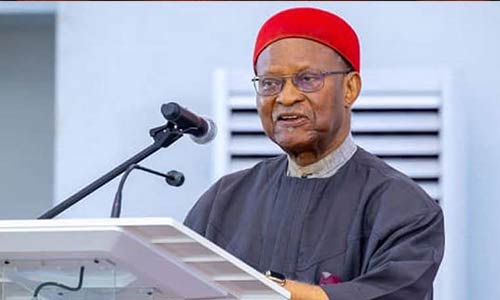
Former Commonwealth Secretary-General, Chief Emeka Anyaoku, has condemned xenophobic attacks against foreign African nationals in South Africa, describing the violence as distressing and regrettable, particularly considering the support the country received from other African nations during its struggle against apartheid.
The 94-year-old elder statesman expressed disappointment that some South Africans were attacking fellow Africans despite the sacrifices made by other countries to help dismantle the apartheid system and secure freedom for the country’s black majority.
Anyaoku spoke during an interview on the sidelines of the MasterClass on Penetrative Leadership in an Increasingly Chaotic World Order, held in Abuja.
Reflecting on his involvement in the international efforts that contributed to the end of apartheid, Anyaoku said the attacks were particularly painful because African countries had played important roles in supporting South Africa’s liberation struggle.
“The attacks are regrettable,” he said.
The former Commonwealth Secretary-General recalled how African governments and international organisations mobilised diplomatic, political and economic pressure against the apartheid regime, eventually helping to create conditions for negotiations between the white-minority government and representatives of the black majority.
Anyaoku, who served as Commonwealth Secretary-General from 1990 to 2000, explained that he was personally involved in diplomatic efforts to facilitate negotiations following the release of Nelson Mandela from prison in February 1990.
He recalled that Mandela visited Abuja in May 1990 to attend a meeting of Commonwealth foreign ministers responsible for South African affairs.
According to him, Mandela also attended his first official dinner as Commonwealth Secretary-General during the visit.
Anyaoku said the occasion marked the beginning of a personal friendship with Mandela and his then-wife, Winnie Mandela, which continued during the period of South Africa’s political transition.
He explained that the Commonwealth subsequently intensified efforts to support negotiations aimed at ending apartheid and establishing a democratic political system in South Africa.
In 1991, Anyaoku secured a mandate from Commonwealth Heads of Government to visit South Africa and explore how the organisation could assist the country’s then-president, F. W. de Klerk, in facilitating discussions among the country’s political and racial communities.
He recalled meeting de Klerk on November 1, 1991, during which they discussed ways of rebuilding trust among South Africa’s deeply divided population.
According to Anyaoku, the South African president initially questioned the Commonwealth’s ability to play a constructive role in the negotiations because the organisation had supported sanctions against the apartheid government.
De Klerk’s reservations reflected the tension between the Commonwealth’s longstanding opposition to apartheid and its proposed role in helping the parties reach a negotiated settlement.
Anyaoku said he explained that the Commonwealth’s experience as a multiracial association of nations placed it in a position to help build confidence among South Africa’s black, white and Asian communities.
He recalled using the diversity of his delegation to illustrate how people from different racial backgrounds could work together towards common objectives.
The former Commonwealth chief said his discussions with de Klerk focused on the importance of confidence-building and dialogue as essential conditions for a peaceful political transition.
He explained that the negotiations were not without difficulties, as disagreements among the participating parties threatened the process at various stages.
According to him, he intervened when the negotiations appeared close to collapse, helping to sustain dialogue and prevent the parties from abandoning the process.
Anyaoku recalled that the negotiations eventually produced an agreement in the early hours of November 17, 1993.
He said the agreement was signed at approximately 3:30 a.m. in his presence, marking an important stage in the negotiations that paved the way for South Africa’s transition to democratic government.
The negotiations culminated in the country’s first fully democratic national elections in April 1994, which brought Nelson Mandela to power as South Africa’s first black president.
Anyaoku’s recollections highlighted the diplomatic efforts undertaken by the Commonwealth and the broader international community to support South Africa’s transition from apartheid to democracy.
Against that historical background, he expressed concern that African nationals were now facing hostility and violence in a country whose liberation had attracted extensive support from other African states.
His remarks underscored the importance of remembering the solidarity demonstrated by African countries during the anti-apartheid struggle and the need to preserve peaceful relations among people across the continent.
At the same event, Vice-President Kashim Shettima urged Nigerian elites and other influential citizens to exercise greater responsibility in their public statements, particularly in an era increasingly shaped by social media, artificial intelligence and the rapid circulation of information.
Shettima, who was represented by his Special Adviser on Economic Matters, Dr Tope Fasua, warned against the spread of misleading narratives capable of damaging public confidence and distorting perceptions of the country.
He observed that advances in digital technology had created enormous opportunities for businesses, young people and ordinary citizens but had also increased the risks associated with misinformation and manipulation.
According to the Vice-President, the speed at which information now circulates requires individuals to exercise greater caution before accepting or sharing claims.
“Digital success is an asset. It gives Nigerian businesses access to customers, young people access to opportunities and citizens access to information. But it also places a greater responsibility on all of us to distinguish reliable information from manipulation,” Shettima said.
He urged citizens, particularly those whose opinions influence public discourse, to verify information before sharing it.
The Vice-President maintained that responsible communication was essential to protecting public trust and ensuring that digital platforms contributed positively to national development.
He also stressed the need for Nigerian elites to exercise restraint in promoting narratives about the country, warning that the widespread circulation of unverified information could have consequences for national cohesion and public perception.
Also speaking at the event, the Group Managing Director of Sahara Power Group, Mr Kola Adesina, identified performance, character and goodwill as the three pillars upon which personal and institutional reputations are built.
Adesina said individuals and organisations must recognise that their actions, decisions and public communications contribute to how they are perceived by others.
He urged Nigerians to become more conscious of how their conduct and statements shape the country’s reputation, both domestically and internationally.
According to him, reputation is not determined solely by public relations or the way individuals present themselves but also by the consistency of their behaviour and the quality of their contributions.
“Your reputation is a matter of choice; it’s a decision,” Adesina said.
He encouraged younger generations to study the experiences of respected leaders such as Anyaoku, particularly their approaches to leadership, diplomacy and crisis management.
Adesina maintained that lessons from experienced statesmen could help emerging leaders make better decisions, avoid previous mistakes and develop the judgment required to manage complex situations.
He also cautioned against the growing tendency to circulate information immediately without establishing its accuracy.
According to him, the desire to be the first to share information should not take precedence over the responsibility to ensure that such information is credible.
The discussions at the Abuja event brought together concerns about leadership, diplomacy, national reputation and responsible communication in an increasingly complex international environment.
While Anyaoku drew attention to the historical bonds between South Africa and other African countries, Shettima and Adesina emphasised the importance of responsible leadership and information management in maintaining public confidence.
Anyaoku’s condemnation of xenophobic attacks also served as a reminder of the solidarity that helped bring apartheid to an end and the responsibility of African countries to promote peaceful coexistence among their citizens.
The former Commonwealth Secretary-General maintained that violence against fellow Africans was regrettable, particularly in a country whose democratic transformation had benefited from the sacrifices and support of people across the continent.
Post Title: “Xenophobic Attacks Against Fellow Africans Are Regrettable” — Anyaoku Condemns Violence In South Africa, Recalls Role In Ending Apartheid By Naijaonpoint.