
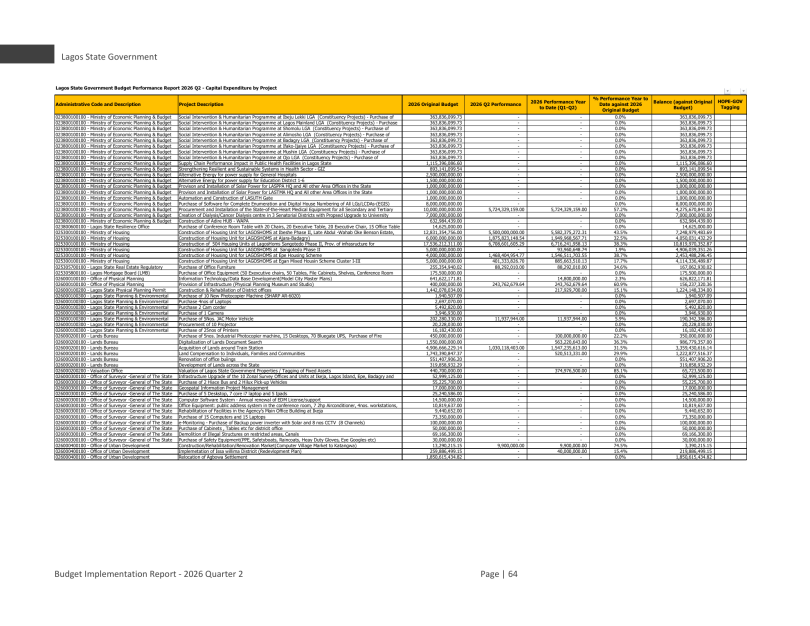
The Lagos State Government budgeted billions of naira for the creation of dialysis and cancer treatment centres, medical equipment, and other public projects but released zero funds for the project and several other projects during the first half of 2026, according to the state’s Budget Implementation Report.
The report, covering the second quarter of 2026 and tracking performance from January to June, listed ₦7 billion for the creation of dialysis/cancer dialysis centres in three senatorial districts, with a proposed upgrade to a university teaching hospital.
However, the expenditure column showed no spending against the project as of June 30, 2026.
The same report listed another ₦450 million for the purchase of equipment for the State Cancer Control programme, also with zero expenditure recorded during the period.
The figures raise questions about the pace of the state government’s planned investment in specialist healthcare at a time when cancer patients and people living with kidney failure in the state face substantial financial pressure, while access to specialised treatment remains uneven.
On page 64 of the Lagos State Government Budget Performance Report for the second quarter of 2026, the project titled “Creation of Dialysis/Cancer Dialysis centre in 3 Senatorial Districts with Proposed Upgrade to University Teaching Hospital” was assigned an original budget of ₦7 billion.
The report recorded no second-quarter performance and no year-to-date expenditure against the allocation, leaving the full ₦7 billion as the balance against the original budget.
The report listed the project under the Ministry of Economic Planning and Budget, rather than directly under a health ministry or a named hospital.
It does not identify the three senatorial districts where the centres are expected to be established, provide implementation milestones or explain why no expenditure was recorded.
The state also budgeted ₦450 million for the purchase of 10 pieces of equipment for the State Cancer Control programme. The report similarly showed no spending against the project by June 30.
Another health-related project, the purchase of healthcare facilities equipment under the SOML P for R programme, carried an allocation of approximately ₦2.39 billion, with no expenditure recorded for the project during the period under review.
Cancer Patients Face High Costs, Treatment Barriers
The budget figures are particularly significant in a state where cancer patients face difficult choices between continuing treatment and finding the money to pay for it.
A study published in JCO Global Oncology, examining the distribution of cancer screening and treatment services in Lagos over a 10-year period, found that only about five per cent of health facilities assessed provided cancer screening or treatment services.
The researchers also highlighted gaps in the documentation of services and patient records, warning that incomplete information could undermine planning and resource allocation.
A separate study of patients attending tertiary oncology clinics in Lagos documented substantial out-of-pocket expenses for medicines, laboratory tests, consultations and transportation.
In the study, 90 per cent of respondents reported out-of-pocket spending on drugs or medicines, while 91.7 per cent reported such spending on laboratory tests. Relatives were a major source of financial support for many patients.
The pressure is not limited to diagnosis. Cancer treatment involves surgery, chemotherapy, radiotherapy, repeated laboratory tests, imaging and medicines to manage complications.
Patients who cannot afford these services experience delays or struggle to complete treatment.
In 2025, a Lagos cancer patient reportedly said she could not proceed with chemotherapy after being told it would cost ₦2.5 million.
That illustrated how the cost of treatment becomes a major obstacle even after a patient has received a diagnosis.
Although Lagos has specialist oncology services, including those at the Lagos University Teaching Hospital (LUTH) and the Lagos State University Teaching Hospital (LASUTH), the existence of such facilities does not eliminate the financial burden or guarantee that every patient obtains timely treatment.
The proposed centres could potentially expand access if they are properly funded, equipped, staffed and made operational.
But the second-quarter budget report does not show expenditure against the ₦7 billion allocation for the proposed dialysis/cancer centres or the ₦450 million State Cancer Control equipment project.
The report does not explain whether other sources of funding were used or whether any services were delivered through existing facilities during the period.
Lagos’ Dialysis Infrastructure Has Faced Questions
The concerns extend to kidney care, where dialysis is often a recurring, life-sustaining treatment for people with kidney failure.
In December 2024, the Lagos State Cardiac and Renal Centre in Gbagada, commissioned in 2015 with 24 dialysis machines, reportedly remained in ruins.
It was reported that only three of the state’s 28 general hospitals operated dialysis units: General Hospital, Lagos; Gbagada General Hospital; and Alimosho General Hospital in Igando.
This shows why the implementation of new dialysis infrastructure matters. A budget allocation is not the same as a functioning centre as patients need accessible facilities with working machines, reliable electricity and water, trained personnel, consumables and affordable treatment.
The cost of dialysis can also be punishing for households. In March 2026, it was reported that sessions in many private healthcare facilities cost between ₦50,000 and ₦80,000, with patients often requiring two or three sessions each week.
At that frequency, treatment can consume a substantial share of a household’s income.
Although the Nigerian Government introduced a subsidised dialysis scheme at selected federal hospitals, the intervention does not by itself establish the availability or affordability of dialysis services in Lagos State-owned facilities.
The state’s proposed ₦7 billion investment therefore warrants close scrutiny, particularly regarding the locations, implementation timetable, procurement status and expected capacity of the three planned centres.
Other Projects Also Recorded Zero Expenditure
The same budget implementation report identified several other projects under the Office of the Surveyor-General with no expenditure recorded by the end of the first half of 2026.
They include ₦73.35 million for the purchase of 15 computers and 15 laptops, ₦100 million for backup power inverters with solar facilities and an eight-channel CCTV monitoring system, and ₦50 million for cabinets, tables and other furniture for district offices.
Others are ₦69.17 million for the demolition of illegal structures in restricted areas and canals, and ₦30 million for safety equipment, including personal protective equipment, safety boats, raincoats, heavy-duty gloves and goggles.
The report also listed approximately ₦1.85 billion for the relocation of Agbowa Settlement under the Office of Urban Development, with no fund release recorded for the project by June 30.