
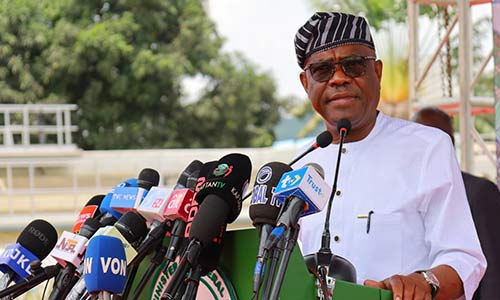
Nyesom Wike, minister of the Federal Capital Territory (FCT), says his promise to give each Abuja council chairman and councillor ₦10 million for delivering their respective wards for President Bola Tinubu in the 2027 general elections is a reward for political mobilisation and not an attempt to buy votes.
Wike made the clarification on Tuesday while speaking with journalists during an inspection of ongoing projects in Abuja, a day after announcing the financial incentive at a political stakeholders’ meeting in Kwali Area Council.
The minister had told councillors at the meeting, which attracted traditional rulers, political leaders and other stakeholders, to ensure that Tinubu secured victory in their respective wards in 2027, promising ₦10 million to each of them for meeting the target.
The announcement attracted criticism, with questions raised over whether offering public-facing political officeholders money in exchange for electoral results amounted to vote-buying.
However, Wike dismissed the allegations, arguing that there was a clear difference between rewarding political workers for their efforts and giving voters money in exchange for their ballots.
To explain his position, the minister compared the offer to a parent promising a child a house or a new car for graduating from university with a first-class degree.
He maintained that his message to the councillors was to work towards achieving a political objective rather than distribute money to voters.
“It is only trained journalists or reasonable persons who understand the difference between a reward and a bribe,” Wike said, according to the News Agency of Nigeria (NAN).
He added: “You tell your son, ‘I want a first class from you. Get a first class, and you get a house or a brand new car.’ Just go and work hard.
“That is what we are bringing. I didn’t say take this money and go and buy voters; I said go and work and show commitment.”
The former Rivers State governor further argued that vote-buying involved directly paying individuals to influence their choices at the polling booth, insisting that his offer did not fall into that category.
“Vote-buying is giving someone money to go and vote for a specific candidate,” he said.
Wike also questioned why financial incentives offered to political mobilisation teams attracted criticism when media organisations routinely received payments for political advertisements during election campaigns.
“Media houses collect millions for prime-time advertisement slots to let voters know what candidates offer, but when you tell your constituents or party workers you will reward their hard work, critics call it bribery,” he said.
The minister also addressed allegations that opposition parties were being denied equal access to public facilities for political campaigns.
He rejected claims of restrictions, challenging opposition politicians to identify locations where they had been prevented from holding rallies.
“Who is not allowing the opposition to campaign? I know they held a rally the other day in a state stadium,” Wike said.
He further referred to Rivers State, where he said he was unaware of any formal complaints about opposition parties being prevented from campaigning.
“In Rivers, I don’t think anybody has complained to you that we are not allowing them to campaign,” he added.
Wike urged opposition parties to make use of major stadiums and other available facilities to organise their activities and communicate their political programmes to voters.
“Let them go to the main stadiums, mobilise, and talk to the people,” he said.