
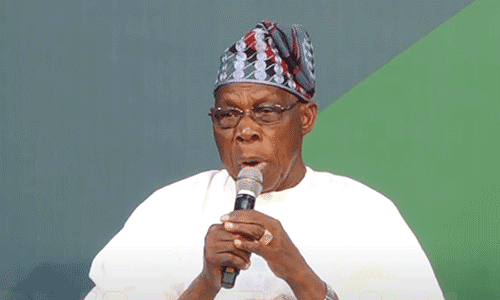
Former President Olusegun Obasanjo has revealed how he rejected an offer of political asylum from the United States despite warnings that he would be arrested upon returning to Nigeria, only to be subsequently detained and imprisoned under the military regime of the late General Sani Abacha.
Obasanjo said the American government offered him political asylum after receiving information that the Abacha administration had allegedly concluded plans to arrest him.
However, he turned down the offer because he believed he had committed no offence that would justify fleeing his country.
The former President made the disclosure while recounting his experiences under Abacha’s military government in a video published by BBC News Pidgin on Tuesday, November 10, 2026.
Obasanjo, who became Nigeria’s military Head of State on February 13, 1976, following the assassination of General Murtala Muhammed, handed over power to civilian President Shehu Shagari on October 1, 1979.
Explaining the circumstances surrounding his retirement from the military and subsequent decision to venture into agriculture, the 89-year-old former President said he had already attained the highest military rank and political office available to him by the age of 42.
He explained that having become a four-star general and military Head of State, he decided to concentrate on farming rather than continue pursuing a military career.
According to him, his agricultural activities were progressing successfully until his arrest under the Abacha administration.
“When I was leaving government as military head of state, there was I was leaving too early. I didn’t join the army to retire at the age of 42.
“Now I had to retire at the age of 42. At the age of 42, I had become a four-star general. There’s nothing else I can do in the army. I’ve become the military head of state. That’s the highest political office I could rise.
“So what can I do? I decided I would go into farming. It really was going well, and it went well until I was arrested,” Obasanjo recalled.
The former President alleged that Abacha had regarded him as a threat to his administration and had resolved to eliminate him to consolidate his control of the country.
Obasanjo said he was unaware of the alleged plan until the American ambassador in Nigeria contacted him while he was travelling and informed him that the United States government was prepared to grant him political asylum.
He explained that the offer was based on intelligence suggesting that he would be arrested if he returned to Nigeria.
“Abacha had decided that I must be liquidated; otherwise he would not be able to have his way. I didn’t know that.
“I was travelling and coming back, and the American ambassador in Nigeria called me and said his country had offered me political asylum because they knew that I would be arrested if I returned home.
“This was difficult for me. I don’t— I haven’t done anything. What do they want to arrest me for? Um, I don’t want political asylum,” he stated.
Despite the warning, Obasanjo said he decided to return to Nigeria, where his passport was seized upon his arrival.
He explained that he subsequently proceeded to his farm, unaware of the extent of the security arrangements allegedly put in place to apprehend him.
According to him, one of his security aides later informed him that government security operatives had surrounded the property.
Obasanjo recalled that a police officer dressed in civilian clothes approached him and conveyed a message that an Assistant Inspector-General of Police wanted him to report for questioning.
The former President said he initially rejected the invitation, insisting that the senior police officer should visit his farm if he wished to speak with him.
He eventually decided to drive himself to the police station, where the Assistant Inspector-General of Police informed him that he had received instructions to arrest him.
Obasanjo said he later realised that the decision to detain him was connected to Abacha’s alleged determination to prevent certain individuals from remaining free because he considered them threats to his government.
He also recalled the intervention of former United States President Jimmy Carter, who appealed to Abacha on his behalf.
According to Obasanjo, Carter’s intervention resulted in his transfer from confinement to house arrest, although the arrangement did not last.
The former President narrated that security operatives subsequently arrived at about 1 a.m. while he was playing squash and took him away to prison.
“I didn’t know that it was a decision of Abacha that some of us must not be kept free; otherwise, he would feel unsafe. I was put in a place.
“Then President Jimmy Carter came. He pleaded, and then they put me under house arrest. Then they came one day; I was playing squash at about 1 am.
“They came and said they were taking me away. And they took me away, and from there, I went to prison,” Obasanjo recounted.
Abacha ruled Nigeria from November 17, 1993, until his death on June 8, 1998.
Obasanjo was subsequently released following Abacha’s death and later contested the 1999 presidential election, which he won.
His victory marked his return to national leadership as Nigeria’s first elected President of the Fourth Republic, having previously served as military Head of State.
He served two consecutive terms as civilian President before leaving office on May 29, 2007.
Post Title: “I Rejected US Political Asylum Because I Committed No Offence” — Obasanjo Recounts Arrest, Imprisonment Under Abacha By Naijaonpoint.