
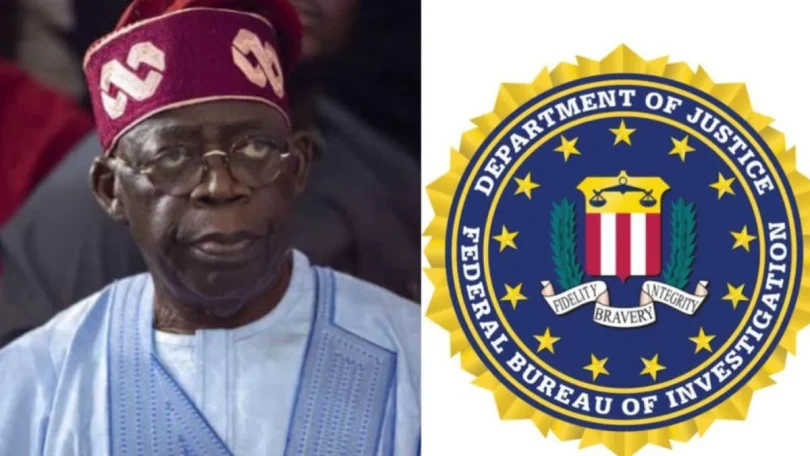
Reno Omokri has dismissed reports suggesting that the United States Federal Bureau of Investigation (FBI) has released criminal records against President Bola Ahmed Tinubu, saying the development has been wrongly presented.
Omokri said the fact that the FBI has records bearing Tinubu’s name does not automatically mean that the Nigerian president has a criminal record.
His comments came amid the recent controversy over documents relating to Tinubu’s dealings with US authorities in the 1990s.
The controversy intensified after the FBI submitted records connected to Tinubu to Judge Beryl Howell of the US District Court for the District of Columbia on August 28, 2026.
However, the documents were not released publicly.
The FBI submitted the records under seal and for the judge’s private review. The development followed a long-running Freedom of Information Act case involving American transparency campaigner Aaron Greenspan, who has been seeking access to records relating to Tinubu.
Omokri, a former aide to ex-President Goodluck Jonathan and Nigeria’s ambassador-designate to Mexico, Honduras, Guatemala and Nicaragua, reacted to the development in a post on Monday.
He challenged the description of the material as “criminal records”, arguing that such a description could create a false impression about what the documents contain.
According to him, government agencies in the United States keep large volumes of information on individuals for different purposes.
Such records, he said, may include information collected during immigration, visa processing and security checks.
He argued that the existence of such information in an FBI database should not be treated as proof that the individual committed a crime.
US court records previously made public have shown that about $460,000 connected to Tinubu was forfeited to the US government in 1993.
Tinubu has denied wrongdoing and has not been convicted of a criminal offence arising from the matter.
The latest FBI development is also not a public release of the records.
The bureau delivered the documents to Judge Howell after being directed to comply with proceedings arising from a FOIA request.
The judge is expected to examine the material and determine what information, if any, can eventually be made public.
The documents were submitted privately to the court rather than directly to Greenspan or members of the public.
This distinction is important because reports that the FBI has “released” Tinubu’s criminal records could suggest that the documents are already available for public inspection. They are not.
Omokri therefore urged Nigerians to make a distinction between an official record and a criminal conviction or finding.
He also brought back an earlier episode involving the Nigerian government and the US Embassy in 2003.
According to Omokri, the matter goes back to February 2003, when Tinubu was serving as governor of Lagos State.
At the time, the political atmosphere between the Lagos State governor and the administration of former President Olusegun Obasanjo was tense.
Omokri said the then Inspector-General of Police, Tafa Balogun, wrote to the US Embassy seeking information about whether the FBI had criminal records concerning Tinubu.
He claimed the American authorities responded the following day.
According to Omokri, the response indicated that checks conducted through the FBI’s National Crime Information Center did not return criminal arrest records, wants or warrants for Tinubu.
He said the correspondence can be independently verified through the US Embassy in Nigeria.
The issue has previously featured in arguments surrounding Tinubu’s eligibility and his past dealings in the United States.
A 2003 correspondence cited in earlier public discussions stated that a records check had produced negative results for criminal arrest records, wants or warrants relating to Tinubu.
The document has been referenced by Tinubu’s supporters over the years in response to allegations about his past.
Omokri also referred to his own visit to Chicago in September 2022.
He said he travelled to the United States while Tinubu was preparing to contest the 2023 presidential election in order to investigate questions surrounding the former Lagos governor’s academic and other records.
Omokri maintained that his findings at the time informed his current position.
He said the information he obtained did not establish that Tinubu had a criminal record in the United States, Nigeria or any other country.
“This was consistent with my findings when I visited Chicago in 2022, as a member of the opposition, to establish the truth about then-Presidential candidate Bola Tinubu’s academic and other records,” he said.
Greenspan filed his FOIA request in 2023 and has continued to pursue the matter through the US courts. Nigerian journalist David Hundeyin has also been involved in efforts to obtain the records.
In April 2025, Judge Howell ordered the FBI and the Drug Enforcement Administration to process records connected to requests concerning Tinubu after rejecting the agencies’ earlier use of so-called “Glomar” responses, which allowed them to refuse to confirm or deny the existence of certain records.
The current stage of the case, however, concerns what can legally be disclosed from the records.
The FBI has argued that portions of the material are protected under US law. Issues raised include personal privacy, law-enforcement information, investigative methods and information relating to the safety of individuals.
Tinubu’s legal team has also opposed the public release of the documents, arguing that disclosure could infringe on his privacy rights.