
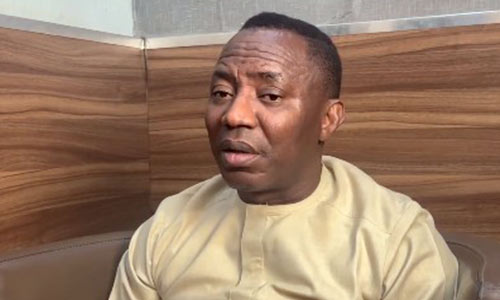
Human rights activist and former presidential candidate of the African Action Congress, Omoyele Sowore, has alleged that President Bola Tinubu is receiving medical treatment in France rather than merely observing the working vacation announced by the Presidency, while also linking the President’s absence from the 81st United Nations General Assembly in New York to what he described as fear of possible legal difficulties in the United States.
Sowore made the claims in a post on X on Sunday, September 20, 2026, following the Presidency’s announcement that Vice President Kashim Shettima would represent Tinubu and lead Nigeria’s delegation to UNGA81.
The Presidency had earlier on Sunday confirmed that Shettima would head the Nigerian delegation to New York and deliver the country’s national statement during the General Debate.
According to a statement by Stanley Nkwocha, Senior Special Assistant to the President on Media and Communications in the Office of the Vice President, Shettima will also participate in high-level meetings and bilateral engagements during the UN gathering.
Reacting to the development, Sowore alleged that Tinubu’s decision not to personally attend UNGA81 was connected to what he described as the President’s “mortal fear” that United States authorities could order his arrest in connection with a decades-old U.S. forfeiture case.
“There is something inherently wrong with Nigeria,” Sowore wrote.
He further alleged that Tinubu was receiving treatment in France and that the administration would subsequently present his return to Nigeria as the conclusion of an ordinary vacation.
“Tinubu is not on vacation; he is receiving treatment in France, and they will package him to return as though nothing happened,” Sowore alleged.
Sowore also compared what he described as secrecy surrounding the President’s trip with controversies that accompanied overseas medical treatment by former Nigerian presidents.
The activist did not provide medical records or other independently verifiable evidence in the post establishing that Tinubu is currently undergoing medical treatment in France.
The Presidency, for its part, has publicly described Tinubu’s European trip as part of his annual leave.
In an August 30 statement, presidential spokesman Bayo Onanuga announced that Tinubu was departing Abuja for Europe to begin a three-week vacation as part of his annual leave, with London identified as his first destination.
The Presidency said the period would constitute a “working vacation” and that Tinubu was expected to return to Nigeria at its conclusion.
On September 18, the State House announced that French President Emmanuel Macron had received Tinubu for a private dinner at the Élysée Palace, describing the meeting as reflecting the relationship between Nigeria and France and efforts to strengthen bilateral cooperation.
On September 18, the State House announced that French President Emmanuel Macron had received Tinubu for a private dinner at the Élysée Palace, describing the meeting as reflecting the relationship between Nigeria and France and efforts to strengthen bilateral cooperation.
The same day, the Presidency said Tinubu, “as part of his working vacation,” held talks in Paris with businessman Vincent Bolloré and executives of the Bolloré Group on expanding investments in Nigeria’s creative and digital economy.
Neither of those official statements said the President was receiving medical treatment.
Sowore’s second allegation concerns Tinubu’s historical encounter with United States authorities.
While Sowore described the matter as Tinubu’s “past drug-dealing case,” available court records require a more qualified description.
Authentic U.S. court documents relate to a 1993 civil forfeiture case in which Tinubu reached a settlement with the United States government and agreed to the forfeiture of $460,000 from accounts held in the United States.