
The latest development follows months of consultations involving the Presidency, the National Assembly and top security officials aimed at overhauling the country’s security structure to better address emerging threats.
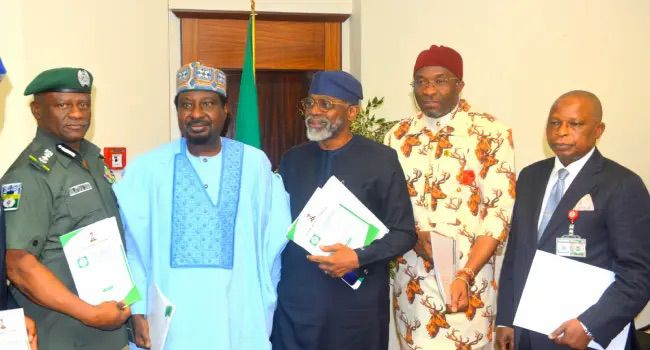
Speaking with State House correspondents after a consultative meeting on state police held at the Presidential Villa in Abuja on Thursday, Chief of Staff to the President, Femi Gbajabiamila, said significant progress had been recorded toward achieving the objective.
According to a statement issued by the Special Adviser to the President on Information and Strategy, Bayo Onanuga, discussions on the proposed framework commenced several months ago following a directive from President Bola Tinubu.
“We started deliberations in the last three or four months on how to go about the establishment of state police as directed by Mr President.
“Establishing state police is not something that you do with the snap of the fingers. There is a lot involved in terms of constitution and legalities, and thank God, we have now gained a lot of traction.
“Hopefully, the amendment will come shortly, and the details of the amendment will come after that,” he said.
Gbajabiamila explained that the current focus is on securing the necessary constitutional amendments before moving on to the enactment of supporting legislation.
“Right now, what we are looking at is the constitutional amendment itself, and then the enabling law would follow thereafter. That is what we have been deliberating on in the last couple of hours,” he added.
He noted that support for state police has expanded across the country, with discussions now centred less on whether it should exist and more on how it should be structured and implemented effectively.
The Chief of Staff also revealed that President Tinubu, who has consistently advocated for state police, would be presented with a detailed report outlining the outcome of the consultations.
Among those present at the meeting were Deputy Senate President Jibrin Barau, Deputy Speaker of the House of Representatives Benjamin Kalu, Inspector-General of Police Tunji Disu and other senior government officials.
The consultation is part of the Federal Government’s broader efforts to develop a practical framework for state policing. Advocates of the initiative argue that decentralising policing would strengthen grassroots intelligence gathering, improve community security and enable quicker responses to security threats.
Nigeria’s policing system is currently managed centrally through the Nigeria Police Force, but worsening insecurity in several parts of the country has renewed calls for a more localised approach.
President Tinubu had previously described state police as an inevitable solution to the country’s security challenges and urged lawmakers to accelerate legislative action on related proposals.
Supporters believe the system would enhance local intelligence networks and improve crime prevention efforts, while critics have expressed concerns over possible political influence by governors, funding challenges and the potential for ethnic or communal tensions.
The renewed push comes amid growing public concern over insecurity and frequent abductions across the country. One of the most recent incidents occurred on May 15 in Oriire Local Government Area of Oyo State, where armed attackers stormed three schools and abducted 39 pupils and seven teachers, sparking widespread outrage, protests and an indefinite strike by teachers in the state.