
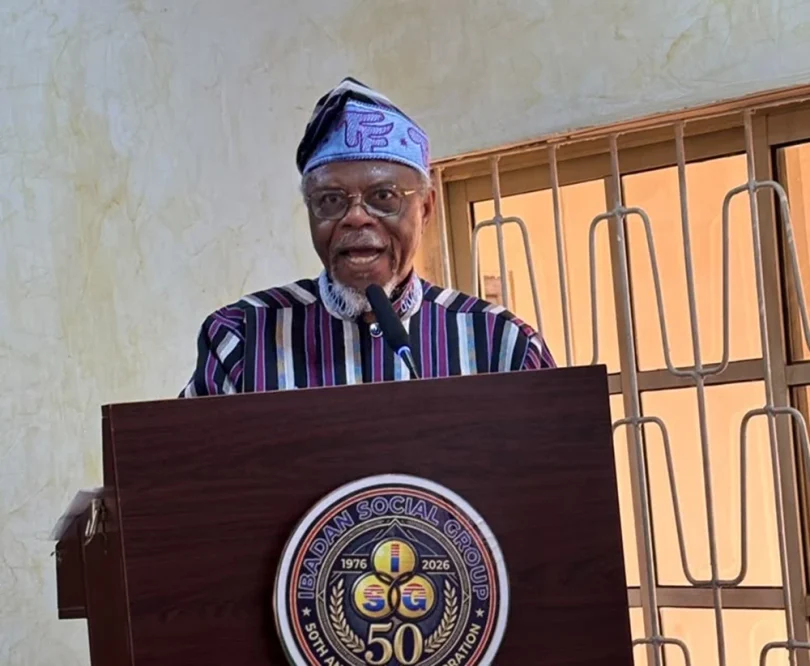
Eminent historian, Professor Toyin Falola, has called on Nigerian social clubs and other voluntary associations to deploy their collective expertise, institutional credibility and professional networks to address public concerns, arguing that civil society institutions have an important role to play in shaping the intellectual and civic life of their communities.
Falola said social clubs should move beyond activities centred exclusively on members’ social interests and deliberately contribute to discussions on issues affecting their cities, including by bringing together professionals from different disciplines to examine public problems and generate informed perspectives.
He made the call in his lecture, “Globalisation and Social Clubs,” delivered at the Ibadan Social Group’s Golden Jubilee anniversary at the ISG Club House, Iyaganku GRA, Ibadan, on Saturday, October 10, 2026.
The lecture examined the place of social clubs in a globalised society, the challenges confronting voluntary associations and the need for such institutions to preserve their relevance through stronger community engagement, intergenerational relationships and effective governance.
Falola argued that the importance of social clubs went beyond recreation, entertainment and professional networking. In his view, they were part of the social infrastructure through which communities developed trust, exchanged knowledge, preserved institutional memory and coordinated collective action.
He maintained that although governments and markets perform indispensable functions, neither could independently provide all the relationships and forms of social trust required for a cohesive society.
“The voluntary association, the club, the guild, the society, and the confraternity are all examples of institutions that fall into this category,” he said, describing them as integral to the structures that sustain communal life.
He added that such organisations should not be dismissed as peripheral to development because they could help establish trust among individuals, transmit knowledge across generations and sustain the social fabric.
According to him, “Markets do a fantastic job of distributing resources. Governments are skilled at making things stick. Neither is adept at the diffuse, non-transactional, slowly acquired social trust on which communal existence eventually rests. That is the work of civil society.”
Falola described the social club as one of the oldest and most successful vehicles of civil society, arguing that its ability to cultivate relationships over time gave it a distinctive role in a society increasingly shaped by individual competition and digital interaction.
He said the networks created within voluntary associations could enable people to accomplish tasks beyond the reach of individual effort or ordinary market transactions. For that reason, he argued, the contribution of social clubs should be assessed not only by the benefits they provide members but also by their capacity to support the wider community.
“An institution that produces social capital is not a luxury. It is infrastructure, as fundamental to the running of a society as its roads or its hospitals, and far more difficult to reconstruct once destroyed,” he said.
Social clubs should contribute to the life of their cities
Applying this argument to the future of the Ibadan Social Group, Falola urged the organisation to use its collective intellectual resources and institutional standing to engage more deliberately with issues affecting Ibadan.
He said the organisation could bring together professionals whose areas of expertise complement one another to discuss public concerns, offer informed perspectives and facilitate conversations that might not otherwise occur.
“What I am proposing is more basic and in some respects more difficult: that the institution resolve, consciously and clearly, to employ its collective intellect, its social capital, and its institutional credibility in meaningful ways with the life of Ibadan as a city,” he said.
He called on the group to develop reasoned opinions on matters of concern to the community and create opportunities for people with different professional backgrounds to contribute their knowledge to public discussions.
“To develop reasoned opinions on matters of actual concern to the community. To convene talks that are not taking place in other institutional locations,” he said, outlining the kind of civic role he envisaged for the organisation.
Falola specifically proposed that social clubs should provide platforms where professionals could pool their knowledge to illuminate issues that no single discipline could adequately address on its own.
“To gather around a dinner table or in a lecture hall the types of individuals, doctors and economists, attorneys and engineers, entrepreneurs and professors, whose pooled expertise might shed light on a public issue in ways that no single discipline ever could,” he said.
He argued that the value of such engagement lay in the ability to connect knowledge across professional boundaries and make it available for a wider understanding of community challenges.
For him, a social club that brings together people with varied experiences and expertise should be able to contribute more than social interaction among its members. It should also create opportunities for informed discussion and constructive engagement with the society in which it operates.
Falola stressed that the proposed civic involvement did not mean that the Ibadan Social Group should become a political party or routinely take partisan positions on disputed electoral questions.
He stated explicitly that he was not recommending that the club become a political organisation or adopt party positions on contestable election issues. Rather, he advocated a broader form of civic participation through public discussions, intellectual engagement and the responsible use of professional knowledge.
The distinction, he suggested, was between partisan political activity and the responsibility of a civic institution to contribute to the understanding of issues affecting its community.
Avoiding controversy could make institutions irrelevant
Falola acknowledged that a more active public role could introduce disagreements into social clubs, particularly because members might hold different views on issues affecting their city or country.
However, he warned that an excessive desire to preserve conviviality could prevent an organisation from engaging with the very issues that matter most to the people around it.
He said some clubs risked creating environments in which members were willing to discuss almost anything except subjects about which people felt strongly.
“Clubs that have attempted to insulate themselves from this discomfort by refusing to talk about anything that is really controversial tend to have a certain atmosphere: a roomful of brilliant people having a very lengthy discussion that carefully skirts around any topic anybody cares about profoundly,” he said.
Falola described such an environment as one in which an organisation could gradually lose its relevance while retaining the outward appearance of vitality.
“That’s not a pleasant environment. It is one dying gracefully,” he added.
He argued that institutions that wished to remain meaningful in their communities had to accept that serious engagement could sometimes generate disagreement among members. The objective, he suggested, should not be to eliminate every difference of opinion but to create an environment where important issues could be examined thoughtfully.
“The alternative is to accept that an institution that intends to matter, in its city and in its time, will sometimes have to take positions that not everyone agrees with,” he said.
Falola further maintained that an organisation’s willingness to expose its views to public scrutiny was part of the process through which it could build credibility.
He argued that the capacity to acknowledge the possibility of error was important to institutional trustworthiness over time, particularly where organisations sought to contribute to public debate.
For social clubs, therefore, avoiding every potentially contentious subject might preserve temporary harmony but weaken their ability to contribute meaningfully to community life.
Professional associations must move beyond internal interests
Falola’s argument also challenged the perception that social clubs primarily serve the comfort and interests of their members. While acknowledging the importance of internal relationships, he maintained that the knowledge and trust developed within these organisations could produce benefits extending beyond their membership.
He explained that social clubs could facilitate professional connections, mentoring, business opportunities and civic activity. These outcomes, he argued, demonstrate why the institutions should be understood as part of the wider infrastructure of society.
At the same time, he acknowledged the criticism that some social clubs were associated with privilege and exclusion in a country marked by substantial inequality.
“Some clubs have, at times, earned the criticism by exclusions, through indifference to the community surrounding them, through an institutional stance that signals entitlement rather than accountability,” he said.
He maintained, however, that such shortcomings should encourage reform and stronger public engagement rather than lead to the wholesale dismissal of voluntary associations.
For Falola, the challenge is to ensure that professional networks become channels for creating opportunities and strengthening civic life, rather than closed systems concerned only with the interests of their members.
He urged social clubs to consider how their institutional resources could be used to contribute to the development of their cities and create a public presence that people would recognise as valuable.
In outlining his long-term vision for the Ibadan Social Group, he said the organisation should aspire to become an institution whose absence would be felt in the city.
“To be the type of institution that would be missed if it left Ibadan,” he said.
That ambition, according to the lecture, would require the organisation to maintain meaningful links with its community, convene serious discussions and deploy the expertise available among its members to address shared concerns.
Governance and long-term relevance
Falola also linked the future of social clubs to the quality of their internal governance, arguing that institutions could not make lasting contributions to society without credible leadership, sound succession planning and financial openness.
He said organisations seeking to remain relevant across generations must be prepared to examine their membership practices, programmes and relationship with the wider community.
His proposed fifty-year vision for the Ibadan Social Group included a deliberate approach to intergenerational engagement, the preservation of institutional memory, meaningful civic involvement and governance reform.
On leadership, he argued that institutions needed leaders committed to serving the organisation rather than using it primarily for personal prestige. He also called for succession planning that genuinely prepares future leaders and financial transparency capable of building confidence among existing and prospective members.
These reforms, he suggested, would help ensure that social clubs could sustain their activities and public contributions despite changing economic conditions and social expectations.
In his closing remarks, he urged the organisation to participate actively in the city’s affairs and preserve the knowledge accumulated over its history.
“Create a place that people want to come to. Cultivate connections that endure. Participate in the city’s real life, its issues and its opportunities, not just its comforts. Know your past, maintain your documents. Bring in the young, but don’t lose what the institution has learnt of itself,” he said.
He argued that the survival of social clubs should not be understood simply as the continuation of old traditions. Their enduring value lies in their capacity to meet human needs that technological change and economic competition cannot eliminate.
“Globalisation did not make social clubs redundant,” Falola said in the lecture’s concluding passage. “They systematically tore down every other structure that might have done what it is they do, making them essential in a way they’ve never fully been before.”