
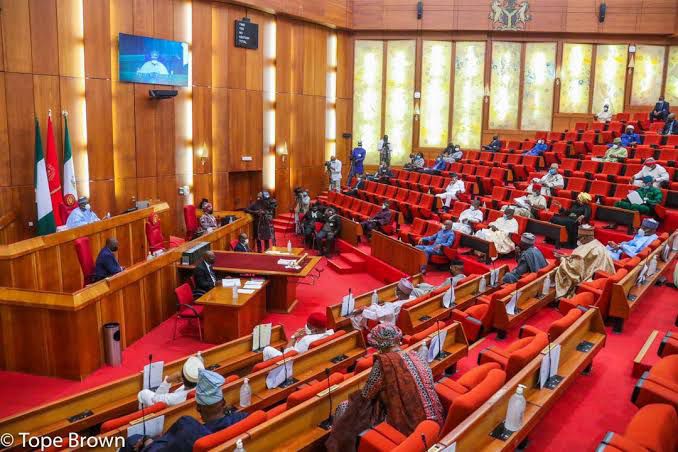
The Senate has confirmed the nomination of Joseph Tegbe as Minister of Power, with a firm pledge to tackle Nigeria’s recurring electricity challenges, especially grid collapses, within his first 90 days in office.
Speaking during his screening, Tegbe urged lawmakers to hold him accountable, assuring that his tenure would deliver visible improvements in the power sector within three months.
He said urgent reforms are needed to stabilise the national grid and address long-standing inefficiencies affecting electricity supply across the country.
He attributed some of the sector’s challenges to severe financial constraints, revealing that generation companies are struggling to pay for gas due to revenue shortfalls.
He added that the power sector is currently weighed down by debts estimated at about N6 trillion, warning that liquidity pressures are affecting operations across the value chain.
Tegbe explained that stabilising the grid would require strict operational discipline, improved real-time system management, and stronger frequency control and spinning reserves.
He noted that repeated grid collapses are not accidental but symptoms of deeper systemic failures that must be urgently addressed.
On tariff structure, the minister-designate said reforms toward cost-reflective pricing are necessary for sustainability, but stressed that vulnerable Nigerians must be protected to ensure fair access to electricity.
Drawing comparisons with the telecommunications sector, he said targeted interventions and incentives helped drive expansion and reliability, adding that similar strategies could be adopted in the power sector to improve performance and reduce system failures.
He also raised concerns over vandalism of power infrastructure, warning that such acts should be treated as a national security threat, and called for stronger protection of critical national assets.
He reaffirmed his commitment to comprehensive reforms aimed at improving revenue collection, enforcing discipline across the sector, and ensuring the long-term stability and sustainability of Nigeria’s power supply.
In his remarks, Senate President Godswill Akpabio urged the nominee to pay close attention to key concerns raised by lawmakers.
He highlighted the inadequacy of the transmission network, noting that while Nigeria can produce up to about 7,500 megawatts, the grid often struggles to sustain more than 4,500 megawatts without collapsing.
Akpabio also warned of entrenched interests within the system, including elements that benefit from ongoing maintenance cycles rather than long-term solutions, as well as stakeholders in the generator market who may resist improvements in public power supply.
He, however, expressed confidence in Tegbe’s capacity, describing him as well qualified and wishing him success.
Earlier, Senator Enyinnaya Abaribe drew attention to the structural imbalance across the power value chainpointing out that although Nigeria has an installed capacity of about 13.6 megawatts, actual generation remains between 4 and 5 megawatts.
He noted that transmission capacity stands at about 7.5 megawatts, while distribution falls below 4,000 megawatts, describing the mismatch as the central problem of the sector.
Abaribe further warned that the incoming minister would have to contend with powerful vested interests, including what he described as a “generator cabal,” as well as distribution companies that have failed to invest adequately in infrastructure.
He stressed the need to enforce compliance with licensing agreements and ensure expansion of distribution networks. He also called for effective coordination between federal and state governments following the new Power Act, which grants states greater authority in the sector.