
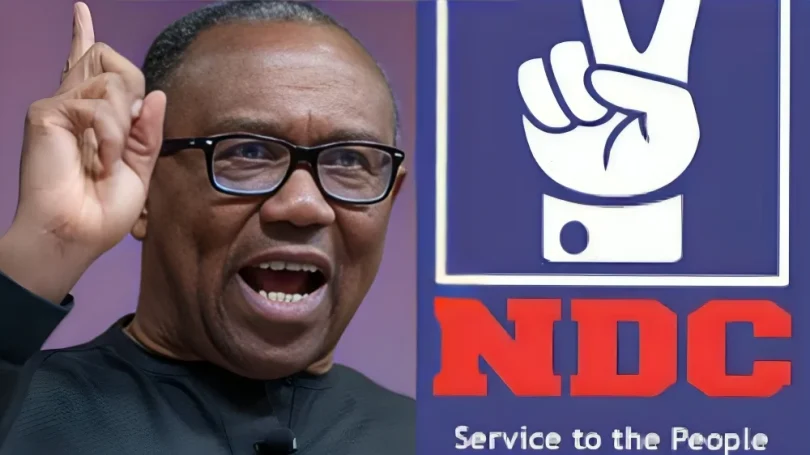
Barely months after the National Democratic Congress (NDC) emerged as a new opposition party with former Labour Party presidential candidate Peter Obi as its standard-bearer and Rabiu Kwankwaso as his running mate, the party has been drawn into a legal dispute that could shape its political future ahead of the 2027 general elections.
At the centre of the controversy is a lawsuit filed by the Peoples Movement Party (PMP), which alleges that the NDC’s logo closely resembles its registered emblem. While the dispute may appear to be a contest over political branding, it raises broader questions about the party’s preparedness to navigate the legal and institutional hurdles that often accompany the formation of new political parties in Nigeria.
ALSO READ: Nomination List: NDC may run into crisis
Interestingly, the case is a reminder that the journey to electoral relevance begins long before campaigns, with battles over registration, identity and legitimacy often proving just as critical as the contest for votes.
A familiar registration battle
The logo dispute is not the first legal challenge to confront the NDC.
In September 2025, the Independent National Electoral Commission (INEC) announced that 14 political associations had been pre-qualified for registration as political parties, but the NDC was excluded from the list.
The following month, eight of the 14 associations successfully uploaded the required documents for the next stage of the registration process. The NDC protested its exclusion, insisting that it had met the necessary requirements.
The party’s National Secretary, Ikenna Enekweizu, said its registration journey dated back to 2017 when it first applied for recognition alongside other political associations.
According to him, INEC declined the application at the time because the party’s logo was considered too similar to that of another registered political party.
The party’s National Leader, Senator Seriake Dickson, echoed that position, explaining that the registration process stalled after INEC suspended the registration of new political parties.
He said the application was revived when the commission resumed the exercise in 2025, but INEC again declined registration on the grounds that the party’s logo resembled that of the All Progressives Congress (APC).
Dickson maintained that despite the party’s willingness to adopt a different logo, INEC rejected its explanation and declined to allow the change.
The dispute eventually went before the courts.
On December 10, 2025, Justice Isah Dashen of the Federal High Court in Lokoja ordered INEC to register the NDC as a political party.
Following the judgment, INEC Chairman Joash Amupitan announced on February 5 the registration of two new political parties, including the NDC.
Another legal obstacle
Having overcome the registration hurdle, the party is once again before the courts, this time over allegations that its current logo infringes on that of the Peoples Movement Party (PMP).
Should the court uphold the PMP’s claims, the NDC could be compelled to redesign its logo, revise campaign materials, and embark on another rebranding exercise.
Although such a decision may not threaten the party’s existence, it could slow its efforts to build nationwide recognition at a crucial stage of its development.
If, however, the Appeal Court dismisses the suit, the NDC would gain legal certainty over one of its most important political identifiers and shift its focus to strengthening its structures ahead of the elections.
Whichever way the case goes, it reinforces the importance of legal compliance in party administration.
More than a logo
The dispute extends beyond the design of a political emblem.
The NDC must demonstrate that it possesses the organisational strength, internal discipline and national appeal required to compete effectively in Nigeria’s highly competitive political environment.
For a relatively new party, building structures across the federation, attracting credible candidates, mobilising grassroots support, and presenting clear policy alternatives remain more pressing challenges than winning a courtroom battle.
The logo litigation simply illustrates how procedural and legal issues can consume valuable time and resources if not resolved quickly.
Peter Obi’s biggest challenge
Peter Obi enters the 2027 race as one of Nigeria’s most recognisable opposition figures, having built significant support during the 2023 presidential election through the OBIdient Movement.
However, personal popularity alone has rarely been sufficient to secure electoral victory in Nigeria.
The NDC must transform that popularity into a functional political organisation with strong grassroots networks, effective mobilisation and nationwide acceptance.
Achieving that while simultaneously defending itself in court will test the party’s organisational capacity.
The road to 2027
Political parties are ultimately judged not by how they begin but by how they respond to challenges.
The lawsuit filed by the Peoples Movement Party is unlikely, on its own, to determine the NDC’s electoral fortunes in 2027.
However, it has become the party’s first significant institutional test since gaining registration.
How quickly the matter is resolved, and how effectively the party continues building its national structures despite the litigation, may provide the first real indication of whether the NDC can establish itself as a durable force in Nigeria’s political landscape ahead of the next general election.
Lawyers react
Lawyers are divided over the Federal High Court’s decision to set aside its earlier judgment directing the Independent National Electoral Commission to register the Nigeria Democratic Congress, with one side defending the ruling as a necessary safeguard for fair hearing and the other questioning its legal foundation.
Counsel for the PMP, Chikezie Ekeocha, defended his client’s application, arguing that the judgment affected the PMP’s rights despite the party not being joined in the original suit.
Ekeocha maintained that the dispute centred on ownership of the NDC’s proposed two-finger victory sign logo, which he claimed had earlier been submitted to INEC by the PMP. He said the NDC had acknowledged the dispute by requesting permission to submit a fresh logo but later approached the court relying on the same disputed symbol.
“They (NDC) had already acknowledged the dispute over the logo and even requested permission from INEC to submit a fresh one. But when they went to court, they relied on the same logo that had become the subject of dispute,” he told PUNCH.
He insisted the suit was not politically motivated but aimed at protecting the PMP’s legal rights after discovering that the judgment affected its registration process. According to him, the court rightly exercised its inherent powers after finding that material facts had been concealed and that the PMP was denied a fair hearing.
However, Senior Advocate of Nigeria, Jibrin Okutepa, faulted the decision, describing it as legally questionable and arguing that the court departed from settled legal principles in setting aside a judgment that had already been executed by INEC.
Okutepa questioned why the court reversed its December 2025 judgment after the electoral commission had complied with the order by registering the NDC.
“I have resisted the urge to comment on the ruling of Hon Mr Justice Dashen of the Federal High Court sitting in Lokoja on the NDC matter until I read the judgment.
“Having read the judgment, I am just wondering why the learned trial judge agreed to set aside the judgment His Lordship gave in December 2025, wherein INEC, the only Defendant in that case, was ordered to register NDC as a political party.
“That order was obeyed, and NDC registered as a political party,” Okutepa told Sahara Reporters.
The senior advocate also argued that the PMP was not a party to the original suit and contended that the trial court ought to have first determined whether the applicant deserved an extension of time before considering the request to set aside the judgment.
“Now, an association known as the Peace Movement Party (PMP) was never a party to that judgement. So when an application was filed on the 5th May 2026, the application had two prayers.
“Prayer one was for extension of time to apply to set aside the said judgment and an order setting aside the said judgment.
“The learned trial judge in the ruling under review set out the two prayers in the motion in the ruling, but his lordship did not consider at all prayer one that deals with extension of time to apply to have the judgment set aside. Why? Nobody can hazard a guess. But was his lordship right? I do not think so.”
Okutepa maintained that Supreme Court authorities require an applicant seeking to set aside a judgment to first establish good reasons for failing to participate in the original proceedings and demonstrate a prima facie defence on the merits before the court can exercise its discretion. He also criticised the court for failing to explain why it overlooked the delay in bringing the application after INEC had already implemented the judgment.