
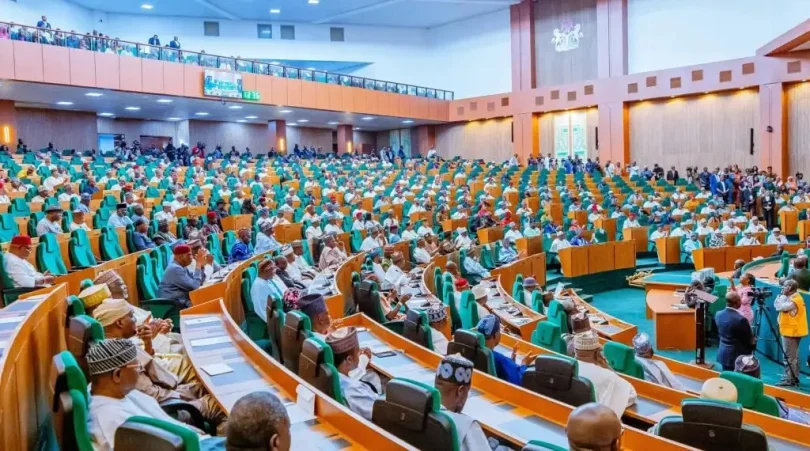
As Members of the House of Representatives are expected to resume the fourth legislative year on Tuesday, the lawmakers are set to commence debate on the general principles of the Executive Bill, which seeks to overhaul the nation’s policing architecture, empower state governors to appoint Commissioners of Police, subject to confirmation by State Houses of Assembly.
Other priority bills to be considered during the fourth legislative year, which marks the end of the 10th Assembly, include the Electoral Act (Amendment) Bill, with specific reference to independent candidacy; the Special Reserved Seats for Women Bill; and over 40 other Constitution amendment-related bills.
The proposed State Police Bill, passed by the Senate the penultimate week, further seeks to establish a dual policing structure, allowing states to run their own police services concurrently with the Federal Police.
Confirming this, Chairman of the House Committee on Rules and Business, Hon. Francis Waive, disclosed that the State Police Bill passed by the House before it embarked on a two-week recess, marking the end of the third legislative year, was strictly the outcome of the ongoing Constitution Review exercise.
Hon. Waive argued that the House embarked on an amendment to the 1999 Constitution (as amended) to allow for state police, while the Senate passed a proposed amendment to the Police Act, “which will now make provisions for the specific administration of how this (State Police) is going to run. The Constitution will simply allow State Police, which is what we have done in the House.
“What the President’s bill is saying does not have to do with constitutional amendment; it has to do with the administrative structure, how Police will now relate – Federal Police and State Police. That is the bill that the President sent, which we are also going to consider and, of course, there’s going to be a concurrence.”
Reacting to the statement credited to the Chairman of the Senate Committee on Media and Public Affairs, Senator Yemi Adaramodu, Waive argued that: “Usually, by law and by practice, whatever the Senate passes, the House must concur. And you are aware that since the Senate made their passage, we have not sat. So we’re looking forward to doing our own concurrence.”
Giving a breakdown of the third-year legislative activities of the 10th House spanning June 2025 to June 2026, Hon. Waive disclosed that a total of 484 bills were introduced, of which 31 were Executive Bills, 391 were sponsored by private members, and 62 were sent from the Senate to the House for concurrence, while 126 bills were passed during the period under review.
In addition, out of a total of 341 motions presented before the House, 192 motions were referred to Standing Committees, 28 motions were referred to ad hoc committees, 121 motions were presented as matters of urgent public importance, while 48 petitions were considered.
Speaking further on the progression of bills from June 2023 to 15 June 2026, Waive disclosed that, out of a total of 2,747 bills presented for First Reading, 57 bills were transmitted from the Executive arm of government, 95 bills were transmitted from the Senate for concurrence, while 2,595 were sponsored by private members. A total of 363 bills were passed during the first three years of the 10th House of Representatives.
For the first legislative year, 1,351 bills were introduced. Of these, 12 were introduced by the Executive arm of government, 1,336 were sponsored by private members, and three were transmitted by the Senate for concurrence, while 89 bills were passed during the period.
For the second session, 912 bills were introduced. Of these, 14 were introduced by the Executive arm of government, 868 were sponsored by private members, and 30 were transmitted by the Senate for concurrence, while 148 bills were passed.
For the third legislative session, 484 bills were introduced, of which 31 were transmitted by the Executive arm of government, 391 were sponsored by private members, and 62 were transmitted by the Senate for concurrence, while 126 bills were passed.
According to the available data on the progression of the 2,747 bills, 1,782 bills are awaiting Second Reading, 323 bills have been referred to Standing Committees, 185 bills are awaiting consideration, 363 bills have been passed, five bills were negatived, while 89 bills are to be consolidated.
While responding to a question on the number of bills assented to by the President, he disclosed that the “House Committee on Rules and Business is not in a position to give that figure. Those are issues that are usually handled by the Clerk to the National Assembly and the Presidency. They can give exact figures. Our job is limited to what happens in the House of Representatives.
“For the PAC reports, Public Accounts Committee reports, you will notice that this is the first Assembly where PAC reports have been presented, conceived, considered, and passed on the floor of the House since the return to democracy. It is something that the Tenth Assembly is very proud of. It is the first time that PAC reports have been presented, considered by a Committee of the Whole, and passed on the floor by the House of Representatives.
“We are very proud of this. What happens to laws that we make thereafter, what happens to resolutions we make after we have made them, is not in the House of Representatives. It is within the confines of the Legislature. It moves on to the Executive. But this Tenth Assembly has done a good job in this respect.
“Then, the number of bills awaiting concurrence. That also will be available from the Clerk to the National Assembly because when we finish our work, our Clerk transmits them to the Clerk of the Senate. What happens in between is known by the Clerk to the National Assembly.”
While clarifying the House’s position on the allegation raised by one of its members regarding the payment of millions of naira before the passage of a bill, Hon. Waive dismissed the allegation.
He said: “The Jigawa legislator alleged, in English you would say he alleged, that you pay to sponsor. But if you remember, he spoke in Hausa and then, when he was virtually confronted or interrogated, he said he was misinterpreted. I don’t understand Hausa. But he did confirm that he didn’t mean that you needed to bribe. What he was trying to say, from what he has since clarified, was that to sponsor a bill, you spend time, you spend resources. You take time to lobby.
“If you do a First Reading bill and you go home to sleep, it will end at First Reading. But you need to lobby your colleagues. You need to talk to them. You need to visit them. You need to lobby, that’s the word. But that’s not what he was referring to in the way it was interpreted. Because he spoke in Hausa. It was translated to mean that he said you bribe to get your… I have been here for quite some time. From the last Assembly until today, I have not encountered that,” he emphasised.
In his address, Chairman of the House Committee on Media and Public Affairs, Hon. Akin Rotimi, commended the House Committee on Rules and Business and its secretariat, headed by Mrs Florence Akerele, for providing impactful service over the past three legislative years.
He said, “We’ll give you highlights on the progress we’ve made in terms of our bills and our motions. I must say that this is also within the broader context of open governance and accountability.
“As you know, next week we’re going to be having the NASS Open Week. So this does not replace that session where we’ll also be giving a broader account of our stewardship that goes beyond just the bills and motions.
“So today we thought it was important, before we resume tomorrow, to come and engage with you.”
According to the House spokesman, the top priority bills passed by the House and, indeed, the National Assembly are the NELFUND Act, the Electoral Act, 2026, the State Police Bill, 2026, the National Minimum Wage Act, and the Appropriation Acts for the three fiscal years, among others.