
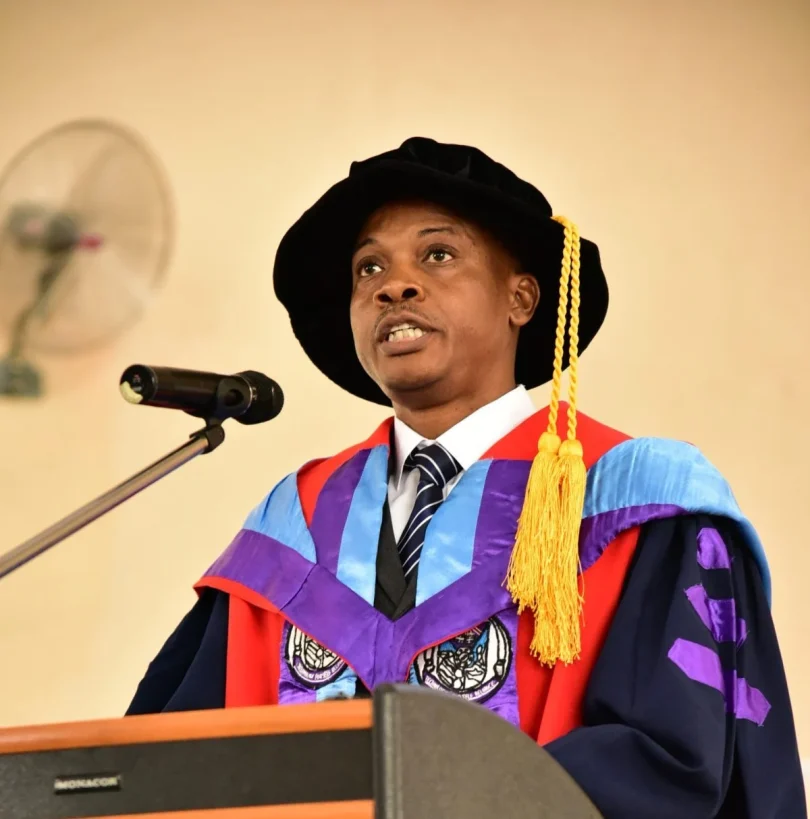
A Professor of Mechanical and Structural Materials Engineering at the Federal University of Technology, Akure, Kenneth Kanayo Alaneme, says that Nigeria must begin to see agricultural and industrial waste as valuable resources, and harness them to develop indigenous technologies, create wealth and drive industrial growth.
Delivering FUTA’s 206th Inaugural Lecture on Tuesday, September 8, 2026, Professor Alaneme noted that Nigeria’s agricultural and industrial activities generate substantial quantities of wastes and secondary materials that, rather than being discarded, could serve as feed stocks for the production of useful engineering materials.
According to him, agro-industrial wastes, industrial scraps and other secondary resources could be transformed into value-added products, reducing environmental pollution and pressure on virgin resources while creating opportunities for entrepreneurship, employment and industrial development.
He called for a deliberate shift from dependence on imported materials and technologies to the development of sustainable, locally sourced engineering solutions capable of addressing Nigeria’s peculiar challenges.
Speaking on the title , ‘Sustainable Materials Design: Prescription for Optimising Resource Efficiency, Functionality, and Structural Integrity’, Professor Alaneme drew from 26 years of research and scholarship to demonstrate how Nigeria could harness its abundant agricultural, industrial, mineral and human resources to develop sustainable materials and technologies.
He stressed that the challenge was not simply to dispose of waste, but to develop the scientific and technological capacity to convert waste into reliable resources and commercially valuable products. Such an approach, he said, could help Nigeria reduce its dependence on imported raw materials, strengthen local manufacturing and retain more value within the economy.
The lecturer observed that technological advancement throughout history had been closely linked to developments in materials technology. He, however, noted that Nigeria and other developing economies remained largely at the lower end of the global materials value chain, exporting primary resources while importing refined materials, finished products and technologies.
He identified dependence on imported materials, inadequate local manufacturing capacity, high production costs and weak standardisation as major constraints to the development of a competitive and reliable Nigerian engineering sector.
Against this background, Professor Alaneme stressed the need to explore locally available resources, including materials that are currently regarded as waste, as the basis for technological innovation. He noted that Nigeria’s agricultural residues, industrial by-products and other secondary resources could provide important feed stocks for developing engineering materials when subjected to appropriate scientific processing and quality control.
Professor Alaneme, however, cautioned that the use of waste as a raw material does not automatically make a product sustainable.
“Waste-derived materials could have variable composition, impurities, inconsistent supply and uncertain long-term performance. Such materials therefore require controlled processing, rigorous characterisation and quality assurance before large-scale industrial adoption,” he noted.
He said the country’s development must be driven by its ability to identify its own challenges, harness its available resources and develop technologies suited to its environment and economic realities.
ALSO READ: Terrorism financing: Enact law regulating NPOs, EFCC tasks Oyo govt
“Wastes should no longer be viewed merely as materials to be discarded, but as potential resources for creating new materials, products, businesses and jobs,” Alaneme said.
He challenged researchers, policymakers, universities and industry to move beyond viewing Nigeria’s wastes and raw materials as liabilities or commodities for export and instead build the knowledge, infrastructure and partnerships required to transform them into resources capable of powering innovation, industrialisation and economic transformation.
Professor Alaneme proposed the establishment of university–industry innovation clusters in areas with significant agricultural and industrial waste resources. Such clusters, he said, could bring universities, foundries, manufacturers and technology developers together to facilitate the movement of research discoveries from laboratories into commercial production.
He also urged universities to broaden their assessment of academic contributions by giving greater recognition to patents, prototypes, technology transfer and commercially deployed products alongside scholarly publications and research grants.
Summing up, Professor Alaneme stressed that Nigeria cannot import technology and expect imported solutions to develop the country, underscoring the need for sustained investment in research, innovation, local manufacturing and the development of Nigerian expertise.
Representing the Vice Chancellor, Professor Adenike Oladiji, the Deputy Vice Chancellor (Development), Professor Sunday Oluyamo, commended Professor Alaneme for the excellent delivery of the lecture and his highly cerebral scholarship.
Professor Oluyamo said the lecture “reinforced the imperative for Nigeria to move from a resource-exporting and technology-importing economy to one that creates value from its own resources through indigenous knowledge, research and innovation.”
He described Professor Alaneme as an astute researcher who had made an indelible mark on intellectual discourse and contributed immensely to research and development in Nigeria and the global scientific community.