
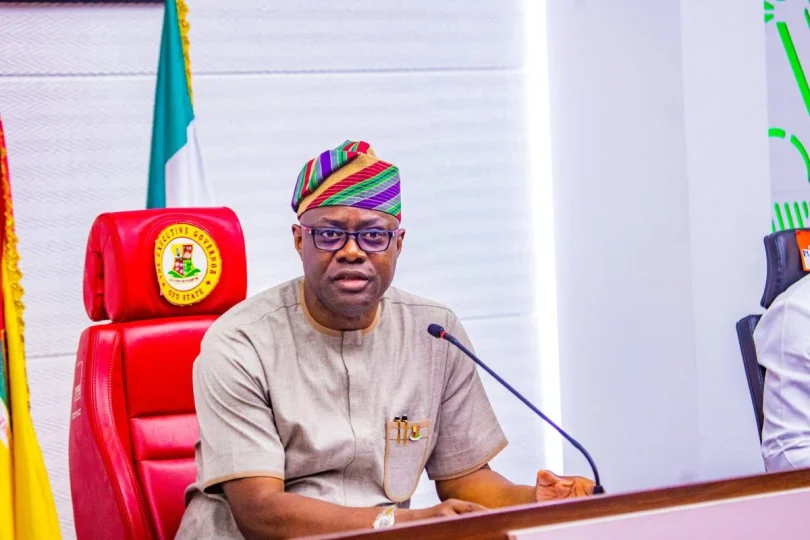
Oyo State Governor and presidential candidate of the Allied People’s Movement (APM), Seyi Makinde, has said Nigerians should not pay more for petroleum products because the Federal Government has failed to secure the country’s borders against smuggling.
Makinde stated this in his newsletter on Thursday while weighing in on the debate over fuel subsidy ahead of the 2027 elections.
He questioned the way Nigeria’s petroleum pricing debate has been presented, saying the government should focus on securing its borders instead of making Nigerians pay more for petrol.
“We should also reject the argument that Nigerians must pay more for petroleum products simply to eliminate the price difference that makes smuggling into neighbouring countries profitable,” Makinde said.
“Nigerians should not be made to bear the cost of government’s inability to secure its borders,” he added.
According to him, the debate should not be limited to whether fuel subsidy should return or remain removed.
“For years, the debate in Nigeria has largely been presented as a choice between subsidising petroleum products or allowing Nigerians to pay the full market price. I believe we are asking the wrong question. The more important question is: what is the right pricing framework for an oil-producing country like Nigeria?”
Makinde said Nigerians should have access to information on how the price of petrol is determined.
ALSO READ: Arise TV cuts short interview after Lere Olayinka flared up against Rufai Oseni’s questions
“What Nigerians deserve to know is the current pricing framework and the assumptions that determine what we pay at the pump: the crude price benchmark, refining costs and margins, exchange-rate assumptions, logistics and distribution costs, taxes and levies, and the other variables included in that calculation,” he said.
“These should be publicly accessible and sufficiently clear for Nigerians to interrogate the basis of the price they are paying and compare it with the alternatives,” he added.
The governor said the fuel pricing debate was part of a wider need to reform the systems and institutions responsible for Nigeria’s economic challenges.
“Over the years, we have changed governments, introduced new policies and promised ourselves new beginnings. Yet, for millions of Nigerians, the fundamental outcomes have remained largely the same,” he said.
“Too many of our people are still trapped in poverty. Too many families work hard without experiencing real progress. Too many young Nigerians are unable to see a clear path from education to opportunity.”
He said insecurity continued to affect lives and livelihoods, while some institutions were not working as effectively as they should.
“This tells us that Nigeria’s challenge is bigger than the individuals occupying public office at any particular time. We must address the systems, institutions and structures that continue to reproduce outcomes that do not serve the majority of our people.”
Makinde said his proposed “Reset Nigeria” movement would focus on addressing these structural problems.
“Reset Nigeria means being willing to interrogate the system itself,” he said.
“The petroleum question should therefore not simply be whether subsidy should return or remain removed. It should be whether the pricing system we are using is the right one for Nigeria and whether it allows Nigerians to derive a fair benefit from the natural resources they own.”
He said details of his alternative would be made public soon.
“In the coming weeks, we will put forward our alternative and allow Nigerians to judge it for themselves,” Makinde said.