
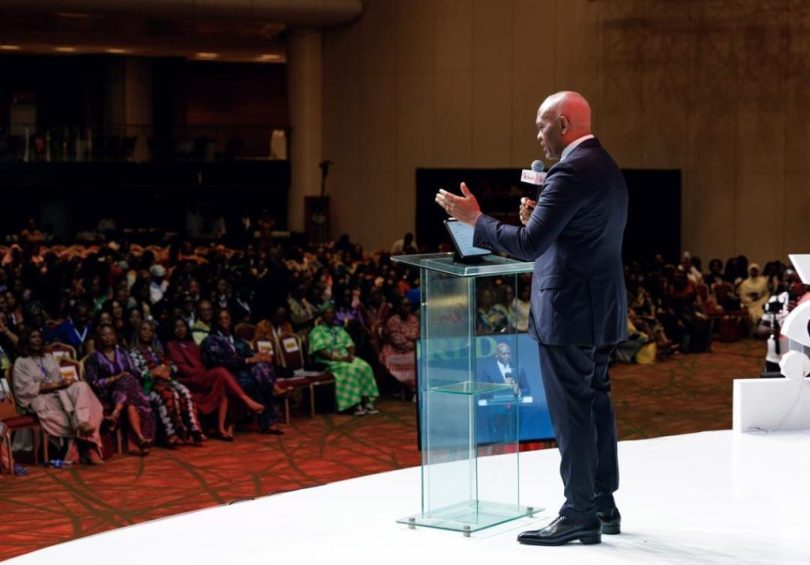
…..He calls for more investment in women, African businesses, electricity, home-grown capital
Group Chairman of Heirs Holdings, Transcorp Group and founder of the Tony Elumelu Foundation, Tony Elumelu, has declared that Africa’s greatest economic asset is its people, particularly its young population and women, urging African leaders and investors to prioritise human capital development, local investment and industrialisation.
Elumelu said the continent could become a major driver of global economic growth if it addressed critical challenges such as inadequate electricity, limited access to capital, weak institutions and low levels of intra-African trade.
He made the call on Friday while delivering the keynote address at the 25th annual conference of the Women in Management, Business and Public Service (WIMBIZ), held at Eko Hotel and Suites, Victoria Island, Lagos.
The conference was themed, “The Geography of Opportunity: Why the World Needs What Africa Has,” with the broader conference theme, “Rooted, Rising, Ready: Born in Africa, Built for the World.”
Elumelu described Africa’s growing working-age population, mineral resources, agricultural potential and expanding consumer market as significant economic opportunities that could position the continent as a global economic powerhouse by 2050.
He, however, warned that possessing abundant natural resources would not automatically translate into prosperity without deliberate investments in infrastructure, industrial capacity and human development.
Citing Singapore and South Korea as examples of countries that achieved economic transformation despite limited natural resources or the devastation of war, he argued that Africa must move beyond exporting raw materials and importing finished products.
According to him, reliable electricity remains fundamental to the continent’s industrialisation, noting that manufacturing, healthcare, education and emerging technologies, including artificial intelligence, depend on stable power supply and connectivity.
He also called for greater local processing of Africa’s natural resources, including lithium, cocoa and crude oil, rather than exporting them in their raw forms.
On financing, the businessman advocated increased mobilisation of African capital through pension funds, insurance companies, banks and private investors, arguing that the continent must increasingly finance its own development rather than depend heavily on foreign aid.
He maintained that investment and trade, rather than aid, would play a more sustainable role in driving Africa’s economic transformation.
Elumelu also called for stronger intra-African trade, observing that it was easier to transport goods from Lagos to Liverpool than from Lagos to Luanda.
He said less than one-fifth of Africa’s trade was conducted within the continent, urging governments to improve roads, railways, ports, payment systems and customs procedures to make cross-border commerce more efficient.
He noted that the African Continental Free Trade Area would remain largely a document unless businesses could effectively utilise it through functional infrastructure, predictable regulations and regional supply chains.
Speaking on inclusive economic growth, Elumelu emphasised the importance of women’s participation in business ownership and corporate leadership, insisting that no serious economy could afford to underutilise half of its human resources.
He disclosed that he and his wife, Dr Awele Elumelu, had invested more than $120 million in 24,633 young entrepreneurs across all 54 African countries through the Tony Elumelu Foundation over the past 15 years.
According to him, women account for 48 per cent of the beneficiaries, while the entrepreneurs supported by the foundation have collectively created more than 1.5 million jobs and generated over $4.2 billion in revenue.
He identified three beneficiaries of the foundation’s entrepreneurship programme, Princess Adeyinka Tekenah, Olamide Ayeni-Babajide and Nkem Okocha, as examples of women who had transformed modest seed funding into businesses with wider economic and social impact.
Tekenah, who received $5,000 in 2015, established Happy Coffee, sourcing coffee beans from women farmers in Taraba State and creating more than 1,000 jobs.
Similarly, Ayeni-Babajide used a $5,000 grant received in 2016 to establish a recycling business focused on converting waste tyres into useful products. Her business, he said, had recorded more than 20-fold revenue growth and trained 15,000 people, mostly women and girls.
Okocha also established Mama Moni, a financial technology social enterprise that provides access to credit for low-income women entrepreneurs in rural and urban communities.
Elumelu further disclosed that the foundation received 265,529 applications from young Africans for its entrepreneurship programme in 2026 but could only support 3,200 applicants.
He described the situation as evidence that Africa’s major challenge was not a shortage of entrepreneurial ideas or talent but inadequate access to funding.
The philanthropist also highlighted the contributions of women to leadership across his business group, citing his wife, Awele Elumelu, who holds leadership positions in several companies, including Avon HMO, Avon Medical, Heirs Insurance Brokers, Transcorp Hotels and Heirs Energies.
He also cited Owen Omogiafo, President and Group Chief Executive of Transcorp Group, whom he said became the first woman to lead the conglomerate, as well as Uzo Oshogwe, Managing Director and Chief Executive Officer of Transcorp Hotels.
Other female executives he recognised included Somachi Chris-Asoluka, Chief Executive Officer of the Tony Elumelu Foundation, and several women heading businesses within the Heirs Holdings and United Bank for Africa groups across the continent.
He urged business owners and corporate leaders to give qualified women greater opportunities to occupy leadership positions, arguing that their inclusion should be driven by competence and performance rather than treated merely as a social responsibility.
On institutional development, Elumelu said Africa must strengthen governance, protect investments, honour contracts and ensure predictable regulatory environments to attract and retain both local and foreign capital.
He urged policymakers to focus on creating conditions that encourage investors rather than spending excessive time seeking investments abroad.
He also challenged private sector operators to demonstrate transparency, accountability and ethical leadership, noting that strong institutions were built not only by governments but also by responsible businesses.
In his closing remarks, Elumelu urged African women to take advantage of emerging opportunities by building businesses, occupying boardroom positions, investing capital and mentoring younger generations.
He maintained that Africa’s economic future depended largely on the ability of its people to take ownership of the continent’s resources and development.
He concluded that the continent’s greatest wealth was not its oil, lithium or land, but its people, stressing that African prosperity must be driven by Africans themselves, including women who have the capacity to shape businesses, institutions and economies.