
Residents of Urukpa Ezimo Community in Udenu Local Government Area of Enugu State — the hometown of the state’s Deputy Governor, Mr Ifeanyi Ossai — have decried what they described as years of government neglect.
They revealed that they still depend on a single contaminated stream for drinking water despite repeated promises of potable water projects.
Photographic evidence SaharaReporters obtained on Tuesday from the community underscores the severe degradation of the ecosystem: in one of the pictures, the surface of the primary water pool is visibly clouded, dynamic with floating organic debris, and completely discolored by heavy silt runoff.
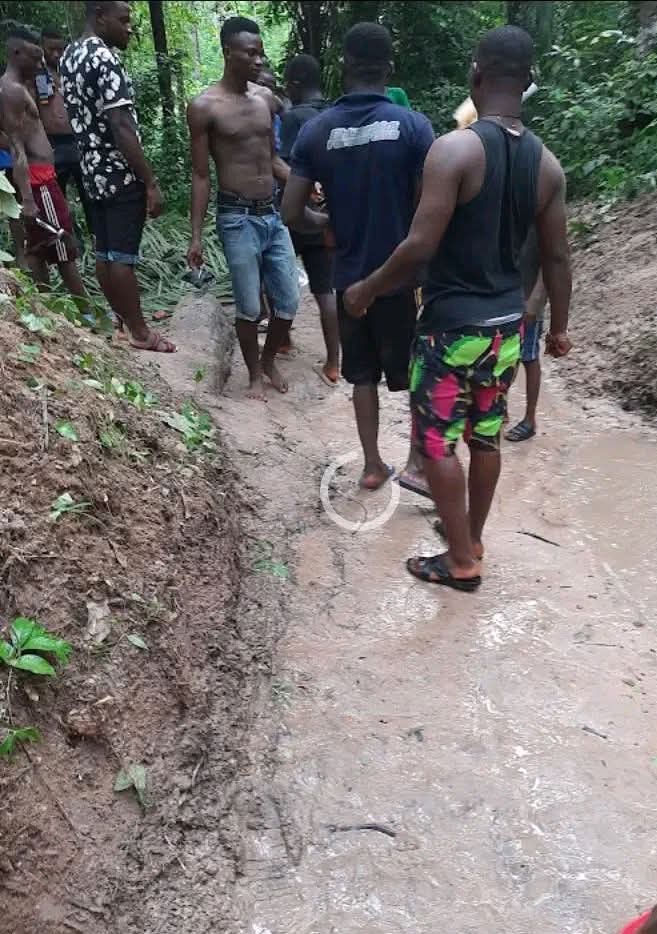
More pictures expose the physical reality on the ground as residents navigate a steep, slippery dirt trail thoroughly churned into deep mud by foot traffic and erosion to access a rudimentary concrete containment basin holding a heavily stagnant, brown, and muddy mixture that serves as the community’s primary source of domestic water collection.
However, residents told SaharaReporters that the community, which has produced the state’s number two citizen, has remained without a functional public water supply, forcing families to fetch water daily from Iyi Urukpa, a natural stream they said has served as the community’s only source of drinking water for generations.
According to them, the situation has deteriorated into a public health emergency as both humans and livestock now depend on the same water source.
Residents alleged that cattle frequently wade into the stream to drink, leaving behind animal waste, while erosion has washed mud, refuse, agricultural runoff and other contaminants into the water body.
“The same water our children drink is the same water where cattle drink and defecate,” one resident lamented.
“The stream has become polluted, but we have no alternative because every government promise to provide potable water has ended in disappointment.”
The residents accused successive administrations in Enugu State of repeatedly announcing water projects in the community during election periods without delivering sustainable infrastructure.
According to them, politicians often arrive with equipment, make public declarations about improving access to clean water and leave without completing the projects.
“They come with fanfare, cameras and promises. They tell us potable water is our right, but after the elections everything disappears and we are left to continue fetching water from the same stream,” another resident said.
A community leader, who requested anonymity for fear of victimisation, described the condition of Urukpa Ezimo as evidence of what he called the wider failure of rural infrastructure in Enugu State.
He alleged that beyond the lack of potable water, the community suffers from poor road access, limited employment opportunities and the absence of meaningful government empowerment programmes.
“We are trapped between a government that remembers us only during election campaigns and politicians who use intimidation to suppress the people’s will,” he alleged.
The community leader further claimed that political thugs were deployed during the recent by-election to intimidate residents.
“Do you know that during the recent by-election, thugs were deployed to thwart our collective will?” he asked.
An elderly resident questioned why a community associated with the state’s Deputy Governor had continued to experience what he described as basic infrastructural deprivation.
“If the hometown of the Deputy Governor cannot get a functional borehole, what hope is there for other rural communities?” he said.
The elder alleged that even the electricity currently enjoyed by the community was not a government project but was funded through community self-help efforts.
“Our fathers and many of us contributed money to bring electricity here, yet government officials claim the credit,” he said.
He also dismissed claims that government-installed solar streetlights had transformed the area, saying many parts of the community remained without functional lighting.
Residents expressed fears that continued dependence on the contaminated stream could expose children and other vulnerable persons to waterborne diseases.
They called on the Enugu State Government to urgently provide a sustainable potable water scheme instead of what they described as politically motivated interventions that rarely outlive election seasons.
According to them, access to clean water should not depend on political affiliation or proximity to those in power.
They noted that Agricultural Transformation Agenda Support Program Phase 1 (ATASP-1), is the only borehole constructed in the community but not accessible by the residents.
“It is managed by cronies and political family. Always locked unless instruction is provided,” a resident told SaharaReporters.
They urged Governor Peter Mbah’s administration to investigate the condition of the community and prioritise long-term investment in rural water infrastructure.
Efforts to obtain the reaction of the Enugu State Government were unsuccessful as of the time of filing ther report.