
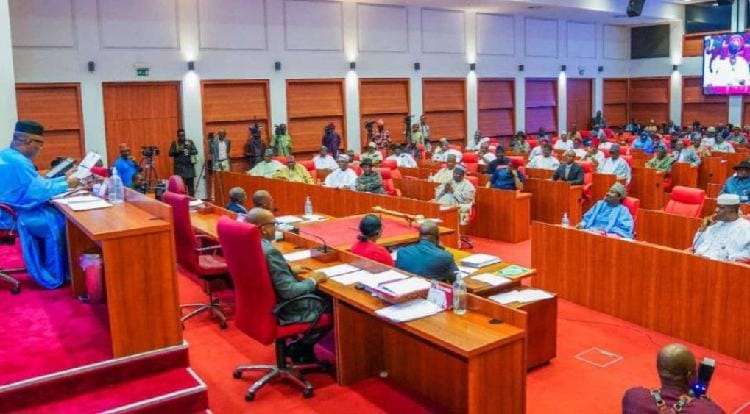
The Senate has warned that Nigeria may be forced to review its diplomatic relations with South Africa if renewed xenophobic attacks against Nigerians continue, as lawmakers condemned the latest wave of hostility directed at Nigerian citizens and businesses in the country.
The resolution followed a motion sponsored by Senator Asuquo Ekpeyong during Tuesday’s plenary, drawing attention to an alleged June 30, 2026 ultimatum issued against Nigerians residing in South Africa.
Presenting the motion, Ekpeyong described the reported ultimatum as a serious threat to the lives, safety and livelihoods of Nigerians living and conducting business in the Southern African nation.
He noted that the latest development had revived concerns over recurring xenophobic attacks that have, over the years, claimed the lives of several Nigerians, destroyed businesses and repeatedly strained diplomatic relations between Africa’s two largest economies.
The Senate observed that despite previous diplomatic interventions, attacks on foreign nationals, particularly Nigerians, have continued, necessitating stronger action by the Federal Government.
During the debate, lawmakers urged the Federal Government to immediately engage South African authorities and obtain concrete assurances on the safety of Nigerians while ensuring those responsible for attacks are identified, arrested and prosecuted.
Senator Salihu Mustapha (Kwara Central) called for a tougher diplomatic response, arguing that Nigeria could no longer tolerate repeated attacks on its citizens.
“We cannot continue to fold our arms while Nigerians are being killed and their businesses looted,” he said.
“This is the starting point for a very robust engagement. I suggest we sever all diplomatic relations with South Africa.”
However, the Senate adopted a more cautious position after former Senate Leader, Senator Yahaya Abdullahi, warned that the attacks might be linked to a broader political agenda aimed at destabilising the South African government.
Abdullahi recalled Nigeria’s historical role in supporting South Africa’s liberation struggle through the National Committee Against Apartheid and assistance to movements such as the African National Congress (ANC), the South West Africa People’s Organisation (SWAPO) and the Front for the Liberation of Mozambique (FRELIMO).
According to him, the current situation should not be viewed in isolation.
“This is a coordinated effort to destabilise the government of South Africa and to remove the ruling party, the ANC, from office.
“There is an attempt from the right wing of the white South Africans and now coming up from the black ones to delegitimise the government as quickly as possible. We should tread with great caution and carefully consider this conspiracy,” he said.
Abdullahi also expressed concern over the poor funding of Nigeria’s foreign missions, saying inadequate financial support had weakened the country’s ability to protect its citizens abroad.
Following extensive deliberations, the Senate adopted four resolutions aimed at strengthening Nigeria’s response to the recurring attacks.
The lawmakers directed the Federal Government, through the Ministry of Foreign Affairs and the Nigerian High Commission in South Africa, to obtain written assurances from the South African government guaranteeing the safety of Nigerians living in the country.
The Senate also demanded that the South African authorities arrest and prosecute all individuals responsible for attacks on Nigerians.
It further directed the Ministry of Foreign Affairs, the Nigerians in Diaspora Commission and the Nigerian High Commission in South Africa to compile a comprehensive database of Nigerians who had suffered death, injuries, unlawful detention, displacement or loss of property as a result of xenophobic attacks.
The Senate said the documentation would provide the basis for pursuing legal redress and compensation for affected Nigerians.
Lawmakers also urged the Federal Government to collaborate with the African Union and other affected African countries to establish an early warning and accountability mechanism capable of preventing future xenophobic attacks across the continent.
In addition, the Senate mandated its Committees on Foreign Affairs and Diaspora Affairs to review the implementation of its May 5, 2026 resolution on xenophobic attacks, alongside existing bilateral agreements between Nigeria and South Africa, and report back within two legislative weeks.
The debate became more heated when Senator Abdul Ningi proposed that President Bola Tinubu should begin the process of severing diplomatic relations with South Africa if attacks against Nigerians persist.
Similarly, Senator Adams Oshiomhole (Edo North) suggested that Nigeria should appropriate the profits of South African companies operating within the country, including financial institutions, and channel the proceeds towards compensating Nigerian victims of xenophobic attacks.
“We can’t allow our people to suffer while South African investments continue to generate profits here,” Oshiomhole said.
“The facts are self-evident. We don’t need further investigation.”
Deputy Senate President Jibrin Barau, who presided over the plenary, appealed for restraint, urging lawmakers to allow the relevant committee conclude its investigation before any far-reaching diplomatic decisions are taken.
“Let the Committee on Foreign Affairs investigate first,” Barau said.
“Nigeria leads Africa. We need to lead by example. Once we have well-informed facts, we can take action. If this report is not satisfactory to this chamber, then we take the line you were taking.”
Following Barau’s intervention, Ningi agreed to withdraw his proposal but insisted that the Senate records should reflect that the motion had been formally moved and seconded.
Lawmakers also reflected on Nigeria’s historic contribution to the anti-apartheid struggle, stressing that while the country remained committed to supporting democracy and stability in South Africa, it had an equally important responsibility to protect the lives, rights and economic interests of Nigerians living and working there.
The matter was subsequently referred to the Senate Committee on Foreign Affairs for further investigation, with a mandate to submit its report to the Senate within two weeks.