
President Bola Tinubu has reiterated his administration determined to replicate the infrastructural stride being recorded in the Federal Capital Territory (FCT) in every part of the country.
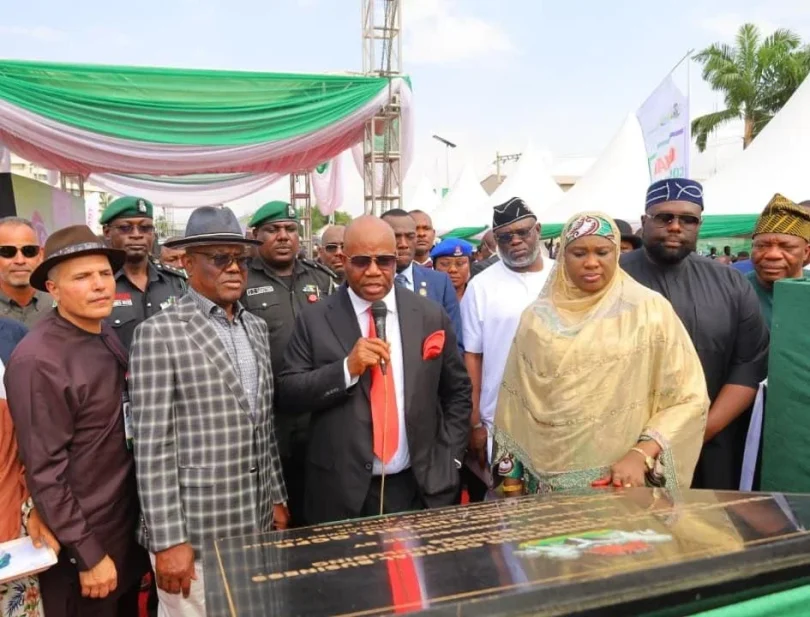
Tinubu made the promise in Abuja on Tuesday, while inaugurating the newly constructed Transitway N2, from Central Business District to Wuse District, with two bridges by the Federal Capital Territory Administration (FCTA).
The president, who was represented by the Senate President, Senator Godswill Akpabio, said that the move would ensure every part of the country is developed with roads, bridges, railways, and more.
This, according to him, will ensure that no region is left behind in the quest for a more developed and secured Nigeria.
Tinubu said that the Transitway project symbolised progress and a reflection of his administration’s Renewed Hope Agenda, committed to building infrastructure that serves the people, unlocks economic potentials, and supports sustainable growth and development.
“This infrastructure is a very important piece of the FCT’s Master Plan, designed to ease traffic flow, enhance connectivity, and improve urban mobility for millions of commuters, residents, and businesses alike in the territory.
“For years, traveling between Wuse and the Central Area meant navigating bottlenecks, losing productive man-hours, and enduring frustrating traffic gridlocks. Today, all that has changed.
“By cutting down travel times and bridging these two major districts, we are opening up new commercial corridors,” he said.
The president commended the FCT Minister, Mr Nyesom Wike, for the ongoing transformation of FCT in line with the Abuja Master Plan.
“You have contributed to something larger than a roadway; you have contributed to the future of our capital city and therefore given pride to Nigeria,” Tinubu said.
In his remarks, Wike described the Transitway as a critical road corridor that seamlessly connects Wuse with the Central Business District.
The minister attributed the successes being recorded in the delivery of infrastructure in FCT to the overwhelming support of Tinubu, particularly the removal of the Administration from the Treasury Single Account.
The minister said that on July 17, the last day of the projects’ inauguration, he would present what Tinubu had done for the people of the FCT and for Nigerians in the last three years.
“There are so many things Mr president has done that we have not made public so that Nigerians will know why we must continue to pray and support him,” he said.
He assured FCT residents that all roads that were not on the Google map would be captured to enable residents to navigate through the city with ease.
On her part, FCT Minister of State, Dr Mariya Mahmoud said that the newly completed corridor was a strategic investment in connectivity, economic growth and urban efficiency.
Mahmoud added that the road corridor also represents another fulfilled promise in the FCTA’s resolve to build a modern and inclusive capital city.
Earlier, Mr Richard Dauda, acting Executive Secretary, Federal Capital Development Authority, said that the project, the first major realisation of the construction of Transitways in Abuja city was awarded in October 2025.
Dauda described the Transitway as a mixed traffic corridor designed to carry both vehicular and rail traffic through the city, and particularly connecting the sector centers.
“The corridor is designed to support integrated mass transit infrastructure, including light rail in the median and dual carriage roads on each side of the rail to inter-modal terminals at intervals.
“It is part of the larger mass transit system, which aims to connect the city center with other districts and satellite towns through the inner and outer transit loops,” he said.
He added that the Transitway in the Abuja Master Plan was designed as a continuous transport corridor that radiates from the transportation centres, located in the Central Area, runs through districts like Garki and Wuse in Phase I of the city.
He said that the corridor also runs through the four phases of the city, dissecting sector centres on both the northern and southern development corridors forming a loop.
“In full development, the northern flank of the Transitway covers almost 52 kilometres (km) and the southern flank covers almost 64 km,” he added.