
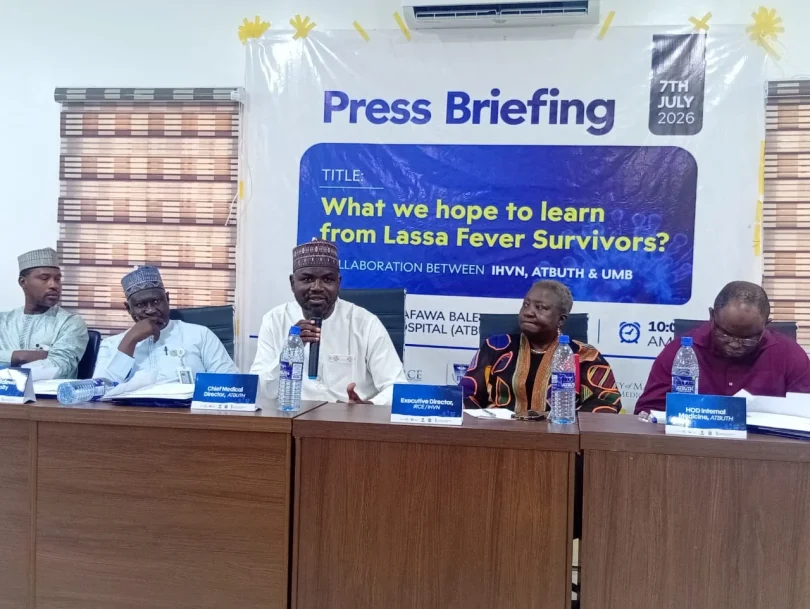
Growing concerns over Lassa fever infections in northern Nigeria have prompted the Institute of Human Virology Nigeria (IHVN) and the Abubakar Tafawa Balewa University Teaching Hospital (ATBUTH) to launch a major research project aimed at accelerating the development of a vaccine against the deadly disease.
The initiative, unveiled in Bauchi on Tuesday, will study people who survived Lassa fever to understand how their immune systems successfully fought the virus, with findings expected to support ongoing efforts to produce an effective vaccine.
The 12-month study, titled “Identification and Immunologic Characterization of Adult Lassa Fever Survivors in Nigeria,” is being carried out by IHVN’s International Research Centre of Excellence in collaboration with the Center for Vaccine Development and Global Health at the University of Maryland School of Medicine.
Addressing journalists during the launch, IHVN Executive Director and Nigerian Principal Investigator, Prof. Alash’le Abimiku, said researchers would also identify the five strains of the Lassa virus circulating in the region to ensure future vaccines are effective against variants affecting local communities.
She noted that while treatment exists for managing the disease, there is still no approved vaccine, making scientific research crucial to reducing the burden of Lassa fever.
According to her, studying survivors will provide valuable insights into the immune responses that protect against the virus, generating evidence that could shape vaccine development and future clinical trials.
Abimiku said the study would also establish a repository of clinical data and biological samples to support future research while leveraging existing laboratory facilities at ATBUTH, IHVN’s accredited laboratory in Jos, its regional biorepository in Abuja, and the hospital’s Molecular Genetics and Infectious Disease Research Laboratory.
She urged residents to reduce exposure to rodents, the primary carriers of the virus, and advised anyone experiencing symptoms to seek medical attention early, stressing that prompt treatment significantly improves survival.
The IHVN boss also called for continuous training of healthcare workers to improve early diagnosis, particularly in patients presenting with multiple infections such as malaria.
She disclosed that the research network would later be expanded to Gombe and Taraba states to strengthen surveillance and improve the region’s response to Lassa fever.
Also speaking, the Chief Medical Director of ATBUTH, Prof. Yusuf Jibrin Bara, described the research as timely, saying Bauchi had witnessed an increase in Lassa fever cases in recent years.
He said the hospital remained committed to supporting research, training and partnerships that would contribute to the development of an effective vaccine.
Bara added that ATBUTH’s academic strength, with more than 80 PhD holders and modern clinical and laboratory facilities, positioned it to play a significant role in global efforts to prevent and treat Lassa fever while sustaining community awareness on disease prevention and early detection.