
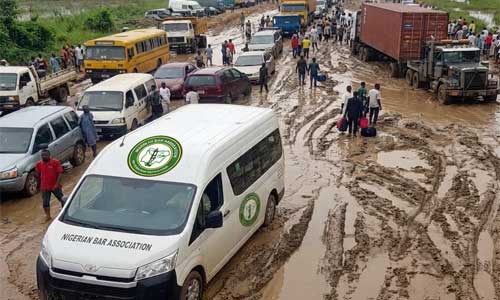
The Federal High Court sitting in Abuja has directed the Federal Government and the Benin-Asaba Expressway Concession Company Limited to appear before it and show cause why emergency measures should not be ordered on allegedly dangerous portions of the highway.
Justice Inyang Ekwo issued the directive on September 17, 2026, in a public-interest action instituted by the Incorporated Trustees of the Society of Public Interest Lawyers in Nigeria.
The suit, marked FHC/ABJ/CS/2171/2026, listed the Benin-Asaba Expressway Concession Company Limited, the Attorney-General of the Federation and the Minister of Works as defendants.
The plaintiff approached the court through an ex parte application dated and filed on September 11, seeking urgent orders to protect the lives and property of motorists using the expressway.
Among the reliefs sought was an order directing the Attorney-General of the Federation and the Minister of Works to take emergency and temporary measures to secure and remedy the allegedly affected portions of the road pending the determination of the substantive application.
The organisation also asked the court to direct the federal authorities to mobilise or procure qualified road construction, rehabilitation, traffic-management and emergency-response personnel to prevent further danger and restore safe passage.
It further sought the immediate filling and stabilisation of dangerous potholes, craters, excavated sections and failed carriageway portions, alongside temporary surfacing, barricading and appropriate road markings.
Other proposed measures included warning signs, reflective barriers, traffic personnel, lighting and diversion arrangements aimed at preventing accidents, loss of life and prolonged traffic obstruction.
The plaintiff maintained that the proposed emergency measures would not prejudice the rights and obligations of any of the parties under the concession agreement or amount to a final determination of the dispute surrounding its validity, performance, termination or continuation.
The application was supported by an affidavit deposed to by a legal practitioner and member of the organisation, Godspower Eroga. Clement Ugo Chukwuemeka appeared for the plaintiff and moved the application.
After considering the application, Justice Ekwo did not immediately grant the requested emergency repair orders. Instead, the judge directed the plaintiff to serve the defendants with notice of the ex parte application within three days.
The court consequently ordered the defendants to appear on the next adjourned date and explain why the reliefs sought by the plaintiff should not be granted.
Justice Ekwo adjourned the case until September 28, 2026, for the defendants to show cause.