
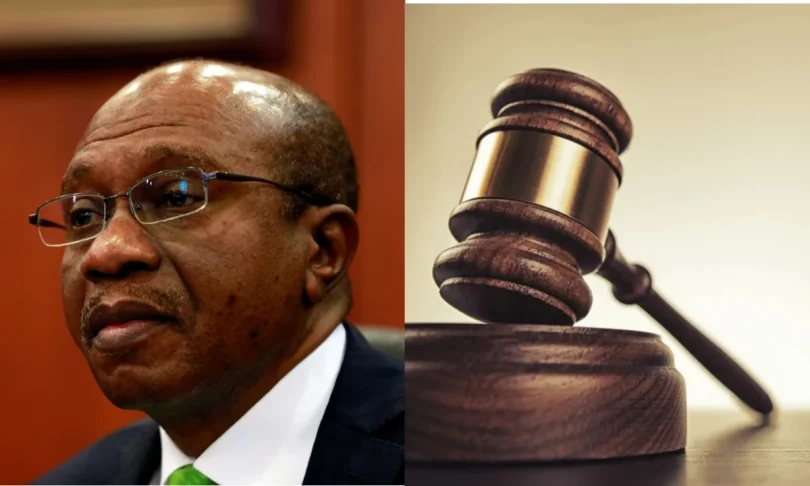
An Ikeja Special Offences Court on Thursday admitted as evidence extra-judicial statements made by former Central Bank of Nigeria, CBN, Governor Godwin Emefiele in his trial for alleged abuse of office.
Justice Rahman Oshodi upheld the statements as exhibits, allowing the substantive trial to proceed expeditiously.
Oshodi admitted the statements and marked them as Exhibit K31 after ruling on their admissibility in the ongoing trial.
The judge thereafter adjourned the case until Oct. 6 for continuation of trial.
Emefiele is facing a 19-count charge of alleged gratification, corrupt demands and abuse of office, involving transactions valued at 4.5 billion dollars and N2.8 billion.
His co-defendant, Henry Omoile, is standing trial on a three-count charge of alleged unlawful acceptance of gifts.
The court had fixed July 9 to rule on the admissibility of the statements after Emefiele’s counsel, Mr Olalekan Ojo (SAN), challenged them.
Ojo argued that the statements were not voluntarily obtained.
He alleged that they were extracted through oppression and physical and mental torture while Emefiele was in detention.
The senior advocate told the court that Emefiele was detained by the Department of State Services (DSS) for more than 157 days.
He relied on provisions of the Anti-Torture Act, 2017, and relevant sections of the Evidence Act.
“The issue before this honourable court is whether the statements credited to the first defendant were made voluntarily,” Ojo said.
He argued that video recordings of interrogations were the most reliable proof of compliance with due process.
According to him, the absence of such recordings rendered the statements unreliable and inadmissible.
Ojo also questioned the role of the lawyer who witnessed the interviews and urged the court to reject the statements.
However, the prosecution opposed the defence’s arguments.
The Director of Public Prosecutions of the Federation, Mr Rotimi Oyedepo (SAN), called an EFCC investigator, Mr Alvan Gurumnaan, as a witness.
Gurumnaan told the court that Emefiele was invited for questioning in the presence of his lawyer.
He said the interviews were conducted in the presence of Emefiele’s legal representative.
Oyedepo argued that there was no basis for a trial-within-trial.
He maintained that the statements did not amount to confessions.