
A SaharaReporters’ review of the Open Contracting Data Standard (OCDS) portals operated by state governments across Nigeria has shown that many states have shut down or allowed their open contracting portals to become non-functional, denying Nigerians access to transparency on public projects worth billions of naira.
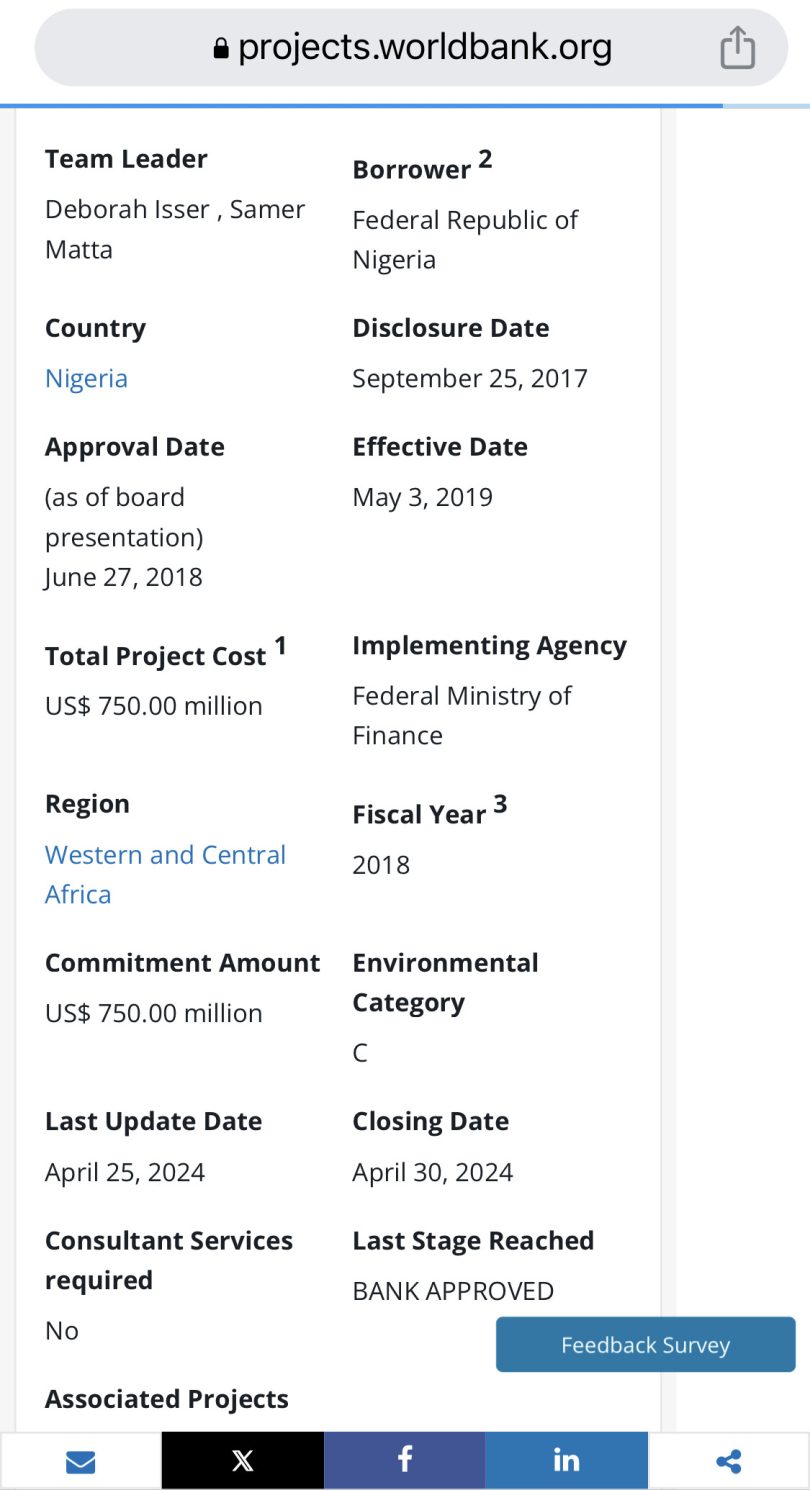
Before many of the portals became inaccessible, Nigeria received $750million in funding through the Federal Ministry of Finance.
The World Bank funding came under the States Fiscal Transparency, Accountability, and Sustainability (SFTAS) Programme, which was designed to strengthen fiscal transparency, accountability, and sustainability in participating states.
Details on the World Bank’s website show that the funding was approved in June 2018, with the project scheduled to end in April 2024.
A publication by the global body, Open Contracting Partnership, acknowledged the progress made by participating states through the partnership with the World Bank.
“Since 2018, Nigeria’s 36 state governments have been offered support to open up their procurement data, implement e-procurement systems, and improve their procurement laws through the States Fiscal Transparency, Accountability, and Sustainability (SFTAS) project, an initiative of the World Bank in partnership with state governors through the Nigerian Governors Forum (NGF),” the post on the Open Contracting Partnership website reads.
However, following the expiration of the funding, many state governments have either shut down or failed to maintain their OCDS portals, effectively denying the public access to information on contract awards, winning bidders, contract values, and procurement processes.
For instance, checks on the Oyo State Open Contracting Portal via https://publicprocurement.
Checks on the Ondo State Bureau of Public Procurement website also showed that its OCDS portal remains non-functional.
While Kwara State maintains a Bureau of Public Procurement website through https://kwppa.kwarastate.gov.
The Imo State Government also operates a poorly functioning OCDS portal.
The situation is similar in Nasarawa State, where the last available updates on its OCDS portal date back to around 2022.
When SaharaReporters visited https://plateaustateocds.
Similarly, the Edo State Open Contracting Portal, where procurement details were expected to be publicly available, was also non-functional when visited for this report.
This development comes despite the states spending billions of naira annually on capital projects. The OCDS portals were designed to provide citizens with information on which companies won government contracts, the amounts paid, and details of the procurement process.
For instance, Oyo State spent N394 billion on capital projects in the 2025 fiscal year, according to figures published on the state’s Open Contracting Portal.
In 2025 alone, Ondo State spent N122 billion on capital expenditure, yet lacked accessible procurement records that would enable citizens to determine which companies were awarded contracts and gain insight into the procurement process.
Kwara State also spent N162 billion on capital expenditure in 2025.
SaharaReporters has previously relied on OCDS portals to expose alleged government irregularities and suspicious procurement practices.
A previous review by SaharaReporters of the Ebonyi State Open Contracting Portal showed that a N1.4 billion contract was awarded to a company that was less than one month old at the time of the award.
At the time the tender process commenced, the company was not registered with the Corporate Affairs Commission (CAC).
The contract, reviewed by SaharaReporters, was awarded to Euslar Consultancy Services on December 16, 2025, for the “procurement of lab equipment for basic Virology research Lab Set Up.” The tender process began on November 6, 2025.
However, records indicate that Euslar Consultancy Services was registered with the CAC on November 17, 2025—eleven days after the tender process had already commenced. The company subsequently won the contract less than one month after its registration.
The findings raise fresh concerns over the commitment of several state governments to transparency and accountability in the management of public funds, despite repeated promises to uphold open governance and public access to procurement information.