
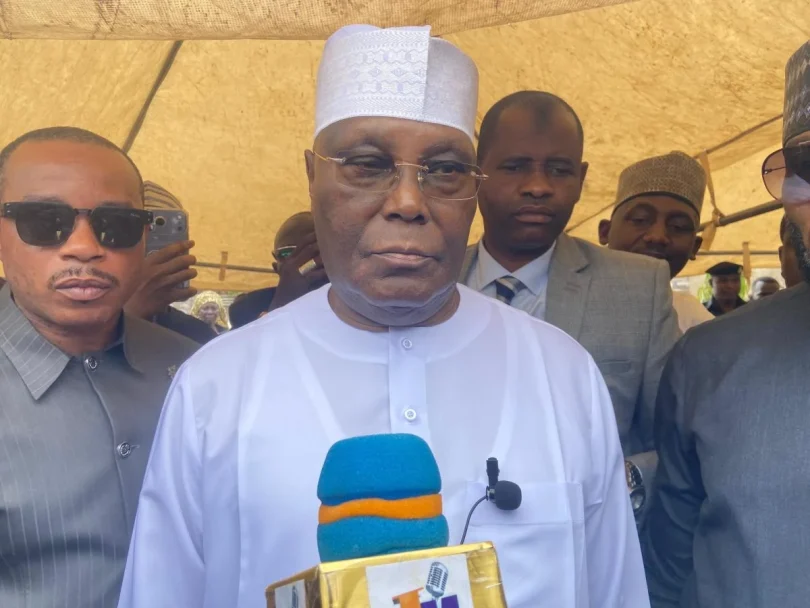
The Tinubu Support Group (TSG) has warned that the proposed return of fuel subsidy under an Atiku Abubakar presidency could set Nigeria’s economy back by 20 years, urging Nigerians to scrutinise political promises ahead of the 2027 general elections.
The group said the debate over fuel subsidy should not be reduced to an electoral promise, arguing that any policy capable of reversing ongoing petroleum-sector reforms must be subjected to serious scrutiny over its fiscal cost, legal framework and implications for investment.
Atiku, the presidential candidate of the African Democratic Congress (ADC), has repeatedly said he would restore subsidy if elected in 2027. He initially described the proposal as restoring subsidy, but subsequently clarified that his plan would involve a targeted, capped and transparently budgeted production subsidy for locally refined petrol rather than a return to the former import-subsidy system.
Reacting to the proposal, TSG Director-General, Dr Umar Tanko Yakasai, said reversing the subsidy reform would place fresh pressure on government finances and could undermine investor confidence in the petroleum sector.
Yakasai, in a statement made available in Abuja, said Nigerians had already endured the difficult adjustment associated with subsidy removal and should be wary of political promises that could reverse the reforms without a clear and sustainable financing plan.
According to him, “any attempt to reverse the Federal Government’s fuel subsidy reform could set Nigeria back by 20 years.”
He said the country could not afford to return to a system that, in the view of the group, imposed a substantial financial burden on government, stressing that the subsidy question should be considered within the broader context of Nigeria’s revenue position, debt obligations and development needs.
Yakasai also questioned the apparent shift in Atiku’s position on subsidy, recalling that the former vice president had previously advocated the removal of petrol subsidy.
Atiku had said in 2022, ahead of the 2023 presidential election, that he would remove petrol subsidy if elected, while his campaign also pledged to privatise the government-owned refineries.
In 2023, Atiku also said the PDP administration between 1999 and 2007 had initiated the phased removal of subsidy and that, as chairman of the committee responsible, he had overseen the first two phases.
Yakasai therefore asked what had changed to warrant Atiku’s current position.
He said: “The question Nigerians should ask is when did Atiku change his longstanding position on fuel subsidy removal, which he has held for over two decades, and what has changed to warrant the sudden reversal of policy on subsidy?
“Is it a populist move to play to the gallery and deceive Nigerians in order to get votes through false promises?”
The TSG director-general urged opposition politicians to provide Nigerians with clear details on the cost, funding and implementation of their proposed economic policies instead of making promises that could create unrealistic expectations.
He said Nigerians should particularly examine campaign promises on fuel prices and subsidies against the country’s available resources and the need to sustain investment in infrastructure, healthcare, education and other critical sectors.
Yakasai further argued that the Nigerian economy had begun to record improvements in some key indicators following the reforms introduced by the Tinubu administration.
He cited the latest National Bureau of Statistics (NBS) data showing that Nigeria’s real gross domestic product grew by 4.43 per cent year-on-year in the second quarter of 2026, up from 3.89 per cent in the first quarter.
He also pointed to increased oil production as another development the country needed to consolidate.
According to the Nigerian Upstream Petroleum Regulatory Commission (NUPRC), combined crude oil and condensate production averaged 1.735 million barrels per day in June 2026, while July production stood at about 1.67 million barrels per day.
Yakasai said such developments required policy consistency and sustained investment rather than major policy reversals.
He further cited Nigeria’s growing engagement with the International Energy Agency (IEA), which formally welcomed the country as an Association country in June 2026, as evidence of expanding opportunities for cooperation and investment in the energy sector.
The TSG director-general said Nigeria’s efforts to attract capital into oil, gas, electricity and renewable energy would require a predictable policy environment.
He cautioned that political proposals capable of creating uncertainty over the direction of petroleum-sector reforms could affect investment decisions and the broader economy.
However, Atiku’s camp has maintained that its proposal is different from the former import-subsidy arrangement.
The former vice president has said his proposed intervention would shift government support from imported petrol to domestic production, with the objective of lowering the cost of locally refined petrol and easing pressure on consumers.
The controversy has consequently placed fuel pricing and subsidy policy at the centre of the emerging 2027 economic debate, with the two sides offering contrasting arguments over how Nigeria should balance consumer relief, fiscal sustainability and investment in domestic refining.
Yakasai urged voters to examine such competing proposals carefully before the 2027 elections, particularly their implications for government revenue, petrol prices, domestic refining and the long-term sustainability of the Nigerian economy.