
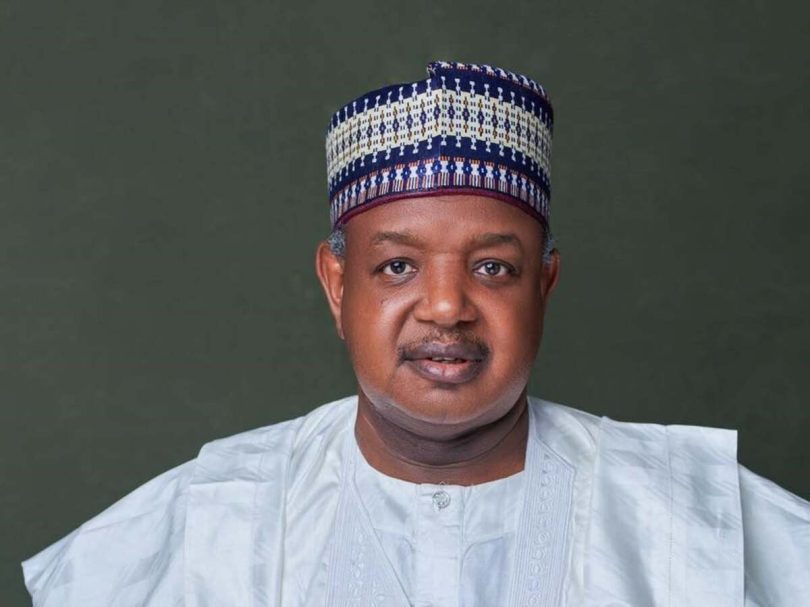
The Minister of Budget and Economic Planning, Senator Abubakar Atiku Bagudu, has said Nigeria’s economy remains too small to meet the country’s development needs, warning that it will continue to disappoint or fail to meet expectations until the nation makes the right economic choices.
Bagudu stated this in Abuja on Monday at a capacity-building workshop organised by the Senate Press Corps with the theme, “Leveraging Legislative Oversight and Media Collaboration to Safeguard the National Budget from Unlawful Insertions.”
Nigeria’s 2026 budget is N68.32 trillion (about $49 billion), the highest in recent years.
Bagudu told the session that Nigeria had the smallest national budget among the 10 most populous countries in the world, noting that the country’s low revenue-to-GDP ratio had also constrained its spending capacity.
The countries are India (about 1.48 billion people), China (about 1.41 billion), the United States (about 349 million), Indonesia (about 288 million) and Pakistan (about 259 million).
The remaining five are Nigeria (about 242 million), Brazil (about 214 million), Bangladesh (about 178 million), Russia (about 144 million) and Ethiopia (about 136–139 million).
The minister noted, “This economy is a small economy, and it will continue to disappoint until we get it right.”
According to him, Nigeria’s closest comparison in terms of population is Pakistan, whose budget for the year is about $67 billion.
He, however, said Pakistan was not the level Nigeria should aspire to, urging Nigerians to look instead at countries that had achieved significantly larger economies.
Bagudu cited Brazil as a more relevant benchmark, saying the South American country had a population comparable to Nigeria and operated a federal system involving federal, state and municipal governments.
He said Brazil’s 2025 federal budget was at least 25 times the size of Nigeria’s budget.
“Do I expect to achieve the same outcomes as Brazil with a much smaller budget? Is it that these needs do not exist? I believe they do,” Bagudu added, stressing that Nigeria must build public understanding around the need to mobilise more resources for development.
The minister explained that President Bola Tinubu’s administration was working towards a $1 trillion economy, building on the country’s Agenda 2050 aspirations, which targeted a GDP per capita of more than $30,000 by 2050. Bagudu argued that achieving such ambitions would require greater revenue mobilisation, investment and, where necessary, borrowing supported by public confidence.
The minister said the national budget should be understood as a product of negotiation between the Executive, the people and the National Assembly, which he described as having the ultimate constitutional authority over the budget. He urged the media to help Nigerians understand the rationale behind budget provisions rather than drawing conclusions without adequate verification.
Bagudu also cautioned against automatically describing unfamiliar budget items as unlawful insertions, explaining that some provisions could reflect genuine needs in communities.
He cited water projects in areas where residents still travel long distances for water and recalled a 2024 budget provision for freezers that, after investigation, was found to be intended for a fishing community that needed facilities to preserve its catch.
On alleged unlawful insertions, the minister said vigilance by the media and legislature remained necessary, acknowledging that errors could occur despite the procedures for transmitting and signing the budget. He urged journalists to interrogate questionable provisions while verifying the facts, saying, “Human processes are susceptible to errors.”
Bagudu further called for a broader assessment of budget performance beyond capital expenditure, stressing that recurrent spending, salaries, security and debt servicing were also essential to the functioning of government. He said responsible budget scrutiny should therefore consider the full range of government obligations while the media continued to promote transparency, accountability and informed public debate.
The Chairman of the Senate Committee on Media and Public Affairs, Senator Yemi Adaramodu, who represented the Senate President, Senator Godswill Akpabio, said the media had a responsibility to scrutinise the budget and its implementation, while warning against misinformation about public finances.
The lawmaker called for balanced reportage to sustain public confidence in the budget and urged parliamentary journalists to familiarise themselves with legislative procedures. Akpabio also charged the media to remain a watchdog by exposing waste and promoting the proper utilisation of public funds.
Presenting the first paper, “Critical Scrutiny of Budget Line Items: Preventing ‘Garbage In, Garbage Out’ and Strengthening the Roles of Legislators and the Media,” Mr Ebu Emmanuel, who represented the Executive Director of the Civil Society Legislative and Advocacy Centre (CISLAC), Auwal Musa Rafsanjani, said budget provisions must be justified, transparent, properly costed and measurable.
He cited ICPC findings alleging that 4,508 inserted or padded projects worth N434.5 billion and 66 duplicated projects worth N6.43 billion were included in the 2022 budget. He urged lawmakers to verify the purpose, location, beneficiaries, cost and expected results of proposed projects and maintain an audit trail from proposal to final budget.
The Director of BudgIT, Oluseun Onigbinde, represented by the Country Director of BudgIT Foundation, Vahyala Kwaga, on his part, said legislative budget scrutiny was often focused on appropriation rather than public policy performance.
The BudgIT official identified late submission of the Medium-Term Expenditure Framework and Fiscal Strategy Paper as a recurring challenge, observing that limited engagement with Ministries, Departments and Agencies (MDAs) weakened oversight.
BudgIT recommended that budget proposals be submitted at least 90 days before the end of the financial year and that the National Assembly assess previous budget performance before approving new allocations.