
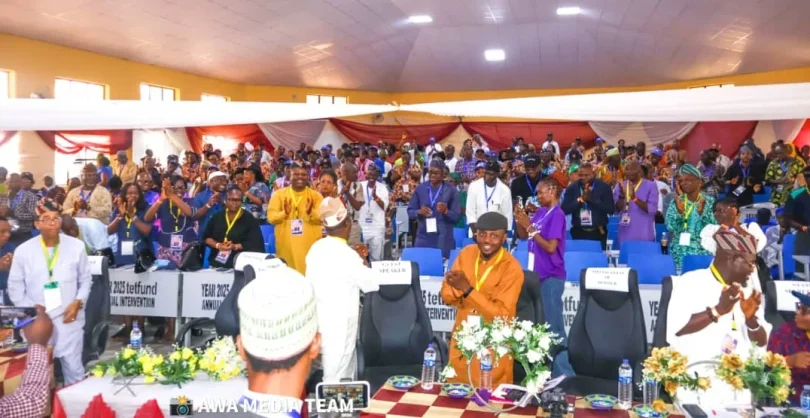
The Non-Academic Staff Union of Educational and Associated Institutions (NASU) has called for increased investment in education and sustained capacity building for workers, saying the survival of public institutions depends on a well-trained, motivated, and protected workforce.
The call was made during the second annual public lecture organised by the NASU branch of the Federal College of Education (Special), Oyo, where members from tertiary institutions across the South-West gathered to discuss the theme, “Defending Workers in a Changing Nigeria: Labour Rights, Collective Power, and the Future of Public Institutions.”
Speaking at the event, Chairman of the NASU branch at the Federal College of Education (Special), Oyo, Comrade Badmus Tolulope Kolawole (ANIPR), said the annual lecture was designed to educate members on the union’s values and strengthen their understanding of workplace ethics, institutional code of conduct, responsibilities, and staff rights.
According to him, the lecture was part of the union’s commitment to staff enlightenment, capacity building, and continuous professional development for non-academic staff in tertiary institutions.
Kolawole said NASU had remained committed to protecting the rights, welfare and privileges of workers across tertiary institutions in Nigeria.
He attributed the union’s growth and recognition at national and international levels to the efforts of its national leadership, while also acknowledging the support of the management of the Federal College of Education (Special), Oyo, for the achievements recorded by the branch.
He urged NASU members to maintain harmonious working relationships with other unions in their respective institutions and called on union leaders to organise regular training and retraining programmes to improve service delivery.
Also speaking, Acting Chairman of the NASU Oyo State Council, Comrade Ibraheem Akekunle Akande, said labour rights were earned through struggle and sacrifice rather than granted by management.
“Labour rights are not gifts from Management; rather they are rights won with sweat, struggle, and sacrifices,” he said.
ALSO READ: Those who owned businesses when Tinubu became president now sell kuli-kuli — Peter Obi
Akande said the union had a responsibility to protect workers’ rights, including the right to fair pay, career progression and dignity in the workplace.
“Management, council, and government only listen when we speak with one voice,” he said, adding that “if public institutions must survive, they must survive with workers who are trained, motivated, and protected.”
In his keynote address, NASU Deputy General Secretary, Comrade Tunji Carroll, said Nigerian workers continued to bear the burden of economic reforms without receiving corresponding benefits.
“Nigeria is changing. Our economy is changing. The world of work is changing. Technology is changing. The cost of living is changing. Government policies are changing. But one thing must not change: the dignity of labour and the right of every worker to fair treatment, decent wages, safe conditions, and a voice at work,” he said.
Carroll said workers were often expected to make sacrifices during difficult economic periods but were frequently overlooked when the benefits of reforms emerged.
He described the denial of workers’ wages after service as injustice, the prolonged use of casual workers without job security as exploitation, intimidation of union members as an attack on freedom, and the neglect of retirees as a betrayal.
“As trade union leaders, we must continue to insist that economic development must have a human face,” he said.
The event was attended by NASU officials from several institutions, including the union’s Akoka, Lagos branch; Lanlate branch; Tai Solarin College of Education, Omu, Ogun State; Federal College of Education, Iwo; and the Federal School of Survey.