
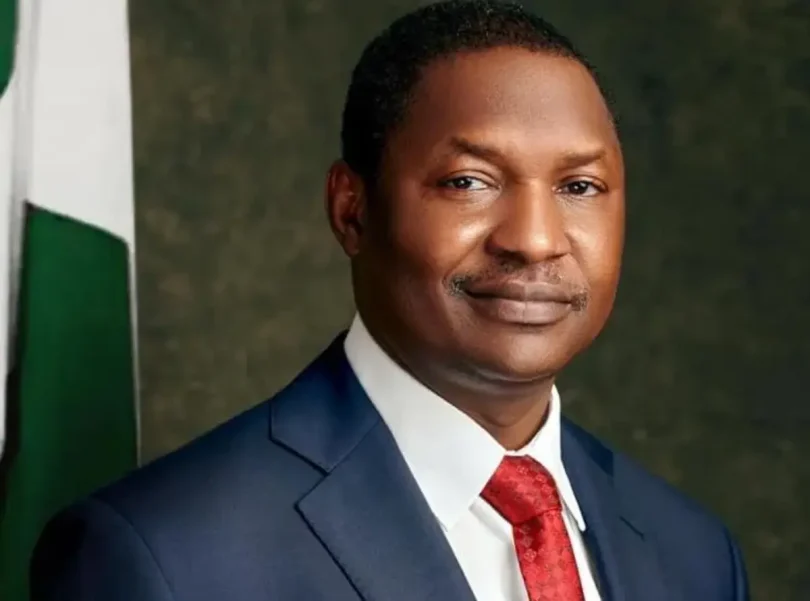
Former Attorney-General of the Federation and Minister of Justice, Abubakar Malami, SAN, has rejected an alleged corruption finding against him in the Mambilla arbitration, stressing that the international arbitration award should not be interpreted as a criminal conviction.
Malami also welcomed Nigeria’s victory in the long-running dispute with Sunrise Power and Transmission Company Limited over the Mambilla Hydroelectric Power Project.
His position was contained in a statement issued on Tuesday by his Special Assistant on Media, Mohammed Bello Doka.
The statement followed reports on the 616-page arbitral award, which reportedly contained adverse findings concerning Malami’s role in negotiations with Sunrise and its promoter, Leno Adesanya.
Malami said the proceedings were commercial in nature and did not amount to a criminal prosecution.
“The proceedings were commercial arbitration proceedings between parties to a dispute. They were not a criminal prosecution of Abubakar Malami, SAN, and the award does not constitute a criminal conviction of him,” the statement said.
He, however, acknowledged the seriousness of the reported findings, saying they should be examined against the complete evidentiary and documentary records.
“Those matters should not be ignored, trivialised or answered by speculation,” he said.
According to Malami, the Mambilla dispute predated his appointment as Attorney-General and had its roots in events dating back to 2003, when Sunrise became involved in the proposed hydroelectric project.
He said previous Attorneys-General and administrations had dealt with the dispute, noting that former AGF Michael Aondoakaa had reviewed the matter and recommended an amicable resolution.
He also cited the November 2012 General Project Execution Agreement involving Sunrise and Sinohydro as evidence that efforts to resolve the controversy predated his tenure.
“The relevance of this history is straightforward: Malami did not create the Sunrise dispute, introduce Sunrise to the Mambilla project, or originate the Federal Government’s attempts to settle the controversy,” the statement said.
“He inherited a longstanding dispute that had traversed previous administrations, Attorneys-General, ministries and contractual arrangements.”
Malami said his involvement in the matter followed governmental and presidential processes, including a directive communicated by the then Chief of Staff to President Muhammadu Buhari in April 2016.
He explained that the Ministry of Justice’s role was primarily to advise the Federal Government on its legal exposure and options for resolving the dispute.
According to him, the unresolved dispute later became an issue in efforts to finance the Mambilla project, including discussions involving China Exim Bank.
He said Sunrise initially demanded $500 million as full and final settlement during negotiations in London in November 2019, while the Federal Government countered with $100 million before $200 million emerged as a proposed settlement figure.
“The governmental calculation was whether an asserted multibillion-dollar exposure, continuing litigation, financing difficulties and delays to the Mambilla project could be brought to an end through a substantially smaller negotiated settlement,” he said.
Malami stressed that Buhari never approved payment of the proposed $200 million settlement.
He said the former President indicated on April 20, 2020, that the Federal Government did not have the money to make the payment, adding that he communicated the decision to Sunrise two days later.
He further said a subsequent request for presidential approval in January 2021 was rejected, with Buhari writing, “Not approved.”
Malami argued that what happened after the rejection was also important to understanding his role.
He said he instructed government lawyers to resist Sunrise’s attempt to enforce the settlement after the President declined to approve payment.
“When Sunrise asserted that Nigeria was consequently in default and sought to rely upon the enhanced financial consequences of the settlement arrangements, Malami instructed counsel representing the Federal Government to resist Sunrise’s attempt to have the settlement terms adopted or enforced against Nigeria,” the statement said.
On the tribunal’s reported finding of an alleged corrupt arrangement between him and Adesanya, Malami denied wrongdoing.
“Malami rejects any suggestion that his official actions were undertaken pursuant to a corrupt agreement or in exchange for personal financial benefit,” the statement said.
He said the allegation should be tested against the complete evidence, including whether he ever received money or any other financial benefit from Sunrise, Adesanya or any related entity.
The statement also referred to reports that Adesanya claimed to have audio or video recordings relevant to his allegations, but that the recordings were not presented before the tribunal.
“Where allegations of this gravity are made, the existence, non-production, authenticity and contents of any claimed recordings are matters of obvious evidentiary importance,” Malami said.
The statement said Malami welcomed the outcome of the arbitration, which resulted in Nigeria defeating Sunrise’s substantial financial claims.
The Federal Government has said the tribunal rejected Sunrise’s claims and awarded substantial costs in Nigeria’s favour.
Malami said he remained pleased whenever Nigeria’s legal interests and public finances were protected.
“Nigeria’s victory should be welcomed, and findings concerning the conduct of former public officials should be carefully examined and answered on the evidence,” he said.
He added that his office would issue a more comprehensive response to the tribunal’s individual findings after studying the complete award and relevant accompanying records.