
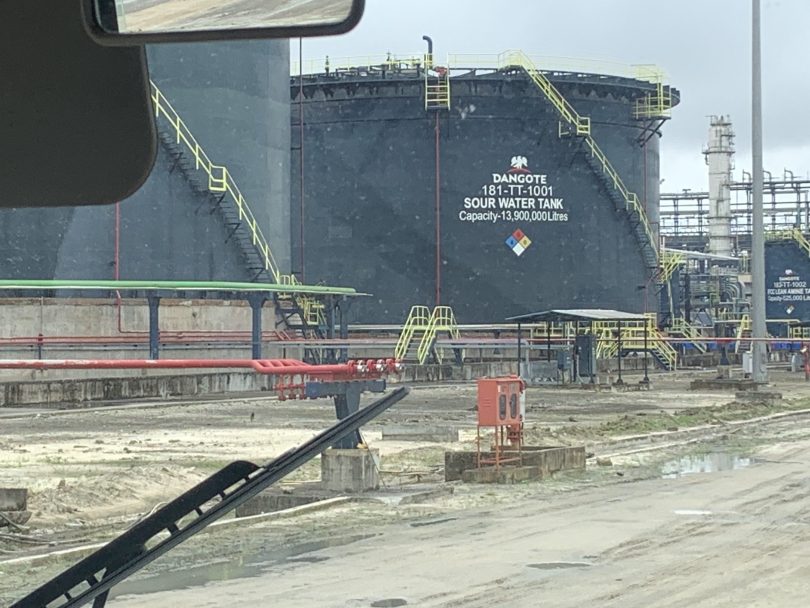
Dangote Petroleum Refinery has set a three-year timeline to double its crude processing capacity from 700,000 barrels per day (bpd) to 1.4 million bpd, as the company moves ahead with a major expansion of its Lagos facility.
Edwin Devakumar, Group Vice President of Oil, Gas and Fertiliser at Dangote Industries Limited, disclosed the timeline on Friday during a tour of the refinery by journalists.
According to Devakumar, much of the groundwork for the expansion has already been completed, with basic engineering concluded and most of the detailed engineering work nearing completion.
He said major equipment has been ordered, key contracts have been signed and advance payments have been made to contractors.
“We are targeting for three years, and probably we may be even doing faster,” Devakumar said.
The proposed expansion is expected to cost significantly less than the approximately $20 billion spent on the refinery’s first phase because much of the supporting infrastructure required for the additional capacity is already available.
Devakumar listed facilities such as the quarry, welding-gas plant, port infrastructure and developed land among the assets that will support the expansion.
He also explained that the project will benefit from the existing refinery’s engineering and design work because much of the new facility will replicate the current plant.
IPO to Support Expansion
The planned capacity increase is coming as Dangote Refinery raises fresh capital through its ongoing initial public offering.
The company is seeking about ₦2.15 trillion, equivalent to roughly $1.6 billion, from investors through the offer. The IPO also includes a 30 per cent green-shoe option that could allow additional shares to be allotted if demand exceeds the initial offer.
TheNewsGuru (TNG) reports that proceeds from the IPO are intended to support the planned expansion to 1.4 million bpd over the next three years.
Devakumar said the expansion would also lead to an increase in the refinery’s workforce, although the scale of additional recruitment would differ across departments.
While some areas, such as water treatment, already have sufficient capacity, employment in other sectors would depend partly on changes in domestic fuel consumption.
Dangote Promises Uniform Petrol Pricing
Beyond increasing production, Dangote Refinery says it is working towards narrowing regional differences in petrol prices across Nigeria.
Devakumar said a mechanism had already been activated to facilitate free nationwide delivery of petroleum products, with the objective of making prices more uniform across different parts of the country.
He said the initiative was intended to help keep petrol prices reasonable even when international crude prices rise.
The pricing pledge comes shortly after the refinery increased its petrol gantry price to ₦1,350 per litre on September 12. The adjustment was the fourth increase since August 21 and represented a cumulative rise of ₦185 per litre.
The latest increase subsequently pushed pump prices above ₦1,300 in some locations, with a PUNCH survey finding petrol selling at ₦1,395 per litre at a Dangote-backed MRS station in Lagos.
The planned expansion is not solely focused on increasing petrol production.
According to Devakumar, the larger refinery will also increase production of petrochemical products, including linear alkyl benzene, base oil and polypropylene.
Also Read: Nwifuru removes Ebonyi works commissioner Stanley Mbam
The facility will retain its focus on higher-value products, with petrol currently accounting for about 53 per cent of its output, compared with roughly 22 per cent at conventional Nigerian refineries.
The refinery, located in the Lekki Free Zone in Lagos, currently has a processing capacity of 700,000 barrels of crude oil per day.
Since commencing operations, the facility has become a major source of locally refined petroleum products and has reduced Nigeria’s dependence on imported fuel.
If the expansion is completed within the projected three-year period, the Dangote Refinery would become one of the world’s largest refining facilities, with its capacity reaching 1.4 million barrels per day.
The expansion could also have implications for Nigeria’s domestic fuel supply, petrochemical production, petroleum pricing and the country’s longer-term effort to reduce reliance on imported refined products.