
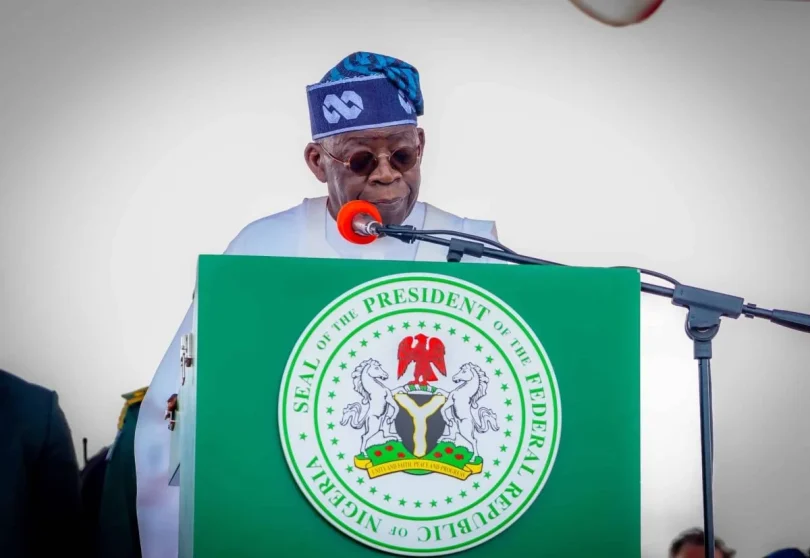
…says administration committed to promote CNG as alternative fuel
President Bola Ahmed Tinubu has ruled out a return to the fuel subsidy regime, which he said some opposition political leaders were advocating, insisting that his administration would continue to promote Compressed Natural Gas (CNG) as an alternative to petrol.
Tinubu said returning to fuel importation would place additional pressure on scarce public resources, adding that his administration was committed to harnessing Nigeria’s gas resources and expanding the use of CNG.
The President’s position comes amid calls by former Vice-President and African Democratic Congress presidential candidate, Atiku Abubakar, for the restoration of fuel subsidies if elected in 2027.
ALSO READ: Subsidy removal not responsible for high petrol price — Tinubu’s aide
The subsidy regime was declared ended by Tinubu during his inaugural speech on May 29, 2023.
Further checks revealed that Atiku, the ADC presidential candidate, had on Friday called on Tinubu to intervene directly by moderating fuel prices, citing the impact of rising international crude oil prices on Nigerians.
In a statement personally signed by him, Tinubu acknowledged that the global energy situation was affecting fuel and transportation costs.
He stated that the “disruptions to global energy supplies are once again pressuring petrol and diesel prices and increasing transportation costs worldwide.”
He added that “Nigeria cannot control events in global energy markets. But as a gas-rich nation, we can reduce our exposure.”
The President said his administration would continue to provide incentives to support the conversion of vehicles to CNG, which he described as a cheaper alternative fuel.
He assured Nigerians that they would begin to see an appreciable reduction in transportation costs from October 1.
To fulfil the pledge, Tinubu disclosed that an implementation committee for the National Affordable CNG Transit Programme had been established under the auspices of the Nigeria Governors’ Forum, with Governor AbdulRahman AbdulRazaq as its chairman.
He explained that the committee, in collaboration with the Presidential Initiative on CNG & Electric Vehicles (PI-CNG & EV), state governments and other stakeholders, had commenced discussions to identify priority transport corridors, determine appropriate interventions and make the necessary arrangements.
Tinubu, who identified states across the geopolitical zones where CNG-powered and electric public transport services were operating, reiterated his administration’s commitment to expanding access to CNG infrastructure, increasing conversion capacity and creating an enabling environment for state governments, transport operators, manufacturers and private investors.
The statement read,”Over the last three years, my administration has deliberately invested in building a CNG transportation ecosystem across Nigeria.
Today, more than 120,000 vehicles have been converted; we have over 400 certified conversion centres and more than 90 CNG refuelling stations across the country, and these figures are increasing daily.
“At a time like this, our answer cannot be to return to the ruinous petrol subsidy regime that consumed trillions of naira and left our economy exposed to every movement in international oil prices, as some have suggested.
“We must accelerate the cheaper alternatives we have been building at home.
“It is reassuring to see the movement spreading. Edo already has 50 CNG buses in active service. Kano has converted more than 1,000 commercial vehicles while rapidly expanding its conversion and refuelling network.
“Delta, Kwara and Lagos are expanding CNG-supported transport services, while Akwa Ibom has taken delivery of 50 CNG buses ahead of commercial operations.
“I encourage every State to maintain the momentum towards October 1. Work with transport unions and commercial operators. Support conversion and fleet deployment. Facilitate the infrastructure required. Above all, ensure that savings from cheaper energy reach Nigerian citizens through lower fares.
“The Federal Government will continue to support the scaling of CNG infrastructure and access, expand conversion capacity, and create the enabling environment for States, transport operators, manufacturers and private investors to participate.
“Nigeria has the gas. We are building the infrastructure. We are already seeing the savings.
“Now we must move faster and scale this so that more Nigerians feel those savings in the fares they pay every day. ”