
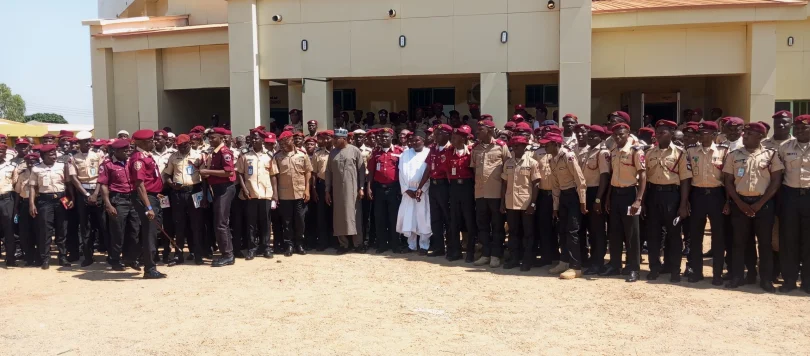
The Corps Marshal of the Federal Road Safety Corps (FRSC), Shehu Mohammed, has charged frontline marshals to demonstrate discipline, integrity, emotional intelligence and professionalism in their interactions with road users.
Mohammed gave the charge on Tuesday in Sokoto during a two-day capacity-building programme organised for frontline marshals under the RS10, Sokoto Sector Command.
The Corps Marshal, who was represented by the Zonal Corps Marshal, ACM Fredrick Ogidan, said the training was part of deliberate efforts to enhance the competence and operational effectiveness of personnel.
He said frontline marshals were the most visible representatives of the Corps, adding that their conduct on the roads significantly influenced public perception of the FRSC.
“The impression formed by members of the public about the FRSC is often influenced by their direct encounters with our personnel on the road.
“Consequently, our conduct, communication, appearance and manner of enforcement must always reflect the standard expected of a professional road safety organisation,” Mohammed said.
He urged the personnel to understand that their responsibilities went beyond traffic control and the apprehension of offenders, saying they must be able to identify hazards, assess changing traffic situations, manage emerging risks and respond appropriately to emergencies.
According to him, discipline must remain non-negotiable because the FRSC uniform carries the authority of government.
“That authority must be exercised responsibly. Every marshal is expected to protect the reputation of the Corps through personal discipline, integrity, courtesy and respect for the public,” he said.
Mohammed also emphasised the importance of fairness and emotional intelligence in traffic enforcement, warning personnel against unnecessary confrontation with road users.
“Fairness is necessary for effective enforcement, but fairness must not require unnecessary confrontation. Enforcement must be professional, measured, consistent and respectful of the dignity of the road user,” he added.
He charged the participants to see the training as an opportunity not only to acquire technical knowledge but also to improve their professional conduct and service delivery.
The Corps Marshal further directed commanders and facilitators to sustain the gains of the programme through effective supervision, mentoring, coaching and periodic assessment.
He also acknowledged the role of the media in supporting road safety campaigns through responsible public education and information dissemination.
Earlier, the Sokoto Sector Commander, Corps Commander Adamu Umar Argungu, said the programme was necessary because of the changing nature of the road safety environment.
Argungu identified increasing traffic volumes, distracted driving, vehicle overloading, road infrastructure deficiencies and technological developments as some of the challenges confronting road safety operations.
He said: “It is therefore necessary for our marshals to continuously update their knowledge and improve their operational skills.”
The Sector Commander urged the participants to actively engage in the training sessions, ask relevant questions and share practical experiences from the field.
He reminded them that their duties extended beyond enforcement.
“As marshals, we are not only enforcement officers. We are also road safety educators, first responders, traffic managers and ambassadors of the Federal Road Safety Corps,” Argungu said.
Also speaking, a guest speaker and facilitator, retired Deputy Corps Marshal Shehu Zaki, described the programme as an opportunity for renewal and reunion with serving officers.
Zaki, who said he spent much of his career in training schools and departments, noted that the operational environment confronting government agencies in Nigeria had changed considerably.
He said the FRSC was not immune to the emerging operational challenges, stressing the need for continuous reorientation and professional development of personnel.
“Somebody who has worked for more than 35 years would tell you definitely that the operational environment of many organisations has dramatically changed.
“The operating environment today in Nigeria is highly charged. It is full of provocation, coupled with increasing vulnerability,” he said.
Zaki said the training had come at the right time to re-educate and reorientate personnel to the realities of modern road safety operations.
He disclosed that participants would receive lectures on ethics and ethical standards, values, emotional intelligence, rule of law and other subjects aimed at broadening their knowledge and improving their effectiveness.
He urged the marshals to take the opportunity seriously.
“This is a rare opportunity. Do not squander it. Sit down quietly and listen attentively so that you can make maximum benefit from your coming here,” Zaki said.
He expressed hope that the participants would return to their respective commands better informed, more confident and better equipped to contribute to the FRSC’s mandate of reducing road crashes and saving lives.