
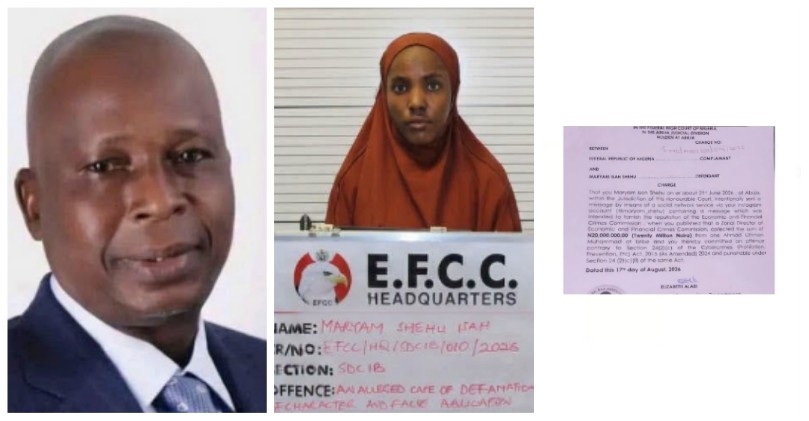
Human rights lawyer, Abba Hikima, has called on the Attorney-General of the Federation to intervene and stop what he described as “recklessness in the name of enforcement of law” by the Economic and Financial Crimes Commission, EFCC.
Hikima was reacting to the case of Maryam Isah Shehu, a final-year student of Bayero University, Kano, BUK, who spent 35 days in EFCC custody before being charged.
In a statement on Thursday, Hikima said barely 24 hours after raising the alarm over Maryam’s prolonged detention, the EFCC “hurriedly filed a one-count charge against her.”
“In other words, it took the EFCC 35 days during which it repeatedly refused her bail to prepare a single-count charge arising from a social media publication,” he said.
According to Hikima, Maryam’s alleged offence was raising an alarm over a corruption allegation involving an EFCC Zonal Director.
He questioned why the Commission has not informed Nigerians “whether that allegation was independently investigated or what the outcome of any such investigation was.”
“From all available information, the accuser was arrested and detained, while the substance of the allegation itself appears to have been set aside without transparent inquiry,” he added.
Hikima said the charge accused Maryam of intending to tarnish the EFCC’s reputation. He, however, argued that detaining a citizen for 35 days and denying her bail does more damage to the agency’s image.
“To make matters worse, she was served with the charge only on the eve of her arraignment. This effectively deprived her legal team of a reasonable opportunity to prepare and properly ventilate her bail application before the Court,” the lawyer stated.
He further said the EFCC “ought not to rely on procedural timelines of its own making to oppose an urgent bail application” and stressed that “a charge filed after 35 days cannot retrospectively legalise or justify the prolonged detention that preceded it.”
Hikima urged the Attorney-General of the Federation, as the Chief Law Officer, to urgently review the matter.
He said the conduct of the EFCC “raises serious questions about abuse of power” and “is capable of bringing Nigeria into disrepute in the eyes of the international community, particularly in light of our obligations under binding human rights instruments.”
“Beyond its domestic obligations, Nigeria is a signatory to several international human rights instruments, and the conduct of institutions such as the EFCC is often used in assessing our pacta sunt servanda compliance,” he said.
The lawyer demanded that Maryam be granted bail and that the corruption allegation against the EFCC official be “independently and transparently investigated.”
“The law must protect the accuser as much as it investigates the accusation,” Hikima said, using the hashtag #FreeMaryamShehu.
There has been no official reaction from the EFCC as of press time.