
…commend Osun election as new benchmark for 2027
…pass vote of confidence in INEC Chairman, Amupitan
…urge political class to stop recruiting youths for electoral violence
Coalition of opposition political parties, civil society organizations (CSOs), and ethnic youth groups on Thursday urged the Independent National Electoral Commission (INEC) to strengthen the use of technology in Nigeria’s electoral process to protect the votes of citizens ahead of the 2027 general elections.
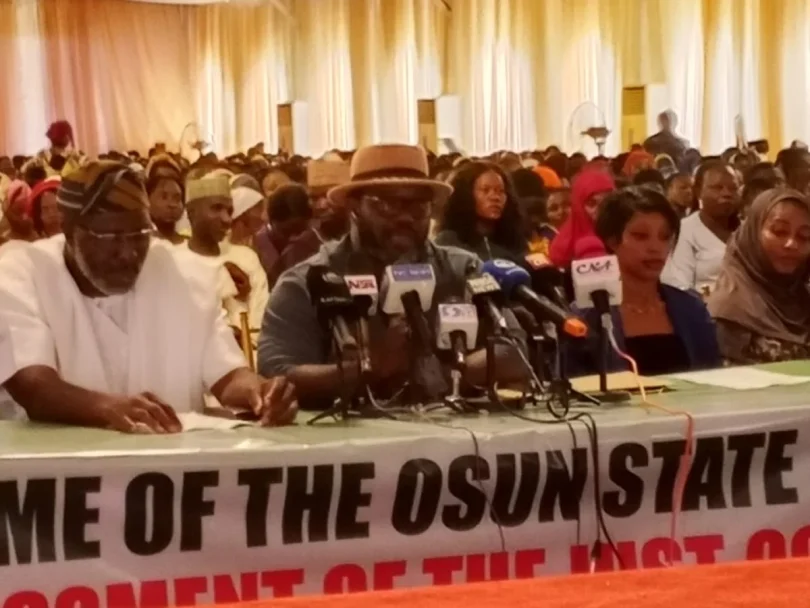
The groups made the demand in Abuja at a National Post-Election Discourse and Roundtable on the outcome of the Osun State governorship election and the performance of INEC, jointly organised by the Coalition of Opposition Political Parties United for Democracy, National Ethnic Groups, Arewa Consultative Youth Movement, Middle Belt Youth Forum, Ohanaeze Ndigbo Youth Movement, South-South Youth Leaders Consultative Forum, Oduduwa Youth Assembly and the African Centre for Justice and Human Rights (ACJHR).
Speaking on behalf of the participating organisations, National Organising Secretary of the Action Peoples Party (APP), Comrade Obed Agu, said the two-day assessment was not designed to determine the political winner of the election but to examine the conduct of the poll, identify what worked and what required improvement, and draw lessons for the 2027 elections.
Agu declared that the Osun election represented “a victory for democracy and a new benchmark for 2027,” stressing that the assessment focused on the independence and neutrality of INEC, compliance with the electoral timetable, stakeholder engagement, political party participation, voter access, security, protection of electoral officials and materials, accreditation, voting and counting procedures, results management and transmission, and post-election dispute resolution.
According to him, the assessment, based on reports, observations and experiences presented during the discourse, showed that the Osun election met approximately 92 per cent of the benchmarks adopted for the review. He, however, cautioned that the figure did not suggest that the election was perfect, noting that “no election is perfect” and that there would always be areas requiring improvement.
Agu said the real heroes of the Osun election were the people of the state, who came out to exercise their constitutional rights, stood in queues, cast their ballots and were allowed to determine the outcome of the election. He congratulated Governor Ademola Adeleke on his victory and urged him to govern in the interest of all residents of the state, irrespective of how they voted.
The APP chieftain also commended INEC for what he described as its commitment to the electoral timetable and stakeholder engagement, noting that the Commission had continued to hold consultative meetings with political parties and other stakeholders. He urged the electoral body to deepen such engagements, particularly with smaller political parties, insisting that “every registered political party represents citizens” and every voter deserves equal protection.
The coalition further passed a vote of confidence in INEC Chairman, Professor Joash Ojo Amupitan, SAN, after reviewing his conduct and the Commission’s preparations for the Osun election and the 2027 electoral cycle. Agu said the chairman should be judged by his conduct in office rather than by the circumstances surrounding his appointment, stressing that “the appropriate test is his conduct in office.”
He, however, stressed that the confidence was not a blank cheque, but was conditional on continued independence, transparency, adherence to the law and improved electoral performance. “Continue to strengthen the use of technology. Continue to protect the votes of Nigerians,” Agu charged the INEC chairman, adding that the institution belonged to the Nigerian people.
On electronic transmission of results, the coalition said participants and observers reported that results were transmitted electronically from polling units through INEC’s Results Viewing (IReV) platform. It urged the Commission to strengthen the technological architecture of elections, arguing that technology, when properly deployed, could reduce uncertainty, enhance transparency, provide an auditable trail and boost public confidence in election results.
The coalition also commended the security agencies for their roles during the Osun election, specifically mentioning the Nigeria Police Force, Department of State Services, Nigerian Army and Nigeria Security and Civil Defence Corps. It called for security neutrality to become a permanent feature of Nigerian elections rather than an exception, while urging the Federal Government to continue allowing electoral institutions to operate without political interference.
In the 2027 elections, Agu said the standard achieved in Osun must become the minimum benchmark for the general elections, insisting that the next national poll must be “more transparent, more inclusive, more technologically secure, more predictable and more trusted by all Nigerians.”
He also called on the National Assembly to continue reviewing the electoral framework and addressing weaknesses identified in the Electoral Act.
Speaking on behalf of the African Centre for Justice and Human Rights, Miss Precious Okonda said democracy should ultimately be measured by the freedom of citizens to choose their leaders without intimidation, coercion or fear. She said the organisation was encouraged by the conclusions of the two-day discourse, which she described as evidence of “meaningful progress” in democratic participation.
Okonda said the organisation commended President Bola Ahmed Tinubu for allowing the Federal Government to maintain neutrality during the Osun election, stressing that “neutrality by government is not a political favour. It is a democratic obligation.”
She also commended Amupitan for what she described as demonstrated commitment to institutional independence, stakeholder engagement, electoral preparation and credible electoral administration, while insisting that civil society would continue to monitor INEC and demand accountability.
On his part, National Coordinator of the Ethnic Youth Organisations of Nigeria, Comrade Melega Godwin, meanwhile, who warned politicians against recruiting young Nigerians as political thugs during elections, lamented that youths were often the first victims of electoral violence and should instead be encouraged to participate meaningfully in democracy. “Nigerian youth do not want to be instruments of electoral violence anymore. We want to be participants in democracy,” he declared.
Godwin therefore urged young Nigerians to reject vote-buying, intimidation, ethnic hatred and electoral violence in 2027, while encouraging them to register, obtain their Permanent Voter Cards, understand the issues and protect their votes peacefully. He said the Osun election had demonstrated what was possible when INEC was allowed to work, security agencies remained professional and government refrained from improper interference.
The coalition concluded by urging President Tinubu, INEC and the political class to sustain the gains recorded in Osun and ensure that the 2027 elections surpass the standard set by the state poll. Agu said the responsibility of protecting democracy went beyond partisan interests, declaring: “When votes count, Nigeria wins.”
He added that opposition parties would continue to criticise wrongdoing but must also have the courage to commend public institutions when they performed creditably, insisting that “that is what responsible opposition means.”