
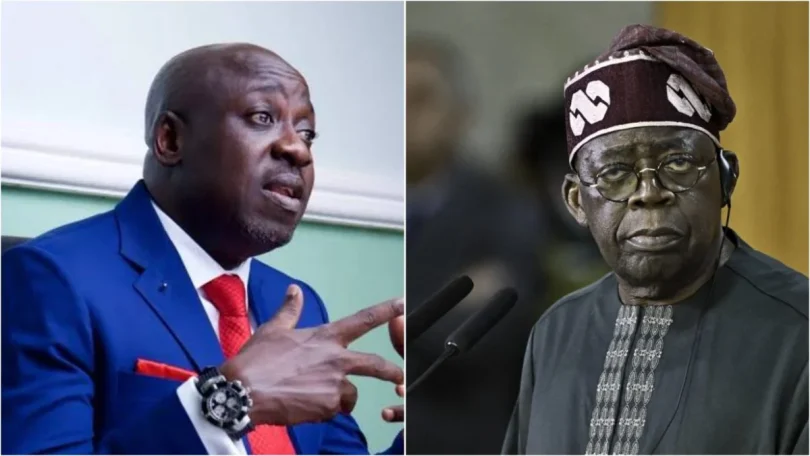
The African Democratic Congress (ADC) has raised an alarm that President Bola Tinubu could announce the implementation of a five per cent fuel tax immediately after the 2027 presidential election.
This was as the party said Nigerians could face another increase in the cost of living and petrol price if Tinubu wins re-election.
It alleged that the administration was postponing the implementation of the tax to avoid a backlash from voters ahead of the election.
The ADC was reacting to comments by the Minister of Finance and Coordinating Minister of the Economy, Taiwo Oyedele, who spoke about the timing of fuel taxation during an interview on the sidelines of the 2026 International Monetary Fund (IMF) and World Bank annual meetings in Bangkok, Thailand.
ADC National Publicity Secretary, Bolaji Abdullahi, alleged that the government would activate the tax after the election, citing the Nigeria Tax Act, which he said President Tinubu signed into law in June 2025.
“They have already enacted the law for a 5% tax on fuel under the Nigeria Tax Act. And President Tinubu has signed it into law since June 2025. If they are not activated it yet, its because of re-election. Once Tinubu is re-elected, he will announce the new tax law on the inauguration ground, just as he did for fuel subsidy in 2023,” Abdullahi said.
The party warned that the proposed levy could further increase transportation costs, food distribution expenses and the operating costs of small businesses.
It calculated that adding a five per cent surcharge to petrol selling at N1,450 per litre would raise the price to N1,522.50.
The ADC also criticised the administration’s economic policies, arguing that Nigerians needed financial relief rather than additional taxes following the removal of the petrol subsidy.
“This Tinubu-led APC never runs out of new ways to make survival more expensive. Each time Nigerians struggle to recover from one punishing policy, another burden is waiting around the corner. A government that has already removed fuel subsidies and subjected citizens to unprecedented economic pressures should be discussing relief, not preparing additional taxes,” the party said.
The opposition party also questioned the government’s argument that the proposed tax would support road infrastructure and fuel-price stabilisation, insisting that the administration should demonstrate measurable improvements before imposing additional financial obligations on citizens.
It recalled that Tinubu, as governor of Lagos State in December 2003, opposed a fuel tax being considered by the administration of former President Olusegun Obasanjo, describing it as double taxation.
“We recall that as governor of Lagos State, in December 2003, Tinubu vehemently opposed the fuel tax being contemplated by the Obasanjo administration, describing it as ‘double taxation’ that placed unfair burden on citizens. Now, Tinubu does not care if the people are burdened to death,” the ADC said.
The party urged Nigerians to support what it described as a fuel production subsidy proposed by its presidential candidate, Atiku Abubakar, arguing that the policy would reduce petrol prices and the broader cost of living.
However, Oyedele has denied that the Federal Government plans to introduce a fuel tax when the economy stabilises and Nigerians’ income levels improve.
In a post on X on Tuesday, the minister said his comments during the ARISE News interview had been misrepresented, describing reports that the government would introduce the levy under those conditions as “fake news”.
Oyedele had told ARISE News business correspondent that fuel taxes would be introduced at an appropriate time when economic conditions and income levels could accommodate them.
He explained that taxes account for between 20 and 80 per cent of pump prices in some countries, while many African countries impose between six and 10 different taxes on fuel products.
The minister also said introducing a fuel tax while petrol was still subsidised would have been counterproductive because the government would effectively be paying the tax itself.
He added that imposing the levy immediately after the removal of the petrol subsidy would have been insensitive to Nigerians.
“The objective should be that instead of trying to suppress prices, which hasn’t worked for us, it hasn’t worked for any country in the world, not one. Instead of trying to suppress prices, think about how to grow income faster than prices rise,” Oyedele said.
“That’s how you bring prosperity and grow the middle class and that is exactly what we are doing as led by Mr. President himself.
“At the appropriate time, when the economy has stabilised and income level will be able to accommodate it, those taxes will come. Not because we want to impose taxes.”