
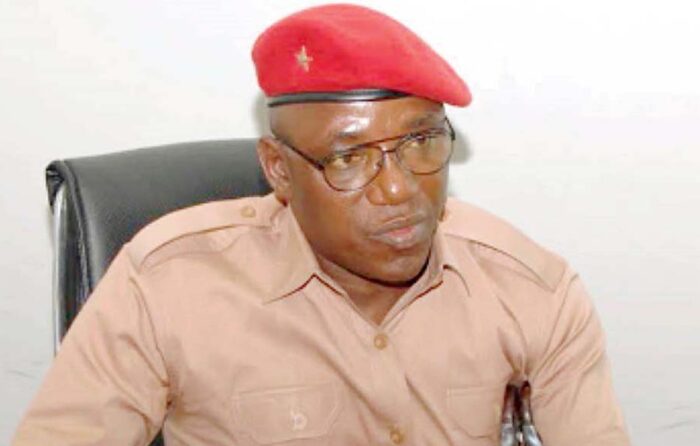
Former Minister of Sports and Youth Development, Solomon Dalung, has asked the Economic and Financial Crimes Commission, EFCC, to explain the legal basis for arresting and publicly parading persons over alleged “defamation of character and false publication.”
Dalung, in a statement on Thursday, said he was not commenting on the guilt or innocence of Maryam Shehu and Shuraim Abdulhamid who were arraigned by the EFCC, but on “the limits of state power.”
Dalung noted that the photographs released by the EFCC showed the accused persons holding placards stating the offence as: “DEFAMATION OF CHARACTER AND FALSE PUBLICATION.”
“Not fraud. Not money laundering. Not obtaining by false pretence. Not an economic or financial crime,” he wrote.
He asked: “What is the statutory basis for the EFCC assuming jurisdiction over these allegations?”
The former minister argued that the EFCC Establishment Act principally empowers the commission to investigate and prosecute economic and financial crimes, “including offences connected with or relating to such crimes.”
Dalung raised a second question on the Commission’s practice of publishing mugshots of accused persons.
“Even if, for the sake of argument, the EFCC had lawful authority to investigate the allegations, does the power to investigate or arrest automatically confer the power to publicly publish the mugshots of the accused?” he asked.
He said while Section 15 of the Administration of Criminal Justice Act permits photographing an arrested person for identification, “that is fundamentally different from taking the photograph, placing an official EFCC placard in the person’s hands and publishing the image on the agency’s public platforms.”
“The power to arrest is not the power to convict. The power to investigate is not the power to publicly shame. The power to photograph for identification is not automatically the power to publish,” Dalung stated.
He stressed that the accused persons “are not convicted persons. They are accused persons who have pleaded not guilty,” and that the Constitution guarantees the presumption of innocence.
The former minister also noted what he called “a striking irony”: that the EFCC is prosecuting people for alleged publications said to have damaged the Commission’s reputation, while itself publicly releasing photographs of the accused with placards.
“If reputational harm is serious enough for the state to invoke criminal law, then the state itself must be held to an even higher standard when dealing with the reputation and dignity of an unconvicted citizen,” he said.
Dalung clarified that he was not defending any false publication, but insisted that “the law must also take its course against the state.”
“The EFCC cannot become whatever it wants to be simply because it is fighting corruption. The fight against corruption does not exempt an agency from the Constitution,” he said.
He listed two direct questions for the Commission: What specific law gives the Commission jurisdiction to investigate and prosecute these particular allegations of “defamation of character and false publication”? What specific law gives the Commission the power to publicly publish the mugshots of these unconvicted defendants?
“These are not questions about whether we like Maryam Shehu or Shuraim Abdulhamid. They are questions about the limits of governmental power,” Dalung said.
“Because if an agency of government can arrest you, photograph you, label your alleged offence on an official placard and publish your image to the public before trial, then every Nigerian should be interested in knowing exactly where that power comes from. The EFCC must answer that question. Fighting crime is not a licence to become the law.”
The EFCC is yet to respond to the former minister’s questions as of the time of filing this report.