
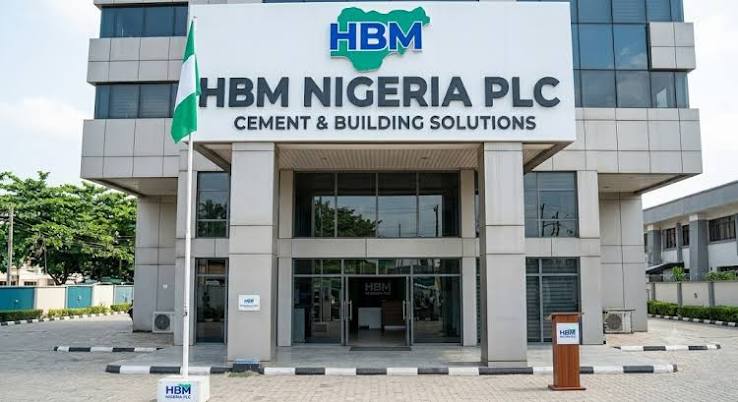
HBM Nigeria Plc, formerly Lafarge Africa Plc, has reported a sharp improvement in profitability for the first half of 2026, with profit after tax (PAT) rising 57 percent to about N208 billion, as stronger cement volumes, improved distribution and tighter cost management lifted margins.
The cement manufacturer said net sales increased 31 percent year-on-year in the six months ended June 30, 2026, while sales volumes rose 11 percent. Operating profit climbed 51 percent to N291 billion, pushing operating margin to 43 percent, from 37 percent in the corresponding period of 2025.
The unaudited financial statements put revenue at N678.41 billion, compared with about N517 billion in the same period last year, while profit after tax stood at N208.35 billion. Profit before tax was N317.73 billion.
ALSO READ: United Capital doubles H1 profit to N21.1bn
The performance marks a continuation of the company’s strong earnings trajectory. In 2025, when it still operated as Lafarge Africa Plc, group revenue rose 53 percent to N1.07 trillion, while profit after tax increased 173 percent to N273.1 billion, from N100.1 billion in 2024. Operating profit also doubled to about N392 billion.
The latest figures suggest that HBM Nigeria is sustaining the operational gains recorded last year rather than relying solely on price increases to drive earnings. The 31 percent increase in sales compared with an 11 percent rise in volumes indicates that pricing and product mix remained important, while the faster 51 percent growth in operating profit points to significant operating leverage.
Lolu Alade-Akinyemi, group managing director and chief executive officer of HBM Nigeria, attributed the first-half performance to disciplined cost management, operational excellence and prudent financial stewardship.
He said the company would focus on improving supply reliability, strengthening its cost leadership, driving innovation, accelerating sustainability initiatives and maintaining high health and safety standards.
The company is also positioning for further capacity expansion as it seeks to capture Nigeria’s long-term cement demand.
HBM Nigeria has commenced engineering design for a third production line at its Calabar operation, a 3-million-tonne-per-annum integrated cement facility. Management expects the project to be completed within 12 months after construction begins, subject to the requisite development processes.
The planned expansion comes as the company currently has installed cement production capacity of 10.5 million tonnes per annum, supported by plants in Ewekoro and Sagamu in Ogun State, Ashaka in Gombe State and Mfamosing in Cross River State.
The company’s capacity expansion strategy is significant for its earnings outlook because volume growth is becoming increasingly important after the sharp price-driven revenue increases seen across Nigeria’s cement industry during the inflationary period.
HBM Nigeria’s management said demand remained positive, supported by infrastructure development, urbanisation and construction activity.
“We plan to continue focusing on capturing volume growth opportunities while maintaining disciplined cost management and operational excellence to strengthen profitability and preserve margins,” Alade-Akinyemi said.
Investors have also responded to the earnings momentum. HBM Nigeria’s shares closed at N365 on July 28, after opening at N387, according to available market data, while another market feed showed the stock trading as high as about N389.90 during the session.
The stock has enjoyed a substantial repricing as investors factor in the company’s earnings strength and strategic transition following the acquisition of Lafarge Africa by China-based Huaxin Building Materials.
The ownership transition was completed in August 2025, bringing the Nigerian cement maker into the Huaxin group and giving the business access to the parent company’s technical and industrial expertise.
With H1 operating margin already at 43 percent, the immediate challenge for management is to sustain efficiency gains while expanding volumes without allowing production, energy, logistics and distribution costs to erode margins.