
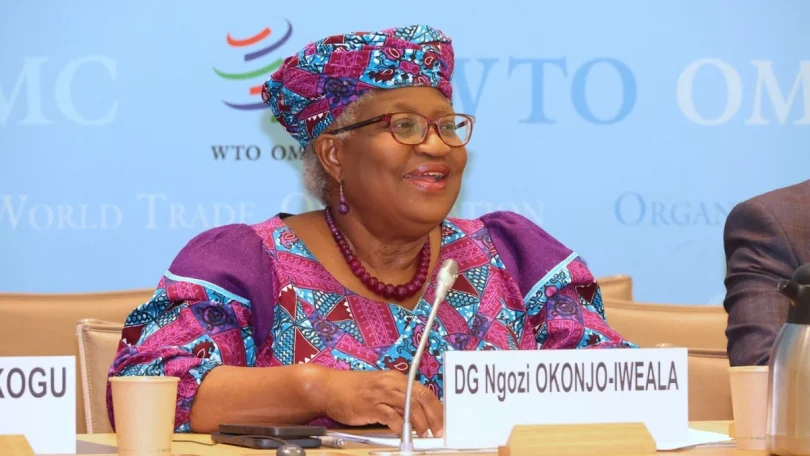
The Director General of the World Trade Organisation (WTO), Dr. Ngozi Okonjo-Iweala, has charged Nigeria and the entire African continent to be deliberate in adding value to the continent’s huge mineral resources before export.
Speaking on Wednesday in Abuja at the 7th African Emerging Markets Forum hosted by the Central Bank of Nigeria (CBN), the DG explained that the continent was overly dependent on other nations for supplies of essential commodities.
“Africa holds an estimated 30% of the world’s non-mineral reserves, instead of the extract and export model that has been the source of so much volatility, economic underperformance, and corruption, conflict, and banditry, the goal should be higher value, higher productivity growth, driven by the development of sub regional value chains and integration into potential supply networks.
“Quite frankly, the time to seize this opportunity is now, as geopolitics exerts some demand pressure for critical mineral supply chain diversification. If we miss this opportunity, I am afraid we would have missed a lot”.
She stated that “fortunately, Africa’s leaders seem to be moving in the right direction, with Morocco using its phosphate resources to produce electric vehicle components for international markets, particularly for Chinese automakers.
“In Zambia, DRC, Mozambique, and Angola, and here also in Nigeria, moves are being put to see how to add value to critical minerals, but these efforts need more systematization and harmonization, including a look at sub regional approaches so that countries are not picked up one by one in suboptimal bilateral agreements.
“The continent can seize green comparative advantages by harnessing abundant renewable energy potential to power minerals processing,” Iweala noted.
She said paths to global trade resilience — reforming the multilateral trading system and broadening the global economic base — are deeply complementary. “To attract the kind of investments we’ve been talking about, developing countries will need to improve their business climate, upgrade hard and soft infrastructure, and provide a stable macroeconomic environment”.
The DG therefore urged African countries to trade amongst themselves. “African nations don’t trade with one another,” she added, noting that the African Continental Free Trade Agreement (AfCFTA) presents an opportunity for the continent to grow its value addition.
In his address, the Governor of the CBN, Mr. Olayemi Cardoso, stated that “with intra-African trade still accounting for only about 16 percent of our total trade, we must build stronger regional value chains, produce more of what we consume, and trade more with one another.
“The African Continental Free Trade Area provides the platform and opportunity to turn this global shift to an African advantage. But we must go beyond the agreements and remove the practical barriers to trade by improving transport networks, harmonizing customs standards, and making cross-border payments faster and more affordable.
“Secondly, capital has become selective and impatient. The era of abundant liquidity chasing returns regardless of risks. Investors now have more choices and less tolerance for uncertainty”.
Cardoso further explained that capital increasingly flows to jurisdictions that offer credibility, transparency, quality, consistency, and strong institutions. For Africa, this means that our development ambitions cannot depend solely on attracting foreign capital.
“We must mobilize more of our own resources, including pension and insurance funds, domestic savings and diaspora capital, and channel them towards productive domestic investment.
“It also means that there is a premium on the quality of Africa’s institutions. Investors must be able to trust our policies, understand our rules, and plan beyond the next political or economic cycle.
“So credibility is not only a central bank concern, it is a national economic asset. Third, artificial intelligence is reshaping economic activity. It is changing how goods are produced, how services are delivered, and the skills required to compete,” he stated.
On his part, the Founding Director and Chief Executive of the Emerging Markets Forum (EMF), Harinder Kohli, said the continent would grow faster by trading with one another.
The Forum was attended by financial institutions and captains of industry from all over the world.