
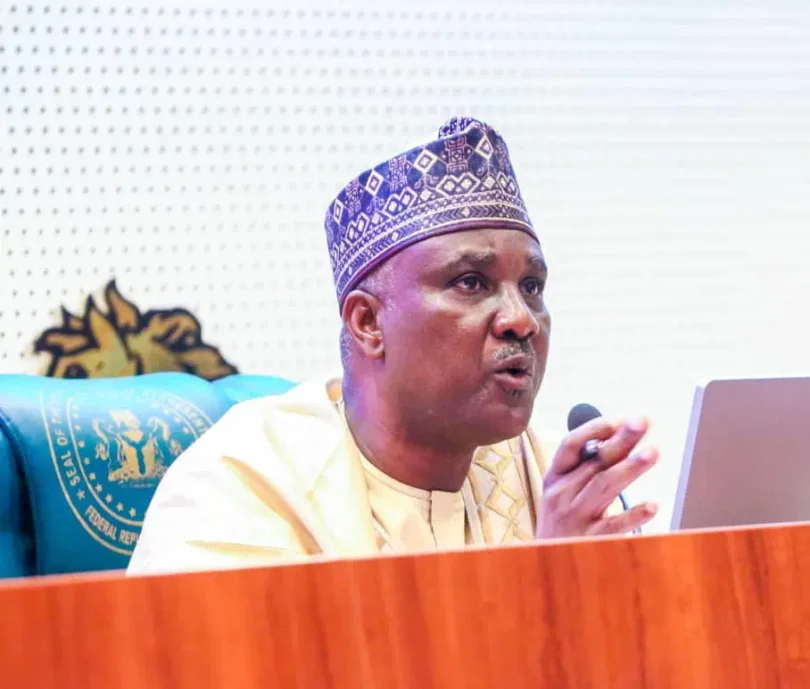
The Speaker of the House of Representatives, Abbas Tajudeen, on Monday, expressed his commitment to improving the ease of doing business in Nigeria.
He emphasized the importance of removing regulatory bottlenecks, attracting investment, and promoting sustainable economic growth.
The Speaker made these remarks during a public hearing organized by the House Committee on Commerce in Abuja. He noted that the proposed bills are designed to strengthen Nigeria’s commercial and trade framework.
This includes the African Continental Free Trade Area (AfCFTA) Domestication Bill, which aims to position Nigeria to maximise opportunities within Africa’s single market.
Speaker Abbas highlighted that these proposed legislations are part of the 10th House’s economic reform agenda.
The Speaker, who was represented at the occasion by the Deputy Chief Whip, Rep Isiaka Ibrahim, described commerce as “one of the strongest pillars of our economy,” stressing that the bills must undergo rigorous public scrutiny to ensure they respond to emerging realities and global best practices.
According to him, “the purpose of today’s hearing is to subject these Bills to rigorous public scrutiny, receive constructive input from stakeholders, identify areas that require refinement, and ensure that the legislation we eventually enact promotes enterprise, protects legitimate business interests, encourages fair competition and advances sustainable economic growth.”
The Speaker noted that the exercise aligns with the Legislative Agenda of the 10th House of Representatives, which prioritises economic growth, institutional reforms, good governance and private sector development.
According to him, “since our inauguration, we have remained committed to enacting laws that improve the ease of doing business, support entrepreneurship, remove unnecessary regulatory barriers, attract investment and create opportunities for our people.”
He further said that the legislative initiative also supports President Bola Tinubu’s Renewed Hope Agenda by providing the legal framework required to drive economic reforms.
“As the People’s House, we shall continue to provide the legislative framework and oversight necessary to translate that vision into measurable progress for businesses, investors and ordinary Nigerians,” he said.
Speaking on the AfCFTA Domestication Bill, the Minister of Industry, Trade and Investment, Dr. Jumoke Oduwole, urged lawmakers to expedite its passage, describing it as crucial to Nigeria’s competitiveness in continental trade.
According to her, the African Continental Free Trade Area, which covers over 1.4 billion people with a combined Gross Domestic Product exceeding $3 trillion, offers enormous opportunities for Nigerian businesses to expand into new markets, attract investment, create jobs and strengthen regional value chains.
She said Nigeria has already made substantial progress since ratifying the agreement in 2020 by establishing implementation structures, submitting tariff concessions, launching digital trade initiatives and supporting local enterprises.
Oduwole disclosed that Nigeria became the first State Party to ratify the AfCFTA Digital Trade Protocol and has launched air cargo corridors linking Nigerian businesses to East and Southern African markets.
She also noted that Nigeria recently hosted the AfCFTA Week, the 18th Meeting of the AfCFTA Council of Ministers responsible for Trade, and the Digital Trade Forum, where the country assumed the Chairmanship of the Bureau of the Council of Ministers.
The Minister, however, stressed that effective implementation of the agreement requires a robust domestic legal framework.
According to her, “the Bill is not merely about implementing an international treaty. It is about positioning Nigeria to fully harness the opportunities of continental trade while safeguarding our national interests.”
She added that the legislation would provide legal certainty for businesses and investors while strengthening coordination among government institutions.
“Its timely passage will consolidate Nigeria’s leadership in continental trade, provide certainty for our businesses and investors, and position our economy to fully harness the opportunities of the African Continental Free Trade Area,” Oduwole said.
Speaking earlier, the Chairman of the Committee, Hon. Ahmed Munir, disclosed that the committee was considering 13 strategic bills designed to modernise Nigeria’s commercial laws, strengthen professional standards and reposition the economy for global competitiveness.
According to him, the bills are grouped into three broad areas: expanding global trade and protecting local assets; modernising commerce and the digital economy; and strengthening professional regulation and institutional capacity.
He explained that key proposals include the AfCFTA Implementation Bill, amendments to the Nigerian Export Promotion Council Act on Geographical Indications and NIMASA updates, amendments to the Sale of Goods Act and the Price Control Act, as well as bills establishing and strengthening several professional institutes.
He said the committee expects stakeholders to provide practical, data-driven recommendations to ensure the proposed laws effectively support economic growth.
According to him, “Our goal in the 10th House of Representatives is to ensure our laws actively foster economic expansion rather than obstruct it. The success of this legislative exercise depends heavily on your candid, expert feedback,”.
He urged participants from government, industry and civil society to make constructive contributions that would help the National Assembly produce legislation capable of driving investment, innovation, job creation and Nigeria’s competitiveness in both regional and global markets.