
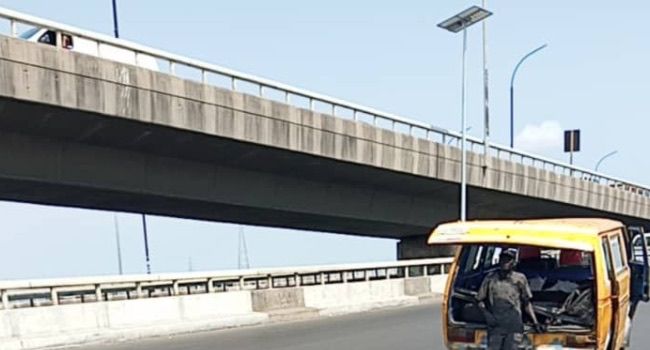
The Federal Government has formally handed over the construction of a new Carter Bridge in Lagos to the China Civil Engineering Construction Corporation (CCECC), as part of President Bola Tinubu’s infrastructure renewal drive aimed at safeguarding critical national assets and improving public safety.
The handover ceremony was held on Wednesday at the Carter Bridge axis on Lagos Island, Lagos State.
Speaking at the event, the Minister of Works, David Umahi, explained that the decision to completely rebuild the bridge followed years of technical investigations that revealed serious structural defects affecting both Carter Bridge and the 3rd Mainland Bridge.
He noted that underwater assessments carried out in 2013 and later in 2019 showed that the deterioration was not only persistent but increasing rapidly, describing the trend as “geometrical progression”.
According to a statement attributed to the minister through his aide, Francis Nwaze, Umahi recalled that earlier studies commissioned under a previous administration had already flagged major concerns about the bridges’ submerged structural components.
Upon assuming office, he said the current administration ordered fresh investigations involving geologists and specialised divers, which confirmed that some supporting piles had become displaced from their pile caps.
He illustrated the severity of the situation by likening it to a critical structural failure, saying the damage was extensive and dangerous.
Umahi further disclosed that consultations were carried out with engineering experts, stakeholders, members of the National Assembly, and foreign specialists to determine the most viable intervention.
He explained that after careful evaluation, it was concluded that rebuilding the Carter Bridge would be more economical than attempting repairs, which could cost nearly double.
He also revealed that the redesigned structure would incorporate a cable-stayed section to improve aesthetics and enhance marine navigation within the Lagos corridor, noting that such designs are commonly seen in major international cities.
The minister stated that the project is expected to be completed within 36 months, commending President Tinubu for what he described as decisive action in addressing long-standing infrastructure challenges.
On the procurement process, Umahi said due process was followed, with seven companies invited and six submitting bids, including Julius Berger. He noted that CCECC emerged as the most technically and financially suitable, leading to its approval by the Bureau of Public Procurement and the Federal Executive Council.
He directed the contractor to immediately mobilise to site and assured that the ministry would conduct monthly monitoring to ensure strict adherence to technical specifications and safety standards.
The project, valued at ₦545 billion, will be financed through a mix of federal counterpart funding and external borrowing, with 30 per cent provided by the Federal Government and 70 per cent sourced externally.
Meanwhile, Umahi also announced an emergency partial closure of the Eko Bridge following significant structural damage caused by illegal sand mining activities.
He explained that reckless dredging operations had led to the destruction of key supporting piles after a barge struck one of the pile caps, worsening the bridge’s condition.
He added that further complications occurred during attempts to remove the barge, resulting in additional structural damage that has now made a section of the bridge unsafe.
As a precaution, the minister directed that one carriageway of the Eko Bridge be closed by midnight on Sunday, May 10, 2026, while the other remains open to traffic.
He stated that the Federal Government has already developed an emergency engineering plan that involves lifting part of the bridge span to access and repair the damaged sections beneath.