
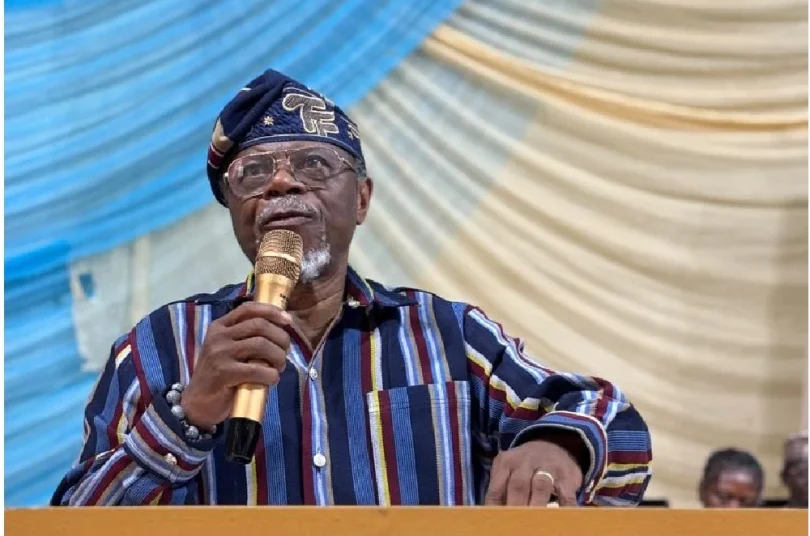
Eminent historian, Professor Toyin Falola and other stakeholders, while interrogating witchcraft in Africa have called for greater responsibility among religious and traditional leaders, warning that spiritual claims can become dangerous when they lead to the identification, persecution or abuse of vulnerable people.
This formed the core of interaction during the Toyin Falola Interview on Sunday, where a distinguished panel examined the theme, “Witchcraft in Africa.”
The programme, chaired by Professor Toyin Falola, featured Professor Godwin Sogolo, Rev. Prof. Grace Sintim Adasi, Prof. David Frankfurter, Dr Claire Ayelotan and Prof. John Azumah.
Dr Claire Ayelotan said religious and traditional leaders occupy a critical position in determining whether concerns about witchcraft develop into accusations against specific individuals.
“If my family goes first to a pastor, an Imam, a healer, or a traditional leader, that leader has a choice at that moment,” she said.
Ayelotan said religious leaders could provide spiritual guidance without identifying a person as responsible for misfortune.
“A responsible pastor can pray without naming a child or a woman,” she said. “An imam can offer [spiritual assistance] without naming a neighbor.”
She stressed that accepting a spiritual belief does not necessarily require accusing another person.
“Believing is not the same as accusing a person,” she said.
According to Ayelotan, the greatest danger begins when spiritual explanations are attached to identifiable human targets and subsequently used to justify violence or the denial of care.
“The line is crossed at a specific point: When a human target is named, when force is used, when medical care is stopped, when beating, hunger and public shaming is offered as a cure,” she warned.
She also called for religious institutions to take responsibility when their leaders identify people as alleged witches.
“Religious body can discipline leaders who name alleged witches,” she said.
Prof. David Frankfurter said particular attention should be paid to the religious and other specialists who claim the authority to identify evil and its supposed human sources.
“I think it is important not to talk immediately about witches in general, in the abstract, but about the charisma and the claims of the so-called experts who identify them as evil beings, the witch cleansers,” he said.
Frankfurter specifically identified religious figures involved in deliverance and the detection of evil as important to understanding how accusations develop.
“To experts, the discerners of evil, the deliverance pastors,” he said, asking: “How do these experts gain such authority? What is their effect on families and communities who may fear evil and danger in their midst?”
He said identifying a person as a witch is not simply a matter of an existing belief, but can be the result of an interaction between influential figures and communities.
“These are important sociological questions that come before we can talk about the witch in general, since identifying a witch is a product of charismatic experts and communities enthralled to those experts,” Frankfurter said.
ALSO READ: Lagos woman docked for ‘battering 3-year-old grandchild accused of witchcraft’
He further stressed the importance of examining the point at which witchcraft becomes attached to an identifiable individual.
“Detection of the expert in evil is therefore a vital part of the process of locating witchcraft in particular people,” he said.
Frankfurter said the consequences become particularly important once a person is transformed into a representation of evil within the community.
“It’s less interesting to me to debate whether witches exist than to discuss how the label gets fixed to a real person and what happens then,” he said.
He explained that the idea of the witch can provide a human explanation for misfortune and anxiety within a community.
“The idea of the witch localizes misfortune or success that creates anxiety in the community,” he said.
According to Frankfurter, this process can turn a person known to the community into a perceived embodiment of danger.
“That real predatory misfortune must have a recognizable human face,” he said.
Prof. John Azumah similarly highlighted the involvement of religious figures in witchcraft accusations, noting that the issue extends beyond traditional African institutions.
“Religious figures, Muslim religious leaders, and traditional leaders are all engaged in witch hunting,” he said.
Azumah warned that the problem is not simply the existence of spiritual beliefs, but the way such beliefs can be distorted and used against individuals.
“The corruption of the belief is real,” he said.
Rev. Prof. Grace Sintim Adasi said Christianity has significantly influenced the way witchcraft and spiritual evil are understood in African societies.
“Christianity has had a profound influence on African understandings of witchcraft,” she said.
She noted, however, that religious transformation has not necessarily eliminated belief in witchcraft.
“Christianity has not necessarily eliminated belief in witchcraft,” she said.
Instead, she said, existing beliefs can be expressed through new theological language, including concepts of spiritual warfare, demonic powers and deliverance.
“The vocabulary may change, but the concern with spiritual causality may remain,” Adasi said.
Professor Godwin Sogolo argued that beliefs surrounding witchcraft should not remain beyond criticism or reform, particularly where they contribute to abuse.
“They should not be static,” he said.
He added that understandings of witchcraft “can be reformed to correct misconceptions and curb abuses.”
The discussion therefore placed particular emphasis on the responsibility of those who interpret spiritual claims and influence how communities respond to suspected witchcraft.
For Ayelotan, societies can respect spiritual beliefs while establishing firm limits on how people are treated in their name.
“We are not settling the unseen world because I’ve never been there, so I don’t know what is going on there,” she said. “But today we can decide what no person will do to another in its name.”