
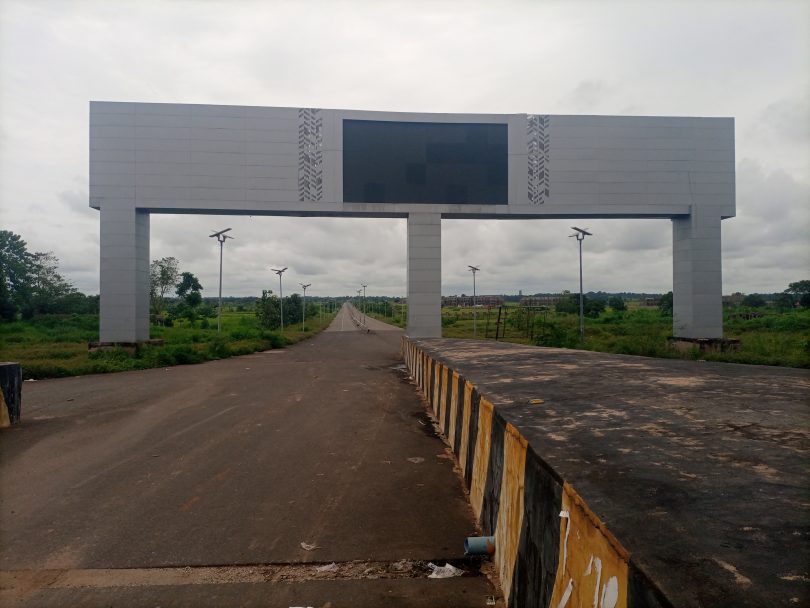
A visit to the Chuba Okadigbo International Airport in Onueke, Abakaliki, the capital of Ebonyi State, reveals a stark monument of fiscal recklessness, and wasted public resources in a state battling severe poverty and infrastructural decay.
Conceived and constructed by the former Governor of Ebonyi State and current Minister of Works, David Umahi, the facility was officially inaugurated on May 26, 2023, by late former President Muhammadu Buhari. Weeks earlier, on April 26, 2023, Umahi had celebrated the touchdown of two inaugural Air Peace flights to mark the symbolic launch of the project.
However, approximately 40 months, or over 1,200 days, since its official commissioning, the multi-billion-Naira infrastructure remains largely inactive, yielding no measurable economic return or revenue for the state.
A recent visit to the facility by SaharaReporters on Tuesday, September 8, 2026, revealed a completely deserted compound, characterised by eerie silence and empty access roads stretching from the Airport Junction along Onueke road to the main terminal gates.
At the security checkpoint, hungry-looking security personnel barred visitors and journalists from entering, confirming that strict directives had been issued to prevent unauthorised public access.
“Workers only come to the airport on the rare days a chartered flight is scheduled to land,” one security guard disclosed under anonymity.
Sources familiar with the operational history of the facility revealed that despite a combined capital outlay exceeding N53 billion, the airport has not recorded up to 55 total flight landings, including both commercial and private chartered flights, since its inception.
Despite attempts by the administration of Governor Francis Nwifuru to salvage the project by offering a 50 percent subsidy on passenger airfares to encourage patronage, commercial airlines have consistently recorded fewer than 20 passengers per flight.
“Chartered flights only come to the airport when former Governor David Umahi and his family are visiting Abakaliki from Abuja, or when the current governor is travelling out,” an insider source revealed. “With the prevailing economic hardship, even the subsidised flights cannot attract passengers. There are simply no travelers to sustain commercial flights.”
The financial drain of the Chuba Okadigbo International Airport escalated further under the current administration of Governor Francis Nwifuru.
While the former Umahi administration expended over N36 billion in borrowed funds to construct the edifice, structural defects on the concrete runway forced the new government to sink an additional N17.3 billion into major remedial overhauls on the runway with asphalt.
Addressing stakeholders on the technical flaws inherited at the facility, Governor Nwifuru previously recounted how construction blunders damaged aircraft landing gear and alienated commercial airline operators.
“A governor called me and we discussed at length on the approval of N13.75 billion for the airport that is deemed to have been completed and handed over,” Nwifuru had stated.
“The question that the governor asked me is the question every reasonable Ebonyi man is asking. The truth is that the mindset of those that started the airport is germane; but did we get it right? In the area of runway, we didn’t get it right because the runway is jumping and it is destroying aircraft tyres.”
Nwifuru admitted that despite early attempts to fill expansion joints, aircraft continued to suffer damages, forcing the state government to consult the Federal Ministry of Aviation.
“They told us that we need to do certification, put tie-rods and start laying asphalt. When you look at the amount that was sunk into that airport, it is not something you get up and say you want to abandon. The former administration sunk over N36 billion into that edifice,” Nwifuru added, noting that the total cost of corrections subsequently swelled to N17.3 billion.
During his one-year anniversary in office, Governor Nwifuru announced the completion of the runway repairs, alongside ongoing work on the control tower and terminal building. Yet, months later, commercial flight schedules remain non-existent.
In a further bid to revive the dormant asset, Governor Nwifuru announced during his January 2026 New Year address that the state government had procured three aircraft to establish a state-owned fleet expected to land before the end of that month.
However, nine months after the public declaration, no aircraft has arrived in the state, generating intense public criticism and allegations of procurement fraud.
Insider sources told SaharaReporters that state officials were defrauded during negotiations to acquire the aircraft, though government representatives have maintained absolute silence on the status of the procurement and the whereabouts of the funds.
Speaking to SaharaReporters on the state of the airport and the government’s priorities, legal practitioner Barrister Gerald Moses Ede described the project as an economic misadventure that ignores the basic needs of the local populace.
“The airport is a misplaced priority. You count one before you count two,” Barr. Ede said.
“If you calculate the amount spent on flyovers, the moribund shopping mall, the Ecumenical Centre, and over N50 billion on an empty airport, these funds run into hundreds of billions. Is this what Ebonyi needs? No! Ebonyi needs factories, but Ebonyi cannot host factories because there is no serious power substation in the state to power heavy industries.”
Ede stressed that without industrialization and commercial hubs, an airport cannot thrive.
“Ebonyi has no functional factories, no major regional markets, yet they built an airport first. It is like going to the university when you haven’t attended primary or secondary school,” he added.
“Even as big as Enugu is, airlines only operate once or twice daily to Abuja. How do you expect Ebonyi to generate passenger traffic when there is no economic activity?”
A businessman, Solomon Ugochukwu told SaharaReporters that the former and current administration should have channelled these monies to building industries.
“But instead of Ebonyi State government to consider doing this, they have been building projects that are not impactful in the life of the people. And that is why that airport cannot grow, because it’s where you have factories that you see – businesses, serious businesses thriving.
“If you have factories, it will also power microeconomic sectors of the state. When you have one factory in a location, just only that factory alone that function. Other small, small businesses will also grow around it. That is how economy grows.
“But Ebonyi doesn’t have factories, so everything is dependent on the state government civil service. That is why the airport is not going to work, at least for now. All those monies, if they had taken all those monies of all these gigantic projects that nobody is using, and what they are doing for the state, and invested in power, it would have mean that there would have been industries, which will now lead to influx of people in the state, influx of other sectors to develop. And then, that’s when you now have the need for airports. Enugu state does not just wake up and start building airport, it build other things, factories, industries. Even Anambra, as big as they are, with all the markets and everything, was it not just under Obiano that they had an airport?”
The massive expenditure on white-elephant projects occurs against the backdrop of acute poverty and infrastructural deprivation across rural Ebonyi.
Data from the National Bureau of Statistics (NBS) ranks Ebonyi among the ten poorest states in Nigeria, with a poverty head-count rate standing at 79.76 percent. Basic infrastructure remains absent in several rural communities, including the border areas of Obeagu and Nkalaha, where deplorable roads have exposed residents to repeated violent attacks by armed herdsmen.
Meanwhile, local activists and citizens who question the financial prudence of the state government face severe intimidation, surveillance, and harassment by state apparatuses.
Sharing his experience regarding state repression, activist Godwin Onyekachi disclosed that critical voices in Abakaliki have been systematically silenced through state power and co-optation.
“Those of us who are here, if you speak out, they will trace you and deal with you. I know what I passed through under the previous administration — at a point, I was frequenting the DSS office almost on a daily basis,” Onyekachi stated.
“They tell you that you are a threat to state security. Having a family to cater for, you have to play safe because Abakaliki is very small. We have all been cowed into ‘see something, say nothing.'”
Onyekachi added that political leaders routinely leverage institutional influence and material inducement to neutralize opposition, including religious leaders and civil society organisations.
“They use materialism to condemn critical institutions into silence,” he added. “The irony is that while innocent citizens are criminalised and intimidated, those responsible for squandering public resources walk free.”
Meanwhile, SaharaReporters’ efforts to speak with the Ebonyi State Commissioner for Information and State Orientation, Chief Ikeuwa Omebeh, were unsuccessful as he did not take his calls.
Also a text message to his phone seeking for an explanation to some issues raised in the report wasn’t responded to as of the time of filing the report.